What Is the Board of Peace? Explained
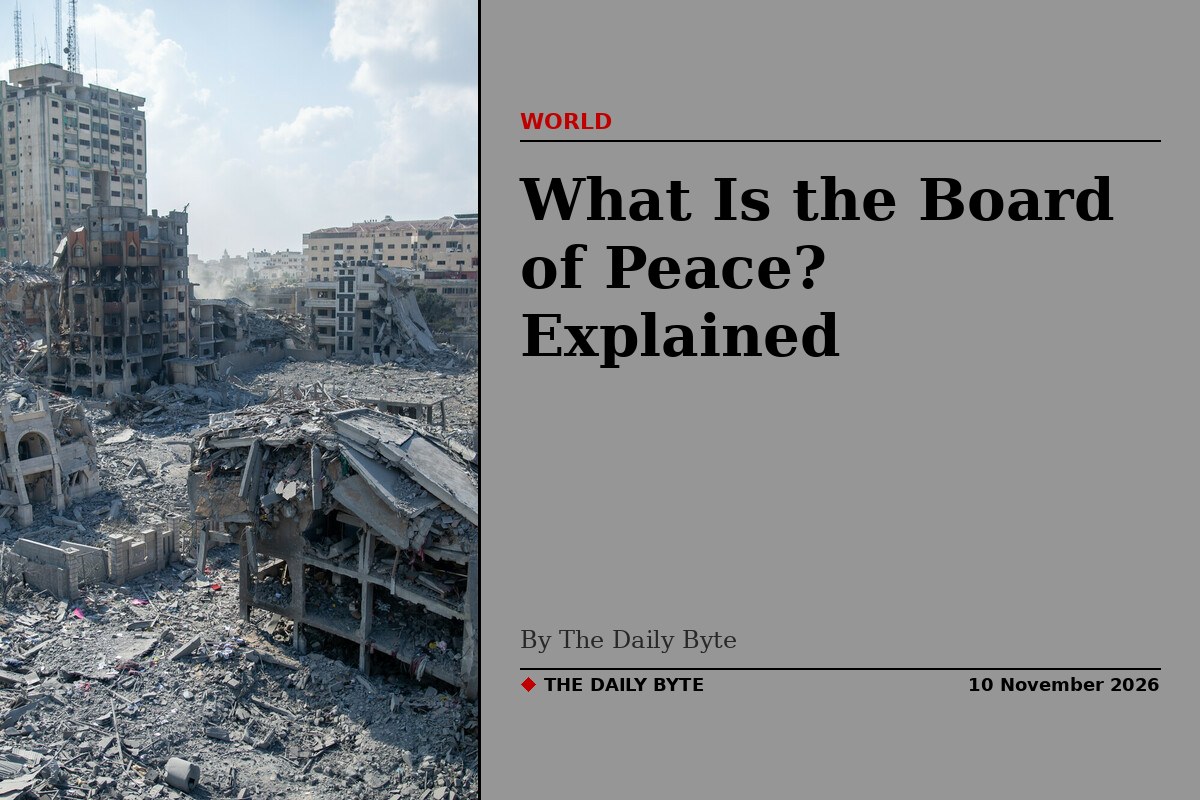
The Board of Peace is an international body created by President Donald Trump to oversee the administration and reconstruction of Gaza after the war there. It was first proposed in September 2025 as part of Trump’s 20-point peace plan, endorsed by the United Nations Security Council, and formally launched with a signed charter at the World Economic Forum in Davos in January 2026. Trump chairs the Board himself, and its charter gives him sweeping powers, including a veto over its decisions. More than 25 countries, including Pakistan, have signed up, while several European states have declined to join.
Where did the idea come from?
The Board was first introduced on 29 September 2025, on the sidelines of the United Nations General Assembly session in New York, as the supervisory authority for Trump’s 20-point plan to end the Gaza conflict. The plan envisaged a transitional administration for Gaza, a temporary international stabilisation force, and a large reconstruction programme. In November 2025 the United Nations Security Council adopted Resolution 2803, which endorsed the American-backed framework for ending the conflict and recognised the Board of Peace as a transitional authority with international legal personality to coordinate Gaza’s reconstruction. The Board was then formally established at the World Economic Forum in Davos, Switzerland, on 22 January 2026, when Trump hosted a signing ceremony and more than 20 countries formally joined. Its first session was held in Washington on 19 February 2026, to discuss a reconstruction plan for Gaza.
How is the Board structured?
The Board has a layered structure set out in an 11-page charter of eight chapters and 13 articles. At the top sits the Board itself, chaired by Trump, which votes on budgets, policy and senior appointments. Beneath it is a Founding Executive Board of seven members, responsible for implementing the mission. Below that is the Gaza Executive Board, an 11-member body tasked with regional coordination and overseeing decisions on the ground, supported by representatives from Arab countries. At the lowest tier is the National Committee for the Administration of Gaza, known as the NCAG, a body of Palestinian technocrats led by Dr Ali Shaath, a former deputy minister in the Palestinian Authority, which is meant to run day-to-day administration in Gaza. Alongside the civilian structure sits a military component, the International Stabilization Force, commanded by Major General Jasper Jeffers, which is tasked with demilitarisation, preventing a resurgence of armed groups and enabling humanitarian aid deliveries. The White House has said Board members will oversee portfolios including governance, capacity-building, regional relations, reconstruction, investment attraction, large-scale funding and capital mobilisation.
Who sits on the Board?
Trump is the chairman, and the charter makes him the final authority on interpreting it. He appoints members, can remove them, approves the budget, and holds a veto over key decisions, including membership removal and executive board actions. The seven members of the Founding Executive Board are US Secretary of State Marco Rubio, US Special Envoy to the Middle East Steve Witkoff, Trump’s son-in-law Jared Kushner, former British prime minister Tony Blair, Apollo Global Management chief executive Marc Rowan, World Bank President Ajay Banga, and US National Security Adviser Robert Gabriel. The Gaza Executive Board includes Turkish Foreign Minister Hakan Fidan, the United Arab Emirates’ Minister of State for International Cooperation Reem Al-Hashimy, veteran Qatari diplomat Ali Al-Thawadi, Egypt’s intelligence chief Hassan Rashad, former United Nations envoy Nikolay Mladenov, who serves as High Representative for Gaza, Dutch politician Sigrid Kaag, and Cypriot-Israeli businessman Yakir Gabay. Mladenov acts as the liaison between the Board of Peace and the NCAG, while Jeffers commands the stabilisation force.
What does the Board actually do in Gaza?
In Gaza itself, the Board’s job is to coordinate the reconstruction of a territory devastated by more than two years of war, and to oversee the transitional administration until a longer-term arrangement is agreed. That means organising large-scale funding, attracting investment, rebuilding housing, water, power and health services, and supporting the NCAG as it runs public services. The Board’s mandate, as written in the charter, is broader than Gaza, however. The charter does not mention Gaza once. Instead it describes the Board as a new international organisation that seeks to promote stability, restore dependable and lawful governance, and secure enduring peace in areas affected or threatened by conflict. That wording has led many observers to see the Board as a body Trump intends to use well beyond Gaza, as a parallel structure to the United Nations for resolving conflicts on American terms. The Board remains active on Gaza: on 10 November it described the flooding in Gaza as a humanitarian emergency, underlining that it still presents itself as the body responsible for the territory’s recovery.
Why does membership cost 1 billion dollars?
One of the most talked-about features of the Board is its membership fee. Countries that join serve three-year terms, but a country that contributes more than 1 billion dollars in cash within the first year is granted permanent membership. The White House has not explained in detail who would pay the money, how it would be used, or what permanent membership would entitle a country to beyond a continuing seat. Critics have described the arrangement as selling permanent seats on an international body, and have noted that it favours wealthy states over poorer ones. Supporters of the plan argue that a large financial commitment is a reasonable way to show that members are serious about funding Gaza’s reconstruction, which is expected to cost tens of billions of dollars, and that countries unwilling to contribute should not shape decisions about spending the money.
Who has joined, and who has stayed away?
Invitations were sent to about 60 countries. As of 2026, 27 of them had signed the charter, including Albania, Argentina, Armenia, Azerbaijan, Bahrain, Bulgaria, Cambodia, Egypt, El Salvador, Hungary, Indonesia, Israel, Jordan, Kazakhstan, Kosovo, Kuwait, Mongolia, Morocco, Pakistan, Paraguay, Qatar, Saudi Arabia, Turkey, the United Arab Emirates, the United States, Uzbekistan and Vietnam. A further group, including Austria, Croatia, Cyprus, the Czech Republic, Finland, Germany, Greece, India, Italy, Japan, Mexico, Poland, South Korea, Romania, Slovakia, Switzerland, Thailand, Ukraine and the United Kingdom, took part as observers without signing. France, Norway and Sweden declined to participate, while Germany, the United Kingdom and Italy remained noncommittal. Canada was invited but Trump withdrew the invitation in January 2026, in what appeared to be retaliation after Prime Minister Mark Carney criticised American policy in a speech at the World Economic Forum. Russia was also invited, and the Kremlin confirmed that President Vladimir Putin had received an invitation, although it was not confirmed whether Moscow was formally offered a seat.
What are the criticisms, and what is the defence?
The Board has drawn sharp criticism from several directions. Diplomats and analysts who favour the United Nations system argue that it sidelines the UN and concentrates power in one man: the charter gives the chairman the power to designate a successor, and he can only be replaced by voluntary resignation or by a unanimous vote of the board if he is incapacitated. Others point out that the charter never mentions Gaza or Palestinians, and that no Palestinian representatives sit on the Founding Executive Board or the Gaza Executive Board, apart from the technocrats of the NCAG, which they say leaves Palestinians without a voice in decisions about their own territory. Supporters, including the White House, respond that existing international institutions failed to prevent or end the Gaza war, and that a smaller body led by the United States can move faster, raise the money and deliver results. They also point to the Security Council resolution endorsing the framework, and to the Arab states that have joined, as evidence that the Board has international backing rather than being a purely American project.
Frequently asked questions
Who chairs the Board of Peace? President Donald Trump chairs the Board. The charter gives him the final say on interpreting it, the power to appoint and remove members, and a veto over key decisions.
Is the Board of Peace part of the United Nations? No. It is a separate body created by the United States, although the UN Security Council adopted Resolution 2803 in November 2025 endorsing the peace framework and recognising the Board as the transitional authority for Gaza’s reconstruction.
Which countries are members? Twenty-seven countries have signed the charter, including Pakistan, Egypt, Saudi Arabia, Qatar, Turkey, the United Arab Emirates, Indonesia, Israel, Argentina and Hungary. Several European states, including France, Norway and Sweden, declined to join.
What does the 1 billion dollar fee buy? A country that contributes more than 1 billion dollars in cash within the first year is granted permanent membership instead of a three-year term. The White House has not published a detailed account of how the money would be spent.
Who runs Gaza day to day? The National Committee for the Administration of Gaza, led by Dr Ali Shaath, a former Palestinian Authority deputy minister, is meant to run day-to-day administration, overseen by the Gaza Executive Board and the Board of Peace itself.
Sources: Al Jazeera and Institute for Palestine Studies.


