What Is BRICS? Members and Purpose Explained
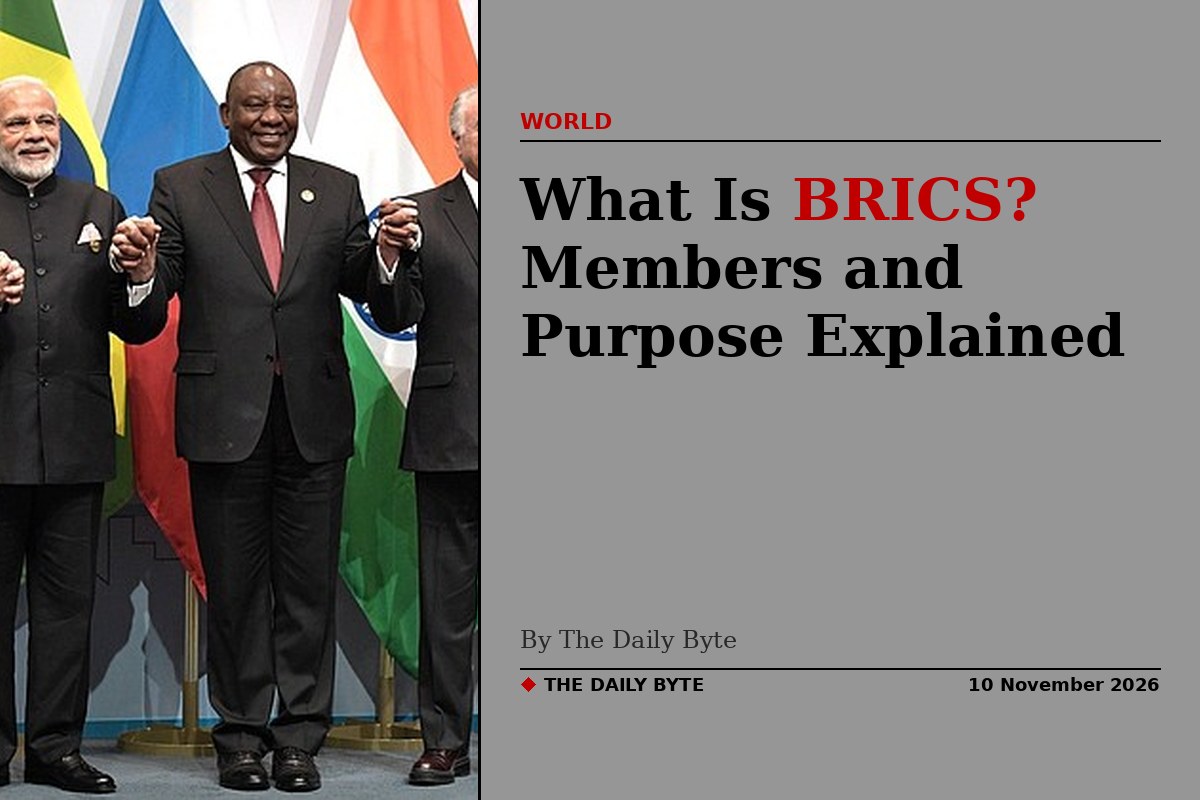
BRICS is a group of major emerging economies that works together on trade, finance and global politics. The name comes from its first five members, Brazil, Russia, India, China and South Africa, and after an expansion in 2024 and 2025 it now has ten confirmed full members, with Saudi Arabia's status still unconfirmed. The group holds an annual leaders' summit, runs its own development bank and has become a shorthand for the growing influence of the Global South. This guide explains what BRICS is, who belongs to it, what it actually does and why it matters.
What does BRICS stand for?
BRICS stands for Brazil, Russia, India, China and South Africa. The name began as an acronym coined in 2001 by Jim O'Neill, then the chief economist at Goldman Sachs, who used the term BRIC to describe four large, fast-growing economies that he expected to reshape the world economy. The four countries first met as a group at a summit in Yekaterinburg, Russia, in 2009. South Africa joined the following year, in 2010, adding the S and turning BRIC into BRICS. Since the expansion of 2024 and 2025, the name has stayed the same even though the membership has grown well beyond the original five, and the term BRICS+ is sometimes used informally to describe the enlarged group.
BRICS is not a trade bloc like the European Union and it is not a military alliance like NATO. It has no permanent secretariat, no headquarters and no common currency. It is an informal grouping whose members coordinate positions on global issues, hold regular meetings of leaders, foreign ministers and finance ministers, and run a small number of shared institutions, the most important of which is the New Development Bank. Decisions are made by consensus, which means every full member must agree, and the rotating presidency passes from one member to another each year. India holds the rotating presidency in 2026.
Which countries are in BRICS?
BRICS has ten confirmed full members as of 2026. The five founding members are Brazil, Russia, India, China and South Africa. Four more countries joined as full members on 1 January 2024: Egypt, Ethiopia, Iran and the United Arab Emirates. Indonesia became a full member in January 2025, the first Southeast Asian country to join. Saudi Arabia was also invited to join in 2023, and appears on some official BRICS lists, but it has not formally confirmed its membership, so some sources count ten members and others count eleven.
- Brazil — founding member, 2009
- Russia — founding member, 2009
- India — founding member, 2009
- China — founding member, 2009
- South Africa — joined 2010
- Egypt — joined 2024
- Ethiopia — joined 2024
- Iran — joined 2024
- United Arab Emirates — joined 2024
- Indonesia — joined 2025
Argentina was invited alongside the 2024 joiners but declined after a change of government in late 2023, before its membership took effect. A further tier of partner countries was created at the Kazan summit in Russia in 2024, giving countries a way to take part in BRICS meetings and projects without becoming full members. Partner countries do not take part in the group's consensus decisions in the way full members do. Together, the ten confirmed members account for close to half of the world's population and, by IMF-based estimates, roughly 40 per cent of global GDP measured by purchasing power parity, which makes the group too large for other countries to ignore.
How did BRICS start?
BRICS began as an idea in an investment note. In 2001, Jim O'Neill at Goldman Sachs argued that Brazil, Russia, India and China were growing fast enough to overtake the world's largest economies within a few decades, and that global institutions built after the Second World War no longer reflected that shift. The four countries began meeting as a group, and their first formal leaders' summit was held in Yekaterinburg in 2009, in the middle of the global financial crisis. South Africa was invited to join in 2010, partly because it gave the group a voice on the African continent.
For its first decade, BRICS was mostly a talking shop: an annual summit, joint statements and meetings of ministers. That changed in 2014, when the members agreed at the Fortaleza summit in Brazil to create two financial institutions of their own, the New Development Bank and a $100 billion Contingent Reserve Arrangement, a pool of funds members can draw on in a currency crisis. The message was that the group wanted alternatives to the World Bank and the International Monetary Fund, where voting power still reflects the economic order of the 1940s, not the world of today.
The biggest change came at the Johannesburg summit in August 2023, when the members agreed to invite six new countries to join. Four of them, Egypt, Ethiopia, Iran and the United Arab Emirates, became full members on 1 January 2024. Argentina declined, and Saudi Arabia has kept its status ambiguous ever since. Indonesia, which had been a partner country, became a full member in January 2025. The 17th BRICS summit was held in Rio de Janeiro, Brazil, on 6 and 7 July 2025, the first with Indonesia as a full member, and the 18th summit was held in New Delhi, India, on 12 and 13 September 2026, with a focus on supply chain resilience, cross-border payments and using national currencies for trade.
What does BRICS actually do?
BRICS works in three main areas: politics, economics and development finance. Politically, the annual summit and the meetings that lead up to it give members a platform to coordinate positions on issues such as reform of the United Nations Security Council, trade rules and conflicts. The leaders issue a joint declaration at each summit, setting out what they have agreed. Because the members include countries with very different interests, including India and China, which have a disputed border, and Russia, which is under Western sanctions, those declarations are often broad and carefully worded, and disagreements are common.
Economically, the members talk about increasing trade between themselves, settling more of that trade in their own currencies rather than in US dollars, and building payment systems that do not depend on Western banks. Progress has been slow and uneven. The dollar still dominates most of the members' trade, and there is no agreed BRICS currency. But the discussion itself matters, because it signals that large economies are looking for ways to reduce their exposure to US financial power, and because central banks in several member countries have been buying gold and signing currency-swap deals with each other.
The third area is development finance, where BRICS has built something concrete. The New Development Bank, based in Shanghai, lends to infrastructure and sustainable development projects in emerging economies. It has also admitted new members beyond the BRICS founders, including Bangladesh, Egypt and the United Arab Emirates, and it raises money by issuing bonds, including bonds in local currencies. For many developing countries, the bank is attractive because it offers an alternative source of finance to the World Bank and the IMF, with fewer policy conditions attached.
What is the New Development Bank?
The New Development Bank, often shortened to the NDB, is the financial arm of BRICS. It was created at the 2014 Fortaleza summit, it is headquartered in Shanghai, China, and it began lending in 2016. Its job is to finance infrastructure and sustainable development in emerging economies and developing countries, including roads, railways, water systems, renewable energy and urban development. Each of the five founding members holds an equal share of the bank's capital, and its presidency rotates among the founders.
The bank was designed to be different from the World Bank in two ways. First, voting power is shared equally among the founders, rather than weighted by the size of each country's economy, which means China has the same vote as South Africa. Second, it aims to approve loans faster and with fewer conditions. In practice, the bank is still much smaller than the World Bank, and its lending has been affected by the same tensions that affect the group as a whole, including the impact of sanctions on Russia. Even so, it has approved tens of billions of dollars in loans since it began operating, and it remains the most tangible institution BRICS has created.
Does BRICS have its own currency?
No. BRICS does not have a common currency, and there is no agreed plan to create one. The idea of a shared BRICS currency is raised regularly at summits and in media coverage, but the members are far from agreeing on it. Their economies are very different in size, their currencies are not freely convertible in the same way, and China, the largest economy in the group, has shown little appetite for a currency arrangement that would dilute the role of the yuan or tie it to the monetary policies of other members.
What the group is doing instead is more modest but still significant: encouraging members to settle trade in their own currencies, building payment systems that bypass Western networks, and exploring central bank digital currencies for cross-border payments. Russia, which has been cut off from parts of the Western financial system by sanctions, has been the keenest advocate of these steps. India has promoted trade in rupees, and China has promoted the yuan. Whether these efforts add up to a serious challenge to the dollar is debated. The dollar remains the world's main reserve and trading currency, but the direction of travel is clear: BRICS members want more of their trade and finance to happen outside the dollar system.
Why does BRICS matter?
BRICS matters because of its scale and because of what it represents. The ten confirmed members are home to close to half of humanity, they produce a large share of the world's oil, food and manufactured goods, and they include two of the world's three largest economies by purchasing power, China and India. When the group speaks with one voice, for example on reforming the UN Security Council or on climate finance for developing countries, it carries weight that the original five could not have carried alone.
For developing countries outside the group, BRICS offers an alternative. The partner-country tier created in 2024 has drawn interest from countries that want closer ties with the group without committing to full membership, and the New Development Bank offers a second source of development finance. For Western governments, BRICS is a reminder that much of the world does not see the global order the way they do, and that sanctions, trade rules and international institutions are contested. For businesses and investors, the group's summits are worth watching because they shape trade policy, currency arrangements and the rules for investing in some of the world's fastest-growing markets.
What are the criticisms and limits of BRICS?
Critics of BRICS point out that the group is divided, slow-moving and short on concrete achievements. Its members disagree openly on trade, on Russia's war in Ukraine and on how far to challenge the dollar. India and China, the two largest members after China, have a disputed Himalayan border and compete for influence in Asia. The expansion of 2024 added members with very different interests, including Iran, which is under sanctions, and Egypt and Ethiopia, which are both dealing with serious economic problems. Some analysts argue that a bigger BRICS is a weaker BRICS, because consensus becomes harder with every new member.
Others argue that the group's institutions remain small compared with the ones they are meant to rival. The New Development Bank lends far less than the World Bank, and the Contingent Reserve Arrangement has never been used. The summits produce long declarations, but follow-through is patchy. Even sympathetic observers note that BRICS has no secretariat to keep its work moving between summits, and that the rotating presidency means priorities change every year. Whether the group becomes a genuine pole in a multipolar world, or stays a useful but limited forum for its members, is likely to be decided by whether it can turn its declarations into institutions that work.
Frequently asked questions
How many countries are in BRICS? There are ten confirmed full members: Brazil, Russia, India, China, South Africa, Egypt, Ethiopia, Iran, the United Arab Emirates and Indonesia. Saudi Arabia was invited in 2023 but has not formally confirmed membership, so some official lists count eleven.
When was BRICS founded? The first BRIC summit was held in Yekaterinburg, Russia, in 2009. The acronym itself dates to 2001, when Goldman Sachs economist Jim O'Neill coined it, and South Africa joined in 2010.
Is BRICS a military alliance? No. BRICS is not a military alliance and its members have no mutual defence commitment. It is a grouping focused on economics, development finance and political coordination.
What is BRICS+? BRICS+ is an informal term for the enlarged group after the 2024 and 2025 expansion, and it is also used to describe the wider circle of partner countries and invited guests that take part in BRICS meetings.
Who chairs BRICS in 2026? India holds the rotating BRICS presidency in 2026 and hosted the 18th BRICS summit in New Delhi on 12 and 13 September 2026.
Sources: Wikipedia, BRICS; SMW Markets, What Is BRICS? Members, Goals and What It Means for Investors. Membership details reflect official BRICS materials and reporting as of 10 November 2026; Saudi Arabia's membership status remains unconfirmed.


