What Is Buy-to-Let? UK Rules Explained
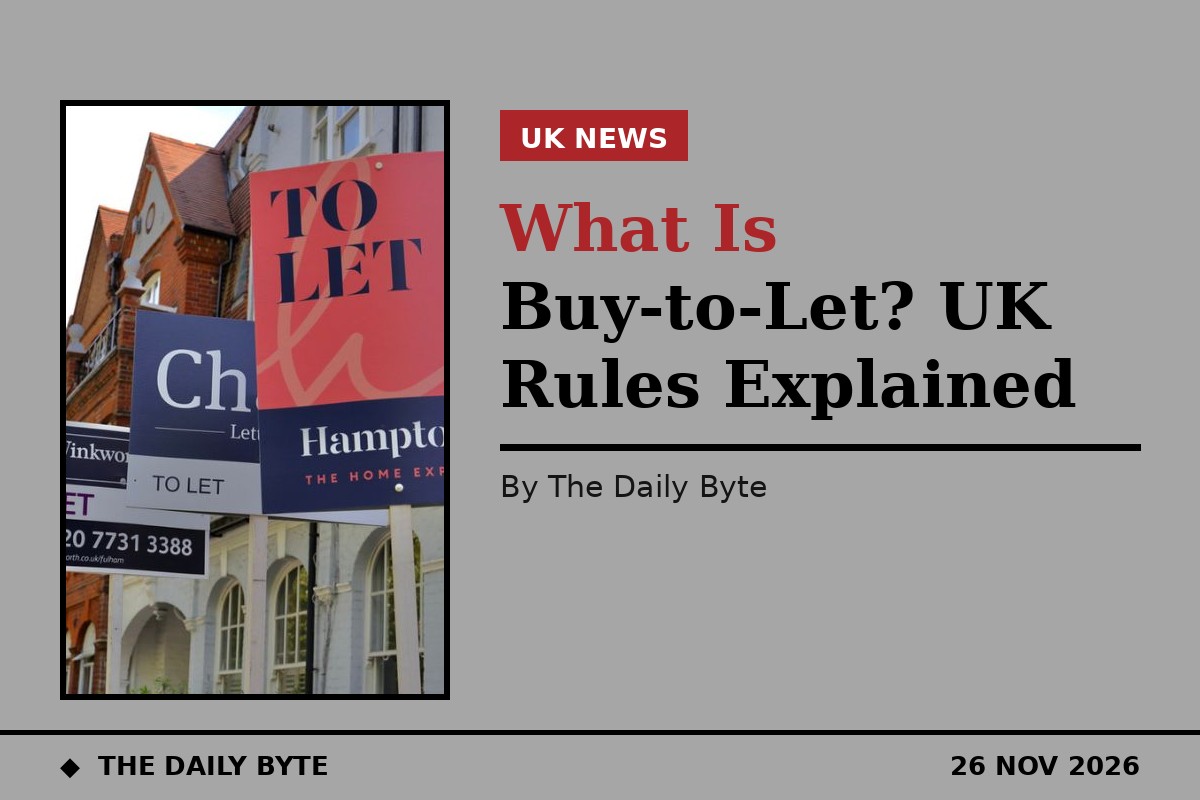
Buy-to-let means buying a property to rent it out to tenants, rather than living in it yourself. The landlord earns rent each month and may also gain if the property rises in value over time. In the UK, buy-to-let is treated differently from buying a home to live in: the mortgage works differently, you pay extra stamp duty when you buy, the rent is taxed as income, and you pay capital gains tax when you sell. This guide explains each of those rules in turn.
Buy-to-let became popular in the UK from the late 1990s, when dedicated buy-to-let mortgages first appeared. Since then the rules have tightened considerably. The stamp duty surcharge on additional properties has risen, mortgage interest relief has been cut to a flat 20% tax credit, and landlord regulation has grown with deposit protection, safety checks and the Renters' Rights Act. Anyone considering a buy-to-let needs to understand the tax and legal costs first, because they can turn a property that looks profitable into one that loses money.
What is buy-to-let?
A buy-to-let property is a residential property bought with the intention of letting it to tenants. The landlord owns the property, the tenant pays rent to live in it, and the landlord is responsible for keeping it safe and in repair. The landlord may manage the property themselves or pay a letting agent to find tenants, collect the rent and arrange repairs, usually for a fee taken as a percentage of the rent.
It is different from buying a home in one important way: the lender, the taxman and the law all treat it as an investment, not as a home. That means a standard residential mortgage cannot normally be used for a buy-to-let. You need a buy-to-let mortgage, or the lender's permission to let a property bought with a residential mortgage, which is known as consent to let and is usually only given for a limited time.
Buy-to-let is also different from flipping properties. A landlord who buys to let usually holds the property for years, collecting rent, while someone who flips buys, renovates and sells quickly. The tax rules are different too: rental income is taxed as income each year, while the profit on a sale is taxed as a capital gain.
What is a buy-to-let mortgage?
A buy-to-let mortgage is a loan specifically for a property you intend to rent out. Lenders usually ask for a larger deposit than they would for a home you live in, because they see a rental property as a higher risk. Many buy-to-let mortgages are interest-only, which means the monthly payment covers only the interest and the original loan still has to be repaid at the end of the term, usually by selling the property or remortgaging.
Lenders also assess the loan differently. Instead of looking mainly at your salary, they look at the rent the property is expected to earn and check that it covers the mortgage payment by a set margin, with room for empty periods and costs. That is why a property in an area with low rents may not qualify for the amount you want to borrow, even if you earn a good salary. Lenders also usually require the property to be in a lettable condition and may refuse properties such as bedsits or very short leases.
Interest rates on buy-to-let mortgages are usually higher than on residential mortgages, and the fees can be higher too. The mortgage is normally arranged for a fixed period, such as two or five years, after which it moves to the lender's standard variable rate unless you switch to a new deal. If you cannot find a tenant, you still have to pay the mortgage, so most advisers suggest keeping a cash buffer to cover empty months and unexpected repairs.
How much stamp duty do you pay on a buy-to-let?
Stamp Duty Land Tax (SDLT) applies when you buy property in England and Northern Ireland, and buy-to-let buyers usually pay extra. If you already own a residential property, you pay the standard rates plus a surcharge of 5% on every band. The surcharge rose from 3% to 5% on 31 October 2024, and it applies to purchases of £40,000 or more. If the buy-to-let will be your only residential property, you generally pay the standard rates instead.
| Purchase price band | Standard SDLT rate | Higher rate (buy-to-let) |
|---|---|---|
| Up to £125,000 | 0% | 5% |
| £125,001 to £250,000 | 2% | 7% |
| £250,001 to £925,000 | 5% | 10% |
| £925,001 to £1.5 million | 10% | 15% |
| Over £1.5 million | 12% | 17% |
Here is a worked example. On a £300,000 buy-to-let, the standard SDLT would be £5,000: nothing on the first £125,000, 2% on the next £125,000, which is £2,500, and 5% on the final £50,000, which is £2,500. At the higher rates, the same purchase costs £20,000: 5% on the first £125,000 is £6,250, 7% on the next £125,000 is £8,750, and 10% on the final £50,000 is £5,000. The surcharge adds £15,000 to the cost of the purchase, and it has to be paid within 14 days of completion, along with the SDLT return to HMRC. A solicitor or conveyancer usually files the return and pays the tax on the day of completion.
There are exceptions. If you are replacing your main home and you sell your old home within 36 months of buying the new one, you do not pay the extra 5%, and if you paid it because you had not yet sold, you can claim a refund. Companies buying residential property generally pay the higher rates on qualifying purchases of £40,000 or more, including their first property. Non-UK residents usually pay a further 2% surcharge on top.
How is rental income taxed?
Rent is taxed as income. You add up all the rent you receive in the tax year, take off the expenses you are allowed to claim, and the profit left is added to your other income, such as your salary. It is then taxed at your marginal rate: 20% if you are a basic-rate taxpayer, 40% if you are a higher-rate taxpayer, and 45% if you are an additional-rate taxpayer. That means rental income can push you into a higher tax band, even if your salary alone would not.
The expenses you can claim are the costs of running the property, as long as they were incurred wholly and exclusively for the letting. That includes letting agent fees, repairs and maintenance, landlord insurance, ground rent and service charges, and accountancy fees. What you cannot claim is the cost of improving the property, such as adding an extension or a new kitchen: that is a capital cost, which may reduce your capital gains tax bill when you sell, but it does not reduce your rental profit now.
The biggest change for landlords came in April 2020, when mortgage interest stopped being a deductible expense for individual landlords. Before 2017, landlords could deduct all of their mortgage interest from their rental income. That relief was phased out between 2017 and 2020, and since 6 April 2020 individual landlords get a tax credit worth 20% of their mortgage interest and other finance costs instead. The credit reduces your tax bill, but it does not reduce your taxable income, so it is worth less to higher-rate taxpayers than the old system was. The rule is sometimes called the Section 24 change, after the section of the Finance Act 2015 that introduced it. It does not apply to companies, which is one reason some landlords hold property through a limited company.
There is also a property allowance of £1,000 a year. If your total property income is £1,000 or less, you do not need to report it to HMRC or pay tax on it. If it is more, you can choose to claim the £1,000 allowance instead of adding up your actual expenses, which is simpler if your expenses are small. Rental income has to be reported through Self Assessment if it is above the allowance, unless it is already taxed through PAYE in some other way.
What tax do you pay when you sell a buy-to-let?
When you sell a buy-to-let, you usually pay Capital Gains Tax (CGT) on the profit, which is the sale price minus what you paid for the property and minus certain costs, such as buying and selling fees and the cost of improvements. Your main home is normally exempt from CGT, but a buy-to-let is not, because you do not live in it.
For the 2026-27 tax year, individuals pay CGT on residential property at 18% on the part of the gain that falls within their unused basic-rate Income Tax band, and 24% on the rest. Each person has an annual exempt amount of £3,000, which is the amount of gain you can make each year before CGT applies. The gain is added to your other income to decide which rate applies, so a large gain can push some of it into the 24% rate even if you are normally a basic-rate taxpayer.
CGT on a UK residential property has to be reported and paid within 60 days of completion, through HMRC's CGT on UK property service. That is separate from your Self Assessment return, although the gain also has to be reported there. Missing the 60-day deadline can lead to penalties and interest, so it is worth getting advice before you exchange contracts, not after you have sold.
What rules must landlords follow?
Landlords in England have a long list of legal duties, and the list has grown in recent years. The deposit a tenant pays must be protected in a government-backed tenancy deposit scheme, and the tenant must be given the prescribed information about it. The property must have a valid Energy Performance Certificate, and it must be safe: gas appliances must be checked every year by a Gas Safe engineer, electrical installations must be inspected at least every five years, and smoke alarms and carbon monoxide alarms must be fitted where required.
Landlords must also check that their tenants have the right to rent in England, keep the property in repair, and give the tenant certain documents at the start of the tenancy, including the government's How to Rent guide. In some areas, the property may also need a licence from the local council, either because it is a house in multiple occupation or because the council runs a selective licensing scheme.
The Renters' Rights Act 2025 is the biggest recent change. It received Royal Assent on 27 October 2025, and its main tenancy reforms came into force on 1 May 2026. From that date, Section 21 no-fault evictions were abolished in England, assured shorthold tenancies became periodic tenancies with no fixed end date, and landlords can only seek possession for a valid legal reason, such as rent arrears or wanting to sell the property. Rent can only be increased once a year and must follow a formal process. Landlords who have not updated their tenancy agreements and eviction procedures for the new rules risk possession claims failing in court.
Is buy-to-let different in Scotland and Wales?
Yes. Stamp Duty Land Tax only applies in England and Northern Ireland. In Scotland you pay Land and Buildings Transaction Tax (LBTT) instead, and if you already own a home, a buy-to-let also attracts the Additional Dwelling Supplement, which is 8% of the total purchase price for properties of £40,000 or more. In Wales you pay Land Transaction Tax (LTT), which has its own higher rates for additional properties.
The tenancy rules are also different. Scotland already abolished no-fault evictions years ago and uses Private Residential Tenancies, while Wales uses occupation contracts under its own Renting Homes legislation. A landlord buying across the border needs to check the rules for that nation, not assume the English rules apply.
Can you buy a buy-to-let through a company?
Yes, and more landlords have done so since the mortgage interest rules changed. A company pays corporation tax on its rental profits instead of Income Tax, and the company can still deduct mortgage interest as a business expense. That can be attractive for higher-rate taxpayers, but it is not a simple saving: taking money out of the company to spend it can trigger further tax, and buy-to-let mortgages for companies are a smaller market with fewer lenders and often higher rates.
Moving a property you already own into a company usually counts as a sale for tax purposes, which can trigger both stamp duty and Capital Gains Tax at that point, so it is rarely worth doing for a single property. Anyone considering the company route should take professional advice first, because the right answer depends on their income, their plans for the money, and how many properties they intend to hold.
Frequently asked questions
Do I need a buy-to-let mortgage to rent out a property?
Usually yes. A standard residential mortgage is for a home you live in, and most lenders will not allow you to rent the property out on one. You need a buy-to-let mortgage, or your lender's written consent to let, which is normally only given for a limited time.
How much stamp duty do I pay on a buy-to-let?
In England and Northern Ireland, if you already own a home, you pay the standard SDLT rates plus a 5% surcharge on every band. On a £300,000 purchase that comes to £20,000, compared with £5,000 at the standard rates.
Can I deduct my mortgage interest from my rental income?
Not if you are an individual landlord. Since April 2020, you get a tax credit worth 20% of your mortgage interest and other finance costs instead. The credit reduces your tax bill but does not reduce your taxable income. Companies are treated differently.
Do I pay tax when I sell a buy-to-let?
Usually yes. Capital Gains Tax applies to the profit at 18% or 24% for individuals in 2026-27, after your £3,000 annual exempt amount. You must report the sale and pay the tax within 60 days of completion.
Can a landlord still evict a tenant without a reason?
Not in England. Section 21 no-fault evictions were abolished from 1 May 2026 under the Renters' Rights Act 2025. A landlord now needs a valid legal reason, such as rent arrears or selling the property.
Sources: GOV.UK, Stamp Duty Land Tax, checked 26 November 2026; MoneySuperMarket, What is stamp duty for buy-to-let properties?; GOV.UK, When will the Renters' Right Act come into force; HMRC rates for Capital Gains Tax on residential property 2026-27 (18%/24%, £3,000 annual exempt amount, 60-day reporting). Tax rules can change; check GOV.UK before acting on them. This guide is general information, not personal financial or tax advice.


