What Is California Proposition 40? Billionaire Tax Explained
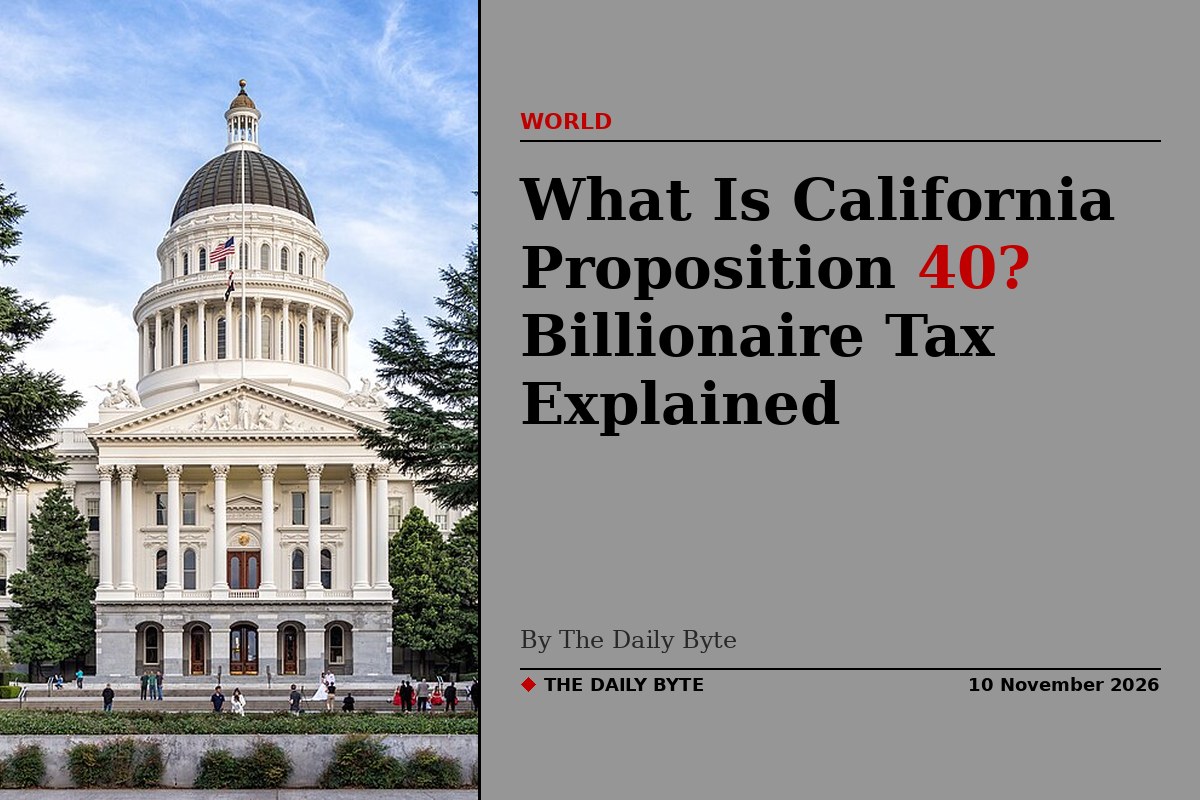
California voters have rejected Proposition 40, a proposal for a one-time 5 percent tax on the wealth of the state's billionaires. The Associated Press called the result on Monday 9 November 2026, with 52.8 percent of voters opposed and 47.2 percent in favour, after the measure trailed for days while ballots from the election on Tuesday 3 November were counted.
The result ends one of the most expensive and most divisive ballot campaigns in California's history, and it means California will not become the first American state to levy a wealth tax on its richest residents, at least not at this election. Supporters of the measure, led by a union representing healthcare workers, had argued it would raise about 100 billion dollars for healthcare. Opponents, led by some of the very billionaires who would have paid it, argued it would drive the wealthy out of the state and cost California revenue.
This explainer sets out what Proposition 40 actually proposed, who would have paid it, why it divided Democrats in one of the most Democratic states in the country, and what happens next.
What Proposition 40 proposed
Proposition 40 would have imposed a one-time tax of 5 percent on the net worth of people who were California residents on 1 January 2026 and whose net worth was more than 1 billion dollars as of 31 December 2026. The tax would have been due in 2027.
It was a tax on wealth, not on income. That distinction matters. California already taxes high incomes at some of the highest rates in the United States. Proposition 40 would instead have taxed the total value of what a person owned, including shares, business holdings and other financial assets, once that total passed the billion-dollar threshold.
Not everything a person owned would have counted. Real estate, pensions and retirement accounts were generally excluded from the calculation, according to reporting on the measure. The tax would have applied only to the wealth above the threshold, in the sense that it was aimed at people whose total net worth exceeded 1 billion dollars, and it would have been charged once, rather than every year.
Supporters estimated the measure would have affected about 200 billionaires in the state. California has more than 200 billionaires, according to estimates cited in coverage of the campaign, with some estimates putting the number at a few hundred. The state is home to more billionaires than any other American state, largely because of the technology industry in Silicon Valley and the entertainment industry in Los Angeles.
What the money was for
The campaign for Proposition 40 was led by the Service Employees International Union-United Healthcare Workers West, known as SEIU-UHW, a union representing healthcare workers. Its backers said the measure would have raised roughly 100 billion dollars, and that the money would go to healthcare and education.
The healthcare argument was central to the campaign. Supporters said the Republican-controlled Congress had cut healthcare programmes in order to give tax breaks to the wealthy, and that it was time for the wealthy in California to fill the gap. The union argued that federal cuts had left California's healthcare system short of money, and that a one-time charge on the state's richest residents was a fair way to make up the difference.
That framing won the support of the California Democratic Party, and of prominent national figures on the left. Senator Bernie Sanders travelled to California to campaign for the measure, and Representative Ro Khanna also backed it. Actor Mark Ruffalo was among its supporters.
But the measure divided Democrats, and that division became one of the main stories of the campaign. Governor Gavin Newsom opposed the tax, arguing that billionaires would find ways to avoid it and would leave the state, and that a national tax on the wealthy would be better than a state-by-state approach. Xavier Becerra, the Democratic candidate for governor, also opposed it. Teachers' unions and Planned Parenthood were among the organisations that opposed the proposal, alongside business groups.
Why it failed: the campaign and the polls
Proposition 40 was trailing from the first results on election night, and it never recovered. With about three-fifths of the expected vote counted on Wednesday 4 November, the result stood at about 56 percent against and 44 percent in favour. As more ballots were counted over the following days, the margin narrowed to 52.8 percent against and 47.2 percent in favour, but the outcome was never seriously in doubt.
Polling before the election had pointed the same way. An October survey by the University of California, Berkeley's Institute of Governmental Studies found 50 percent of likely voters opposed the measure, up from 48 percent in August, with 42 percent in favour. A separate October poll by the Public Policy Institute of California found 52 percent opposed and 46 percent in favour.
Money was a large part of the story. Opponents of the measure spent far more than supporters. Ultra-wealthy opponents donated a collective 378.4 million dollars against the measure, according to one report, while supporters raised about 32 million dollars. One of the main vehicles for the opposition, the Building a Better California political action committee, spent more than 304 million dollars. The campaign broke spending records for a California ballot measure.
The opposition campaign was funded in large part by billionaires who would have been liable for the tax. Google co-founder Sergey Brin was among those who drove the campaign against it. The scale of the spending meant voters in California were exposed to months of advertising arguing that the tax would harm the state's economy.
The core argument against the measure was that it would drive wealthy people out of California. Opponents said billionaires would move to states with no income tax, taking their tax payments, their businesses and their philanthropy with them, and that California would end up poorer as a result. Supporters disputed this, arguing that the wealthy are tied to California by their businesses and their lives, and that a one-time charge would not make them leave. Voters, on the evidence of the result, were more persuaded by the first argument than the second.
Propositions 41 and 42: the countermeasures
Proposition 40 was not the only wealth-tax measure on the ballot. Two further measures, Propositions 41 and 42, were put on the same ballot by opponents of the billionaire tax, and were designed to stop it from taking effect even if voters had approved it.
Proposition 42 would prohibit new state taxes on personal property, including financial and business holdings, and would restrict retroactive taxation. Proposition 41 was a related measure aimed at limiting the state's ability to impose wealth taxes. The rule was that if either Proposition 41 or Proposition 42 received more yes votes than Proposition 40, the billionaire tax could be stopped in court.
In the event, that rule was not needed to defeat Proposition 40, because the measure lost outright. But the countermeasures mattered during the campaign, because they gave voters who opposed the tax a second way to block it, and they complicated the legal picture. Results for Propositions 41 and 42 were still being counted after Proposition 40 was called, with Proposition 42 leading in early counts. Counting in California runs until 16 November, and the results are certified on 11 December.
What happens next
The defeat of Proposition 40 means the proposed one-time billionaire tax will not take effect through this ballot measure. California's tax system is unchanged, and no billionaire will receive a bill for 5 percent of their net worth in 2027.
That does not necessarily mean the idea is dead. Leaders of SEIU-UHW appeared to concede the race shortly before the result was called, but they vowed to try again in 2028 if California's legislature, in their words, fails to deliver a real solution to fund healthcare. The union has a record of returning to the ballot with measures that fail the first time, and the underlying argument, that federal healthcare cuts have left a funding gap, has not gone away.
The result also matters beyond California. Wealth taxes have been debated in several American states and at the national level, and California was seen as a test case. If the most Democratic large state in the country, with the most billionaires, would not vote for a one-time 5 percent tax on billionaires, supporters of wealth taxes elsewhere will have to reckon with that. Opponents will present the result as proof that voters reject wealth taxes even when they are aimed only at the very rich.
At the same time, the narrowness of the final margin, 52.8 percent to 47.2 percent, shows that the idea was far from unpopular. Nearly half of voters in a state of almost 40 million people backed a tax that would have applied to only about 200 of them. The campaign also showed that the politics of taxing the wealthy are more complicated than party labels suggest, with a Democratic governor, a Democratic candidate for governor, teachers' unions and Planned Parenthood all lining up against a measure backed by the state Democratic Party and by the left of the party nationally.
For now, the practical effect is simple. Proposition 40 failed, the countermeasures were not needed to kill it, and California will not levy a billionaire wealth tax. Whether the idea returns in 2028, as its backers have promised, will depend on what the legislature does about healthcare funding in the meantime, and on whether supporters can find a version of the proposal that wins over the voters who rejected this one.


