What Is Carbon Capture and Storage? CCS Explained
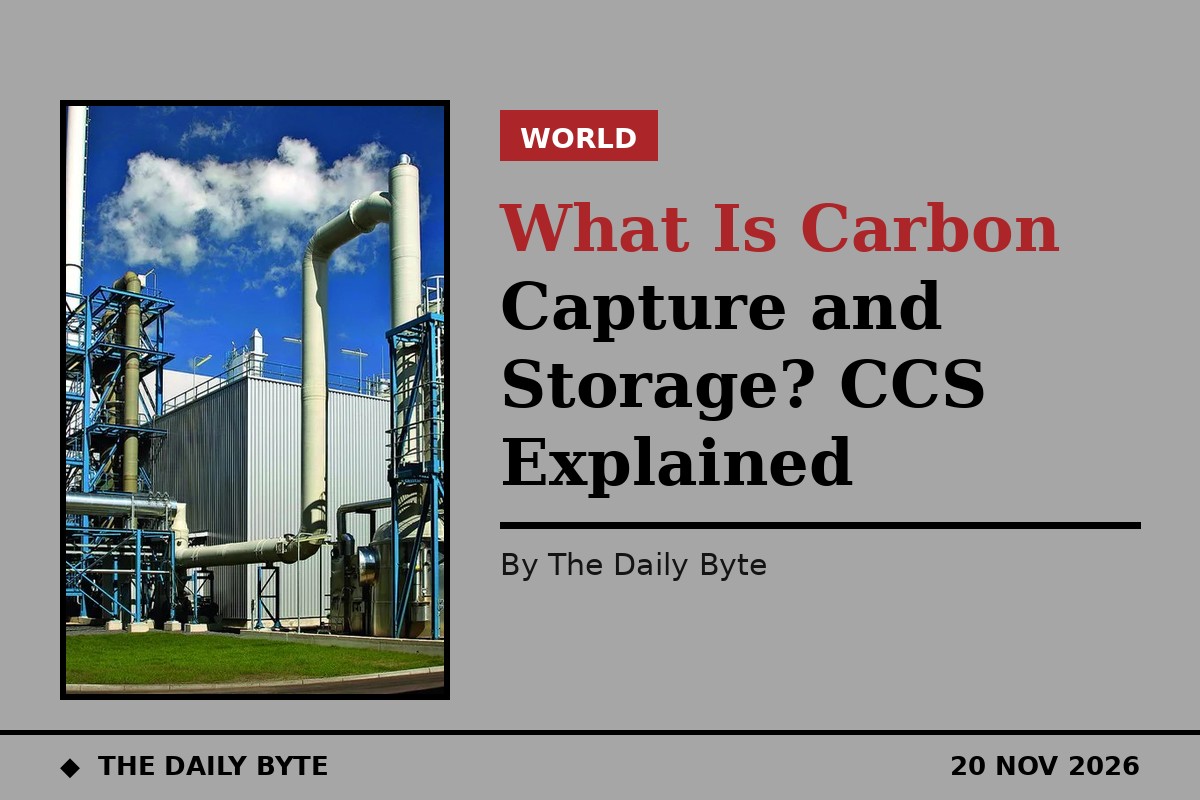
Carbon capture and storage, known as CCS, is a set of technologies that trap carbon dioxide from industrial sources before it reaches the atmosphere, then store it permanently deep underground. The carbon dioxide is captured from a power station, cement works, steel plant or similar facility, compressed, transported by pipeline, ship, rail or truck, and injected into geological formations such as depleted oil and gas reservoirs or deep saline aquifers. Supporters describe it as one of the few ways to cut emissions from heavy industry; critics argue it is expensive, has a poor delivery record, and is mostly used to extract more oil. Both claims have evidence behind them, and understanding the technology means looking at both.
The idea is central to many countries' net-zero plans. The Intergovernmental Panel on Climate Change (IPCC) defines CCS as "a process in which a relatively pure stream of carbon dioxide from industrial and energy-related sources is separated (captured), conditioned, compressed and transported to a storage location for long-term isolation from the atmosphere". The International Energy Agency (IEA) adds that carbon capture, utilisation and storage, or CCUS, can also capture carbon dioxide directly from the air. This explainer covers how it works, where it is used, what it costs, and where the debate stands.
How does carbon capture work?
Capture is the first of three stages: capture, transport and storage. The carbon dioxide must be separated from the other gases leaving a facility before it can be stored. The most widely used method is chemical absorption, in which the exhaust gas is passed through a liquid solvent, usually based on compounds of ethanolamine, known as amines. The solvent absorbs the carbon dioxide, is then heated to release it as a concentrated stream, and is recycled for use again. The IEA describes chemical absorption using amine-based solvents as the most advanced carbon dioxide separation technique, and it has been used in industry for decades.
There are three main approaches to capture, and each suits different kinds of plant:
| Method | How it works | Best suited to |
|---|---|---|
| Post-combustion | Carbon dioxide is scrubbed from flue gas after fuel is burned, usually with amine solvents | Existing power stations and factories, which can be retrofitted |
| Pre-combustion | Fuel is converted into hydrogen and carbon dioxide before burning, so the carbon dioxide can be captured from a concentrated stream | New gasification and hydrogen plants |
| Oxy-fuel | Fuel is burned in nearly pure oxygen, producing an exhaust that is mostly carbon dioxide and water | New-build plants designed for it from the start |
Other methods include physical separation using solid or liquid materials that trap the gas, membranes that filter it out, and looping cycles such as chemical looping and calcium looping. Direct air capture is a separate approach: machines pull carbon dioxide straight out of the surrounding air, rather than from a smokestack. It is far more expensive per tonne than capturing from a concentrated exhaust stream, because carbon dioxide makes up only a tiny fraction of ordinary air.
Where is the carbon dioxide stored?
Once captured, the carbon dioxide is compressed into a dense, liquid-like state and transported to a storage site. The IEA says it is injected into deep geological formations, including depleted oil and gas reservoirs or saline formations, which trap the carbon dioxide for permanent storage. These rock layers sit far below ground, sealed by impermeable rock above them, and the gas is held in place by a combination of the sealing rock, the pressure of the formation, and, over time, the gas dissolving into salty water and reacting with minerals in the rock.
Some captured carbon dioxide is not stored at all, but used. This is the "utilisation" in CCUS. Around 80 percent of the carbon dioxide captured each year is used for enhanced oil recovery, in which the gas is injected into partly depleted oil reservoirs to push out more oil, and much of it then stays underground. Smaller amounts are used to make products such as fertilisers, fuels and building materials. Because most captured carbon dioxide today goes to enhanced oil recovery, critics say the technology is largely serving the fossil fuel industry, while supporters reply that the gas is still stored underground and that oil recovery helps pay for the infrastructure.
How much carbon capture exists today?
The scale of CCS today is small compared with global emissions. As of 2024, CCS was in operation at 44 plants worldwide, collectively capturing about one-thousandth of global carbon dioxide emissions, and about 90 percent of CCS operations involved the oil and gas industry. IEA data from February 2026, cited by Carbon Brief, put the total amount of carbon dioxide captured at around 62 million tonnes a year, with about 49 million tonnes coming from fossil-fuel processing and about 45 million tonnes used for enhanced oil recovery.
The history goes back further than many people realise. The first large-scale carbon dioxide capture and injection project with dedicated storage and monitoring was commissioned at the Sleipner offshore gas facility in Norway in 1996, and it has stored carbon dioxide under the North Sea ever since. Carbon capture itself is older still: the technology was first used at oil wells in the United States and Canada in the early 1970s for enhanced oil recovery, and the idea of injecting captured carbon dioxide underground was first proposed in a 1976 academic article.
Growth, however, has been slower than promised. A 2022 review found that around 70 percent of announced CCS projects had not materialised, with a failure rate above 98 percent in the electricity sector. Many projects were cancelled because of high costs, technical problems or the loss of government funding. The IPCC nevertheless describes CCS as having a critical but limited role in cutting emissions, particularly in sectors where there is no easy alternative.
What is CCS used for, and where does it make sense?
The strongest case for CCS is in heavy industry. Making cement releases carbon dioxide from the limestone itself, not just from burning fuel, so even a cement works running entirely on clean electricity would still produce emissions. The same applies to parts of steelmaking and chemicals production. Carbon Brief notes that capturing carbon dioxide is seen as one of the only viable options for decarbonising some of the world's highest-emitting industries, such as cement production. In these cases there is no simple alternative such as switching to renewable electricity.
The case is weaker for electricity generation, where wind and solar power are usually cheaper than building a gas or coal plant with carbon capture, and where the failure rate of announced projects has been highest. CCS is also proposed for hydrogen production, where it can capture the carbon dioxide released when hydrogen is made from natural gas, and for bioenergy with carbon capture and storage, which in some conditions can remove carbon from the atmosphere overall because the plants absorbed it as they grew.
How much does CCS cost?
Cost is the central obstacle. Capturing carbon dioxide from an industrial source typically costs tens of dollars per tonne, and the full chain of capture, transport and storage costs more. A plant fitted with CCS also needs extra energy to run the capture process, which means it burns more fuel and produces more of the pollution associated with extracting and transporting that fuel. Whether a project makes financial sense depends on the price of emitting carbon dioxide, the availability of suitable storage nearby, and government support. That is why most operating projects are tied to gas processing and oil recovery, where the economics are most favourable.
The debate: what supporters and critics say
Supporters, including the IEA and the IPCC, argue that CCS is essential for reaching net zero because some emissions cannot be eliminated by electrification alone. In almost all of the IPCC's modelled pathways to limiting warming to 1.5 degrees, CCS contributes several billion tonnes of carbon dioxide abatement a year by 2050, mainly in hard-to-abate sectors. They also point to Sleipner's decades of operation as proof that storage can work safely.
Critics argue that CCS has consistently underdelivered, that most of the carbon dioxide captured is used to produce more fossil fuels, and that investment in CCS can delay the shift to renewable energy. They point to the high failure rate of announced projects and the fact that operating plants capture only a tiny fraction of global emissions. The debate is not about whether the chemistry works — it does — but about where the technology should be used, who should pay for it, and whether it should be used to prolong fossil fuel production.
Frequently asked questions
Is carbon capture the same as planting trees?
No. Trees absorb carbon dioxide naturally as they grow, but they can release it again if they burn or rot. CCS captures carbon dioxide from an industrial source and stores it in rock formations intended to hold it permanently.
Does stored carbon dioxide leak?
Storage sites are chosen for their sealing rock and are monitored, and natural gas has stayed trapped in similar formations for millions of years. Leakage is a risk that has to be managed, and the effectiveness of CCS depends on capture efficiency, the extra energy used, and whether the stored gas stays in place.
What is the difference between CCS and CCUS?
CCS is carbon capture and storage. CCUS adds utilisation, meaning some of the captured carbon dioxide is used to make products or to extract more oil, rather than being stored directly. The terms are often used interchangeably.
Can CCS remove carbon dioxide already in the air?
Only through direct air capture, which pulls carbon dioxide straight from the atmosphere. It works, but it is much more expensive than capturing from a smokestack because the gas is so dilute in ordinary air.
Sources: International Energy Agency (IEA); Carbon Brief; IPCC definition of CCS.


