What Is the Chagos Islands Deal? Explained
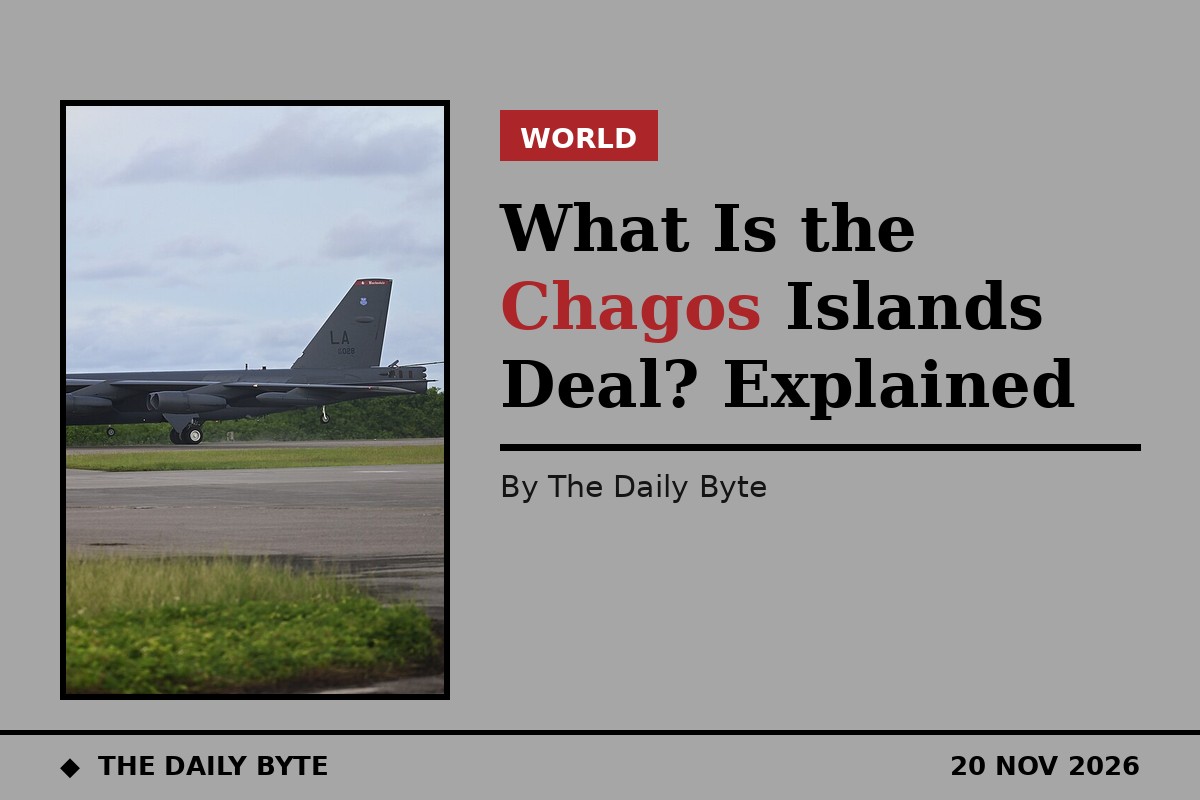
The Chagos Islands deal is the agreement signed by the United Kingdom and Mauritius on 22 May 2025 under which Britain recognises Mauritian sovereignty over the whole Chagos Archipelago, including Diego Garcia, while leasing back the joint UK-US military base on Diego Garcia for 99 years. The treaty has been signed but has not come into force: ratification by the UK is paused, the legislation needed to implement it fell when Parliament was prorogued in April 2026, and the United States, which operates the base with Britain, no longer supports it. Mauritius raised the delay in its own parliament on 17 November 2026, and the two prime ministers agreed on 4 November 2026 to work on a shared plan for further progress by the end of the year.
The deal matters because it would settle one of Britain's longest-running sovereignty disputes, decide the future of a strategically vital Indian Ocean base, and determine whether the Chagossian people, removed from the islands more than half a century ago, can ever return. This explainer sets out what the archipelago is, what the treaty says, how much it would cost, why it has stalled, and what happens next.
What is the Chagos Archipelago?
The Chagos Archipelago is a group of seven atolls made up of more than 60 islands in the central Indian Ocean, about 500 kilometres south of the Maldives, some 1,250 miles north-east of Mauritius and around 5,799 miles south-east of the United Kingdom. Its largest island is Diego Garcia, a coral atoll that hosts a major joint United States-United Kingdom military facility. The other main island groups are Peros Banhos, the Salomon Islands, the Egmont Islands and the Three Brothers.
The islands were uninhabited until French settlers established coconut plantations there in the late 18th century, worked by enslaved people brought from Africa and later by contract workers from India and Mauritius. In 1814 the archipelago passed to Britain with Mauritius, and in 1903 it was administratively separated from the Seychelles and attached to Mauritius. Before Mauritius became independent in 1968, Britain detached the archipelago from Mauritius on 8 November 1965 and created a new colony, the British Indian Ocean Territory, which remains one of the 14 UK Overseas Territories. The detachment was agreed with Mauritian political leaders at Lancaster House in London in 1965, in return for a payment of 3 million pounds and a promise that the islands would be returned when no longer needed for defence purposes.
Between 1967 and 1973 Britain removed the islands' entire population, around 1,500 people, so that the military base on Diego Garcia could be built. Families were taken to Mauritius and the Seychelles, often with little warning and few possessions, and were barred from returning. The Chagossians and their descendants, now numbering several thousand, have campaigned ever since for the right to return and for compensation. Their forced removal is the human story at the centre of the sovereignty dispute, and it is why the deal is about far more than lines on a map.
Why did Britain control the islands?
Britain wanted Diego Garcia as a military base. In 1966 the UK and the United States signed an exchange of notes making the island available for defence purposes, and construction of the joint base began in the early 1970s. Its position in the middle of the Indian Ocean, roughly halfway between Africa and South-East Asia, makes it one of the most strategically valuable military sites in the world. Aircraft based there can reach the Middle East, East Africa and South Asia, and the island's lagoon shelters a naval support facility used by American and British ships and submarines. The base played a role in the Gulf War, the invasion of Afghanistan and the invasion of Iraq, and it remains central to Western military planning in the Indo-Pacific.
Mauritius has never accepted that the detachment was lawful. It argues that the archipelago was carved out of its territory on the eve of independence, in breach of the right of peoples to self-determination, and that the Lancaster House agreement was extracted under pressure because independence itself was at stake. Britain, for decades, maintained that the detachment was lawful and that Mauritius had consented. The dispute ran through the courts and international bodies for more than half a century before the 2025 treaty offered a way to settle it.
What did the International Court of Justice decide?
The turning point came at the International Court of Justice in The Hague. In 2017 the United Nations General Assembly asked the court whether the decolonisation of Mauritius had been lawfully completed when it was granted independence in 1968, following the separation of the Chagos Archipelago. In its advisory opinion of 25 February 2019, adopted by 13 votes to one, the court advised that the separation was not based on the freely expressed and genuine will of the people of the territory, that the decolonisation of Mauritius was therefore not conducted in a manner consistent with the right of peoples to self-determination, and that the United Kingdom's continued administration of the archipelago was a wrongful act that must be brought to an end as rapidly as possible. The UN General Assembly then voted to welcome the opinion and called on Britain to withdraw its administration within six months.
Advisory opinions are not legally binding in the way a court judgment is, but the opinion carried great weight, and it was not the only legal setback for Britain. In 2015 a tribunal at the Permanent Court of Arbitration had already ruled that Britain's declaration of a marine protected area around the archipelago was unlawful because it failed to take Mauritius's rights into account. A further case between Mauritius and the Maldives over their maritime boundary, decided by the International Tribunal for the Law of the Sea, proceeded on the basis that Mauritius had sovereignty over the Chagos Archipelago. The House of Commons Library briefing on the dispute notes that the UK government weighed these legal risks when it decided to negotiate, including the risk that the base itself could eventually face legal challenge.
What does the 2025 treaty actually say?
Negotiations between the UK and Mauritius began in November 2022. A political agreement was announced on 3 October 2024, and the treaty itself, formally titled the Agreement concerning the Chagos Archipelago including Diego Garcia, was signed in London on 22 May 2025 by the then UK Prime Minister Sir Keir Starmer and the Mauritian Prime Minister Navin Ramgoolam. Its main terms are set out below.
Key terms of the UK-Mauritius treaty, signed 22 May 2025:
Sovereignty: Mauritius exercises full sovereignty over the entire Chagos Archipelago, including Diego Garcia. The British Indian Ocean Territory ceases to exist as a British territory.
The base: the United Kingdom is authorised to operate the joint UK-US military base on Diego Garcia for an initial period of 99 years, with an option to extend for a further 40 years. Britain retains full control over the base, including control over who and what enters it and over all communications and electronic systems on the island.
Buffer zone: nothing may be built within a 24 nautical mile buffer zone around Diego Garcia without British consent, giving the UK an effective veto over development near the base.
Resettlement: Mauritius is free to organise a programme of resettlement on the islands of the archipelago other than Diego Garcia, in accordance with its own laws. Chagossians would be able to return to islands such as Peros Banhos and the Salomon Islands, but not to Diego Garcia itself.
Payments: the UK pays Mauritius an annual sum for the lease of the land used by the base, reported at the time of signing as 165 million pounds a year for the first three years and 120 million pounds a year thereafter, with the government putting the overall cost at 3.4 billion pounds in today's prices.
The then government presented the deal as a way of resolving the sovereignty dispute on British terms while securing the base for the next century. The then Defence Secretary John Healey told the Commons that at a cost of less than 0.2 per cent of the annual defence budget, Britain had secured unrestricted access to and use of the base. The United States, after what it described as a comprehensive interagency review, initially said the agreement secured the long-term, stable and effective operation of the joint facility.
How much will the UK pay Mauritius?
The cost of the deal has become one of the most contested parts of the story, and the figures need care. The annual lease payments were reported at the time of signing as 165 million pounds a year for the first three years, falling to 120 million pounds a year from the fourth year, with the payments indexed to inflation. The government estimated the total cost at 3.4 billion pounds in present-value terms, meaning the value of all future payments expressed in today's money. A much larger figure, around 35 billion pounds, has been quoted by critics and in Parliament: that is roughly the nominal cash total of the payments added up over the full 99 years, without adjusting for inflation or discounting future payments to today's values. The two numbers describe the same payments in different ways, which is why they look so different.
What is not in dispute is that no money has changed hands. The Foreign, Commonwealth and Development Office confirmed in a written parliamentary answer on 20 October 2026 that the UK has not made any payments to Mauritius in relation to the Chagos deal, and that no payments will be made until a treaty is ratified and enters into force. Plans for the annual payments have been put on hold while the deal is paused. Mauritius argues that the delay is costing it money, because it cannot budget for income it has been promised but has not received.
Why has the deal stalled?
The treaty needs two things to take effect, and both are missing. First, it needs legislation in the UK to implement it in domestic law. The government introduced the Diego Garcia Military Base and British Indian Ocean Territory Bill in the House of Commons on 15 July 2025. The Commons passed it on 20 October 2025, the House of Lords passed it with amendments on 12 January 2026, and the Commons rejected all but one of the Lords' amendments on 20 January 2026. But the Bill then ran out of time. On 13 April 2026 the Foreign Office minister Stephen Doughty told the Commons that it had become impossible at political level to agree an updated exchange of notes with the United States, which is the second thing the treaty needs, and that the UK could not let the treaty enter into force without US support. Parliament was prorogued on 29 April 2026 and the Bill fell without completing its passage.
The reason for the blockage is in Washington. President Donald Trump initially said in February 2025 that he was inclined to go along with the agreement, but by February 2026 he had changed his mind, saying the then Prime Minister Keir Starmer was making a big mistake and posting on social media that Britain should not give away Diego Garcia, which he said might be needed against Iran. In September 2026, after meeting Prime Minister Andy Burnham at the United Nations General Assembly in New York, Mr Trump said the United States currently does not support the agreement. Mr Burnham said he would work with the US and Mauritius to find a solution, and in remarks reported on 6 November he said Britain was talking with its American friends about how to recast the arrangement.
The UK government has not abandoned the deal, but it has not reintroduced the Bill either. A private member's bill aimed at blocking any transfer of sovereignty, the British Sovereignty Protection (Chagos Islands) Bill sponsored by Lord Weir of Ballyholme, passed its second reading in the House of Lords on 23 October 2026 without a division; the government does not support it. Meanwhile the treaty sits signed but not in force, and Britain still administers the islands.
Timeline of the Chagos deal:
8 November 1965: Britain detaches the Chagos Archipelago from Mauritius and creates the British Indian Ocean Territory.
1967 to 1973: the islanders are removed so the Diego Garcia base can be built.
25 February 2019: the International Court of Justice advises that the separation was unlawful and must end.
3 October 2024: the UK and Mauritius announce a political agreement on sovereignty.
22 May 2025: the treaty is signed in London; Mauritius gains sovereignty and the UK leases back Diego Garcia for 99 years.
13 April 2026: the government tells the Commons the deal cannot proceed without US support.
29 April 2026: Parliament is prorogued and the implementing Bill falls.
September 2026: President Trump says after meeting Mr Burnham that the US does not support the agreement.
4 November 2026: Mr Burnham and Mr Ramgoolam meet at the Commonwealth summit in Antigua and agree to work on a shared plan for further progress by the end of the year.
17 November 2026: Mr Ramgoolam updates the Mauritian National Assembly on the state of the agreement.
What does it mean for the Chagossians?
For the Chagossians, the deal is bitter-sweet. On one hand, it is the first agreement that would formally recognise that the islands are Mauritian, not British, and it would allow resettlement of the outer islands, which Britain has resisted for decades. On the other, it would permanently exclude them from Diego Garcia itself, the largest island and the place most of them or their parents came from, and it was negotiated between governments without the Chagossians at the table. Some Chagossians challenged the deal in the UK courts; a High Court judgment rejected several of those claims as unarguable.
Frustration has already spilled into direct action. In February 2026 four Chagossians, led by Misley Mandarin, landed without permission on Ile du Coin in Peros Banhos, an uninhabited island in the archipelago, in an attempt to reassert a presence on their homeland. In March 2026 the Supreme Court of the British Indian Ocean Territory quashed removal notices served on them and declared unlawful part of the territory's constitution order that denied any right of abode. The episode underlined that, while governments argue over sovereignty, the people removed from the islands are still waiting for a way home.
What happens next?
Three things will decide the deal's fate. The first is the United States: without an updated exchange of notes on the base, the UK government says the treaty cannot enter into force, so the talks between London and Washington matter more than anything else. The second is Mauritius's patience. Mr Ramgoolam told the National Assembly on 17 November 2026 that Mauritius had made clear in July that it would soon have to take a decision if there was no clear roadmap for ratification, and Mauritius has been exploring legal action over the delay. The third is the timetable Mr Burnham and Mr Ramgoolam set at their meeting on 4 November 2026, when they agreed to work on a shared plan to make further progress by the end of the year.
Until one of those things changes, the position is frozen: the treaty is signed, the Bill that would give it effect in UK law has fallen, no payments have been made, and Britain still administers the islands. The deal that was meant to close a 60-year dispute has become a test of whether the governments that signed it can still deliver it.
Frequently asked questions
Is the Chagos Islands deal in force? No. The treaty was signed on 22 May 2025 but has not been ratified and has not entered into force. The UK legislation needed to implement it fell in April 2026, and ratification is paused pending agreement with the United States.
Who owns the Chagos Islands now? In practice, Britain still administers them as the British Indian Ocean Territory. Under the signed treaty, sovereignty would pass to Mauritius, but that transfer has not taken effect.
Why is Diego Garcia so important? It hosts a joint UK-US military base in the middle of the Indian Ocean, used by aircraft, ships and submarines operating across the Middle East, East Africa and South Asia. Its location is the main reason the base, and the deal, are so politically sensitive.
Can Chagossians return to the islands? Not yet. The treaty would allow Mauritius to resettle people on the outer islands, but not on Diego Garcia, where the base is. No resettlement programme has begun while the treaty remains unratified.
How much will the deal cost the UK? The lease payments were reported as 165 million pounds a year for the first three years and 120 million pounds a year thereafter, with the government estimating the total cost at 3.4 billion pounds in today's prices. No payments have been made so far.
Sources: House of Commons Library, International Law and the Chagos Archipelago (research briefing CBP-10512); House of Lords Library, UK-Mauritius treaty on the Chagos Archipelago; Government of Mauritius, statement by Prime Minister Navin Ramgoolam to the National Assembly, 17 November 2026; Foreign, Commonwealth and Development Office written answer, 20 October 2026.


