What Is Chhath Puja? Festival Explained
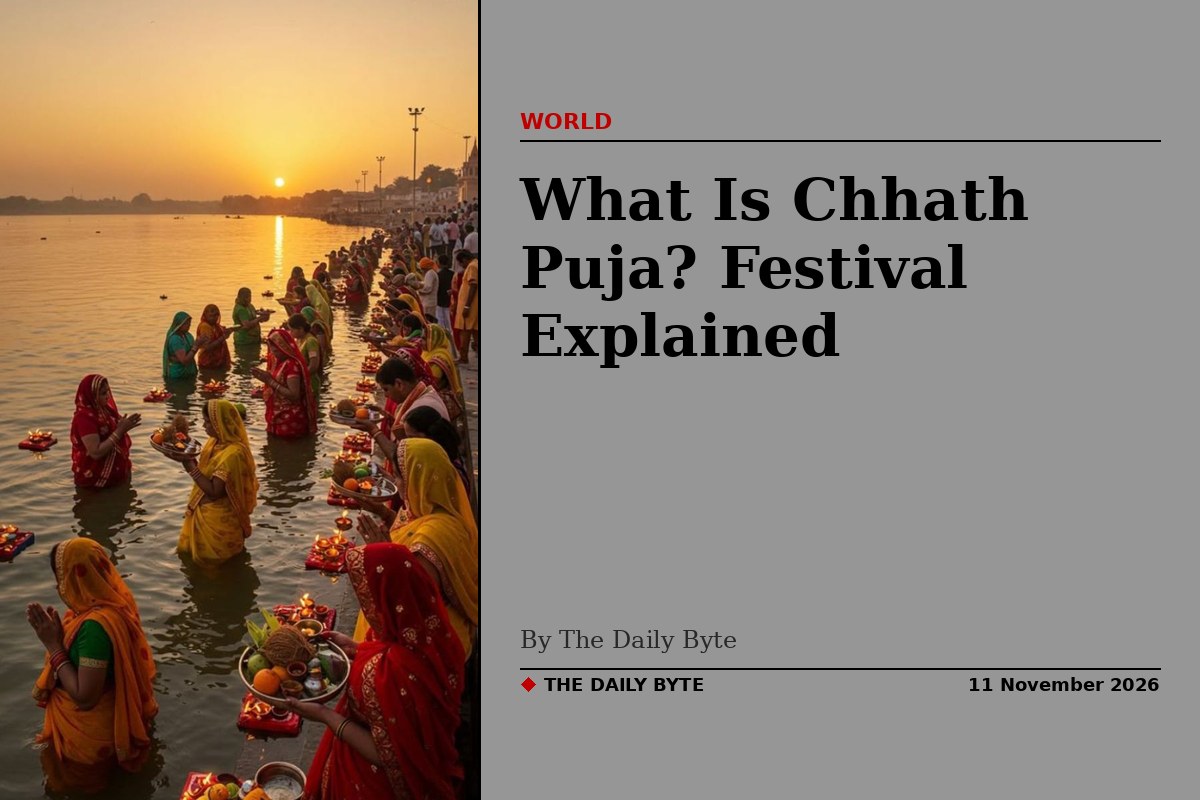
Chhath Puja is a four-day Hindu festival in which devotees thank Surya, the Sun god, and worship Chhathi Maiya, offering water known as arghya to the setting sun and then to the rising sun. In 2026 it runs from Friday 13 November to Monday 16 November, with the main evening offering on Sunday 15 November and the closing morning offering on Monday 16 November. It is one of the few major Hindu festivals with no temple ritual at its centre: the worship happens outdoors, at a riverbank, pond or ghat, with the fasting devotee standing in the water.
The festival is most closely associated with Bihar, Jharkhand and eastern Uttar Pradesh in India, and with the Terai region of southern Nepal, but it is now observed wherever families from those regions live, including Delhi, Mumbai and cities overseas. This year it is in the news in Delhi because the city government has declared Monday 16 November a public holiday for the festival and is preparing more than 1,400 ghats across the capital. This explainer answers the questions people are searching for: when it falls, what happens on each day, what the rituals mean, and why Delhi is marking it.
When is Chhath Puja in 2026?
Chhath Puja 2026 falls from Friday 13 November to Monday 16 November. The four days, in order, are Nahay Khay on Friday 13 November, Kharna on Saturday 14 November, Sandhya Arghya on Sunday 15 November and Usha Arghya on Monday 16 November. The dates follow the Hindu lunar calendar: the festival is observed on the sixth day, or Shashthi, of the bright fortnight of the month of Kartik, six days after Diwali, which fell on 8 November in 2026. Panchang listings put the Shashthi tithi itself from late on Saturday 14 November into the early hours of Monday 16 November, which is why the evening offering falls on Sunday and the morning offering on Monday.
Sunday 15 November is the day most people mean when they say Chhath Puja, because that evening brings Sandhya Arghya, the offering to the setting sun and the emotional high point of the festival. Monday 16 November closes it with Usha Arghya, the offering to the rising sun, after which the fast is broken. A smaller version of the festival, Chaiti Chhath, is also observed in the month of Chaitra, in March or April, but the Kartik Chhath in October or November is the grander and far more widely observed one.
What does Chhath Puja celebrate?
Chhath Puja is an expression of gratitude to the Sun for sustaining life on Earth. The Sun is worshipped as the visible source of light, warmth and energy, and the festival thanks it for the harvest and for the health and wellbeing of the family. Devotees also worship Chhathi Maiya, also called Chhathi Mata, who is revered as a guardian of children and is believed in folk tradition to be the sister of Surya. Prayers are offered for the long life and good health of children, for prosperity and for wishes the family has made.
The name itself points to the timing. Chhath is commonly linked to the Hindi word for six, and the festival's principal observance falls on the sixth lunar day, Shashthi, of Kartik Shukla Paksha. It is also known as Surya Shashthi, Pratihar Shashthi and Dala Chhath in different contexts. Unusually, the festival honours both the setting sun and the rising sun: devotees first thank the light as it leaves, then greet it as it returns, a pairing that is often read as a symbol of the cycles of life and of gratitude before asking.
What happens on each of the four days of Chhath Puja?
Each of the four days has its own name and its own discipline, and the observance builds steadily towards the two arghya offerings.
Day 1, Nahay Khay, Friday 13 November: The festival opens with a holy bath, usually in a river, and a thorough cleaning of the home and kitchen. The fasting person, known as the vratin, eats a single sattvik meal, traditionally kaddu-bhaat, made of bottle gourd, chana dal and rice, cooked without onion or garlic. From here on, purity of food, home and conduct is emphasised throughout.
Day 2, Kharna, Saturday 14 November: The devotee fasts through the day, taking neither food nor water, and in the evening breaks the day's fast with prasad of kheer made with jaggery, known as rasiya, served with roti. Once that prasad has been eaten, the long fast begins: about 36 hours without food or water, known as nirjala vrat, which continues through the two arghya offerings.
Day 3, Sandhya Arghya, Sunday 15 November: This is the main day. In the afternoon, families carry their offerings to the nearest river, pond or ghat in decorated bamboo baskets called soop and daura. As the sun sets, the fasting devotees stand waist-deep in the water and offer arghya, water and milk poured from a small vessel, to the setting sun. In Delhi the sun sets at about 5.30pm on 15 November; times vary by city, so families check their local panchang.
Day 4, Usha Arghya, Monday 16 November: Before dawn, the ghats fill again. Devotees offer arghya to the rising sun, pray to Chhathi Maiya, and then break the fast, an act called parana, usually with water, ginger and the prasad that was offered. In Delhi, sunrise on 16 November is at about 6.44am. With the morning offering, the festival ends and the prasad is shared among family and neighbours.
What is arghya, and what is offered during Chhath Puja?
Arghya is the ritual offering of water to the Sun, poured slowly from a small brass or copper vessel while the devotee stands in the river. It is the central act of Chhath Puja, performed twice: once to the setting sun on the third evening and once to the rising sun on the fourth morning. The offerings are carried to the ghat in a bamboo soop, a winnowing basket, and typically include thekua, a wheat-flour sweet made with jaggery, seasonal fruits such as bananas, oranges and coconut, sugarcane stalks, and a lit diya, or oil lamp. Diyas are also floated on the water, and the banks fill with folk songs sung by women through the evening.
What sets Chhath apart from many other Hindu festivals is its simplicity. There is no idol to install and no temple ceremony at the centre of it; the worship is directed at the sun itself, in the open air, at the water's edge. That directness is part of why the festival is often described as one of the most democratic of Hindu observances: the rituals need no priest and no temple, only a riverbank, a basket of offerings and the discipline of the fast.
Where is Chhath Puja celebrated?
Chhath Puja is native to eastern India and southern Nepal. It is celebrated primarily in Bihar, Jharkhand and eastern Uttar Pradesh, and in the Koshi, Gandaki, Bagmati, Lumbini and Madhesh provinces of Nepal. In those regions it is a major community event: ghats are cleaned and decorated, families travel home for the festival, and whole neighbourhoods gather at the water.
Beyond its heartland, the festival has travelled with migration. Delhi has a large community from Bihar and eastern Uttar Pradesh, and Chhath is now one of the biggest public festivals in the capital, with ghats prepared along the Yamuna and at ponds and parks across the city. It is also observed in Mumbai, Kolkata, Patna, Varanasi and Ranchi, and by diaspora communities in the United States, Britain, Australia and elsewhere, wherever a riverbank or lake can stand in for the Ganges.
Why is Delhi marking Chhath Puja in 2026?
Delhi's preparations for Chhath Puja 2026 have become a civic operation. The Lieutenant Governor of Delhi has declared Monday 16 November 2026 a public holiday on account of Pratihar Shashthi, or Surya Shashthi, with the General Administration Department issuing the notification on 9 November 2026. The holiday covers Delhi government offices, autonomous bodies and public sector undertakings, and government and government-aided schools in the capital will also be closed, so that devotees can take part in the morning Usha Arghya rituals.
Chief Minister Rekha Gupta directed officials to prepare more than 1,400 ghats across Delhi this year, compared with 1,326 last year, and to complete the basic works by 6 November, with tents at large and medium ghats in view of the November cold. The city government has also been trialling a Yamuna boat service, described as a Yamuna safari, ahead of the festival. The scale of the preparations reflects how large the festival has become in Delhi, where the community that observes it now runs into the lakhs.
What is the story behind Chhath Puja?
The origins of Chhath Puja are ancient and are told through legend rather than a single founding text. The most widely repeated stories connect it to the Mahabharata, in which Draupadi, the wife of the Pandavas, is said to have observed a similar fast and offered prayers to the Sun. Another tradition links it to Karna, the great warrior of the epic, who was himself a devotee of Surya and is said to have stood in the water offering arghya to the sun. In the Vana Parva of the Mahabharata, the priest Dhaumya teaches Yudhishthira a hymn of the hundred and eight names of Surya, and the text promises grace to whoever worships the Sun with devotion on the sixth or seventh day.
Scholars note that no Veda or Purana prescribes the four-day Chhath vrat by name. What the scriptures do contain are hymns to Surya, including Rigveda hymn I.50, and a goddess Shashthi, guardian of children, described in the Brahmavaivarta Purana. The festival as it is practised today appears to have grown out of the folk and agricultural traditions of the Gangetic plain, where the Sun's place in the harvest cycle made it a natural object of gratitude. Its observance at the end of the monsoon and the start of the winter crop cycle reinforces that link between the festival and the farming year.
Frequently asked questions about Chhath Puja
When is Chhath Puja in 2026? Chhath Puja 2026 runs from Friday 13 November to Monday 16 November. Nahay Khay is on 13 November, Kharna on 14 November, the main Sandhya Arghya to the setting sun on Sunday 15 November, and Usha Arghya to the rising sun on Monday 16 November.
What is arghya in Chhath Puja? Arghya is the offering of water, and sometimes milk, poured to the Sun while the devotee stands in a river or pond. It is offered twice: to the setting sun on the third evening and to the rising sun on the fourth morning.
Who is Chhathi Maiya? Chhathi Maiya, also called Chhathi Mata, is the goddess worshipped alongside Surya during Chhath Puja. She is revered as a guardian of children, and devotees pray to her for the health, long life and wellbeing of their families.
Is Delhi closed on 16 November 2026 for Chhath Puja? Yes. The Delhi government has declared Monday 16 November 2026 a public holiday for Chhath Puja, covering government offices, autonomous bodies and public sector undertakings, and government schools in the capital are closed too. Private schools set their own schedules, so parents should check with their child's school.
What food is eaten during Chhath Puja? The festival's foods are simple and sattvik. Nahay Khay features kaddu-bhaat, made of bottle gourd, chana dal and rice. Kharna is broken with jaggery kheer and roti. Thekua, a jaggery wheat sweet, is the best-known prasad, offered along with seasonal fruits, coconut and sugarcane, and shared once the fast is broken on Monday morning.
Sources: the 2026 dates and four-day sequence are set out in Drik Panchang-based listings for Chhath Puja 2026 and in the Chhath festival overview, which also covers where the festival is observed and who is worshipped. The Delhi public holiday, its notification number and the 1,400-ghat preparation drive are reported by JagranJosh and by Education Times.


