What Is Citizenship by Investment? Explained After St Kitts and Nevis Wind-Down
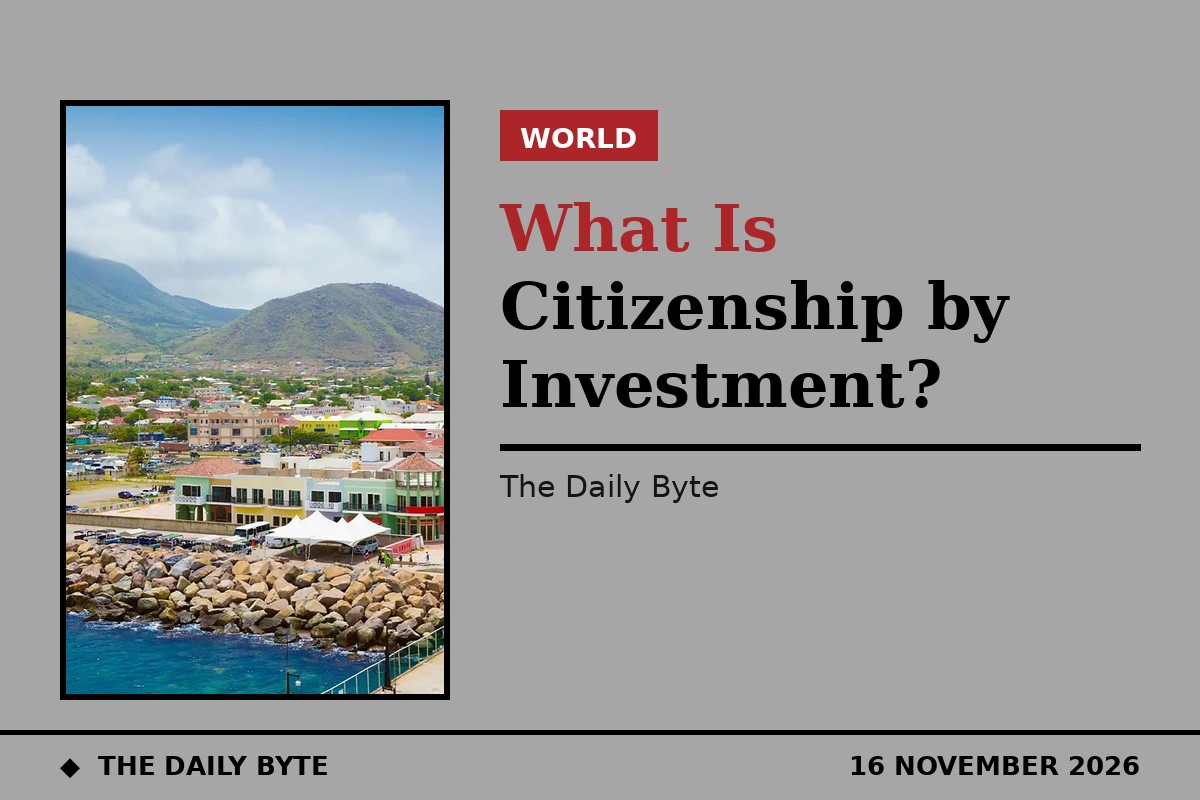
What is citizenship by investment? It is a legal route under which a country grants full citizenship to a foreign national who makes a qualifying financial contribution or investment and passes the government's checks. It is not a visa, and it is not residence: the successful applicant becomes a citizen, with a passport, and the citizenship is normally for life. The question is in the news because St Kitts and Nevis, which runs the world's oldest such programme, announced on 13 November 2026 that it will wind its scheme down.
That announcement does not close the programme overnight. No final closing date has been agreed, applications are still being accepted, and the prime minister has said nothing changes for people who already hold citizenship lawfully. What has changed is the direction of travel: after 42 years, the model that St Kitts and Nevis pioneered in 1984 is being phased out under pressure from the European Union, and the other Caribbean states that copied it face the same choice.
What is citizenship by investment?
Citizenship by investment, often shortened to CBI, is a government programme that exchanges citizenship for a set economic contribution. The applicant usually chooses between a non-refundable contribution to a government fund, an investment in an approved project, or the purchase of approved real estate. In return, after due-diligence checks and, in the St Kitts and Nevis case, an interview, the applicant and eligible family members are granted citizenship.
Three features set it apart from other immigration routes. First, there is generally no requirement to live in the country before or after citizenship is granted. Second, the grant is citizenship itself, not a temporary right to live or work somewhere. Third, the qualifying amounts are fixed in advance by law or regulation, so the applicant knows the minimum contribution before applying. That is also why critics call the schemes "passports for sale" and why supporters describe them as a legitimate way for small states to raise development finance.
St Kitts and Nevis is the reference case because it invented the modern form of the scheme. Its programme was created under the Citizenship Act of 1984, and it has run continuously since then, longer than any other programme of its kind. The other Eastern Caribbean programmes — in Antigua and Barbuda, Dominica, Grenada and Saint Lucia — followed the same template, and the five states now operate within a shared regional framework.
Why is St Kitts and Nevis in the news?
On 13 November 2026, Prime Minister Dr Terrance Drew announced in a national address that St Kitts and Nevis will wind down its citizenship by investment programme "responsibly, on a timeline now being negotiated with the European Union". He said the government had formally communicated its position to Brussels, and he gave no closing date.
"Nothing changes tonight for any person who lawfully holds our citizenship," Drew said, assuring existing citizens — including citizens by investment — that their travel privileges and other rights remain intact. He also ruled out discounts, rushed processing or a "fire sale" before the programme closes, and said the programme would continue to run under strict standards until a final date for receiving applications is agreed with the EU and announced.
The decision matters beyond one small Caribbean federation because of the scale of the programme. Drew said citizenship by investment made up as much as 70 per cent of government revenue in 2022, and less than 20 per cent in 2026, as the economy diversified. One report put the total raised by the scheme over 17 years at $6.5 billion. Those figures, reported in Caribbean and international coverage of the announcement, explain why winding the programme down is a major fiscal decision, not a symbolic one.
How does the St Kitts and Nevis programme work?
The programme is administered by the Citizenship by Investment Unit (CIU), the federal government body responsible for the scheme. Applicants apply through authorised agents, undergo due-diligence checks, and are interviewed. The CIU publishes four qualifying routes, with minimum amounts that do not include due-diligence and other fees.
| Route | Minimum amount | What it involves |
|---|---|---|
| Sustainable Island State Contribution (SISC) | US$250,000 | Non-refundable contribution to the government, covering a main applicant or a family of up to four |
| Public Benefit Option | US$250,000 | Contribution to a government-approved public benefit project |
| Approved real estate | US$325,000 | Share or condominium in a CIU-approved development, held for seven years |
| Private real estate | US$600,000 | Single-family private home, held for seven years |
The SISC replaced the earlier Sustainable Growth Fund, which older guides still describe at US$150,000. Additional dependants beyond a family of four cost extra under the published schedule. The contribution routes are non-refundable: the money goes to the state whether or not the applicant later uses the passport. Real estate, by contrast, is an asset the buyer holds, although it cannot be resold for seven years. Figures change, and anyone considering a route should check the CIU's own published schedule before acting, because fees and requirements have been revised repeatedly.
Applicants should also understand what the checks involve. Every main applicant is interviewed, and the CIU carries out background checks before citizenship is granted. The programme's defenders point to those checks, and to the regional regulator the five Eastern Caribbean states agreed to create in September 2025, as evidence that the schemes are not open to anyone with the money. Critics, including the European Commission, argue that granting citizenship to people with no genuine link to the issuing country creates security and due-diligence risks that checks cannot fully remove.
What does citizenship by investment buy — and what does it not?
What it buys is citizenship of the issuing state, for life, with a passport. For St Kitts and Nevis, that has historically included visa-free or visa-on-arrival access to a large number of countries, including the Schengen Area in Europe. That travel access is one of the main attractions for applicants, and it is also the main point of leverage for the European Union.
What it does not buy is guaranteed travel access for ever. Visa-free access is a separate decision by the receiving country or bloc, and it can be suspended. That distinction is at the heart of the current dispute: the EU is not saying St Kitts and Nevis cannot grant its own citizenship to whom it chooses. It is saying that, if a country runs an investor-citizenship scheme, the EU may suspend that country's visa-free access to the Schengen Area.
Nor does citizenship by investment buy citizenship of the European Union, the right to live and work in the EU, or any say in the issuing country's politics beyond the ordinary rights of a citizen. It also does not remove the tax, legal or reporting obligations an applicant has in their country of residence or of origin. Those are common misunderstandings, and they matter because the marketing around some programmes can blur the line between a passport and a right of residence in Europe.
Why is the EU pushing Caribbean states to end these schemes?
The legal trigger is Regulation (EU) 2025/2441, adopted on 26 November 2025 and in force since 30 December 2025. It revised the EU's visa suspension mechanism, which governs when the bloc can suspend a third country's visa-free access to the Schengen Area. Under the revised rules, operating an investor-citizenship scheme that grants nationality in exchange for pre-determined payments or investments, to people with no genuine link to the issuing country, is itself a ground for suspension.
On 25 June 2026, the European Commission wrote to the five Eastern Caribbean states — Antigua and Barbuda, Dominica, Grenada, Saint Lucia and St Kitts and Nevis — inviting them to phase out their programmes by 1 June 2028 if they wished to preserve Schengen visa-free access. The five governments were asked to confirm their course of action by 12 November 2026, ahead of a Commission review report expected in December 2026.
St Kitts and Nevis answered first, on 13 November. Antigua and Barbuda has also signalled that it will wind its programme down, while seeking a longer transition period running to the end of 2030. Grenada's position, as stated by its prime minister after his swearing-in for a second term, is that it wants to keep both its programme and its citizens' Schengen access. Dominica and Saint Lucia had not, at the time of writing, announced a final decision in the same terms.
The EU's concern is not new. Brussels has argued for years that investor-citizenship schemes create risks around security, money laundering and the integrity of visa-free travel, because a person who buys citizenship of one state can then travel visa-free to the Schengen Area without ever having been checked by a European authority. Vanuatu, in the Pacific, had already lost EU visa-free access over an investor-citizenship programme before the revised regulation took effect, setting the precedent the Caribbean states now face.
Citizenship by investment vs golden visas
The two terms are often used interchangeably, but they describe different things. Citizenship by investment grants citizenship. A "golden visa" — residence by investment — grants a right to live in a country, usually for a fixed period and usually on condition that the investment is maintained. Residence can lead to citizenship after years of living in the country, but it does not grant it at the outset.
That difference matters for the EU debate. Residence-by-investment schemes in EU member states have also faced criticism from Brussels, but they are governed by national law and do not by themselves give the holder an EU passport. Caribbean citizenship by investment is different because the passport it issues carries Schengen visa-free travel with it, which is why the EU has made the operation of such a scheme a suspension ground in its own right.
What happens next?
Three things are still undecided. First, the closing date: St Kitts and Nevis and the EU have yet to agree a final date for receiving applications, and the programme continues to accept them in the meantime. Second, the position of the other four states, each of which must weigh the same choice between programme revenue and Schengen access. Third, what replaces the revenue: Drew has framed the wind-down as a transition to a more diversified economy under the country's Sustainable Island State Agenda, including investment, tourism and other sectors, rather than as a retreat.
For existing citizens, the prime minister's assurance is the key point: nothing changes for people who lawfully hold citizenship, including their travel arrangements. For prospective applicants, the practical point is the opposite: the window is closing, on a timetable that has not yet been fixed, and the terms on offer now are the terms the CIU publishes — not a discounted closing-down sale. For the other Caribbean programmes, the St Kitts and Nevis decision sets the direction, but each government must still make its own announcement.
Frequently asked questions
Is the St Kitts and Nevis citizenship by investment programme closed? No. Prime Minister Terrance Drew announced on 13 November 2026 that it will be wound down on a timeline negotiated with the EU. No closing date has been announced, and applications continue to be accepted.
What is the minimum investment? The Citizenship by Investment Unit publishes a minimum of US$250,000 for the Sustainable Island State Contribution or the Public Benefit Option, covering a main applicant or a family of up to four, and US$325,000 for approved real estate or US$600,000 for a private home. Fees are extra, and figures should be checked against the CIU's live schedule.
Does citizenship by investment give the right to live in the EU? No. It grants citizenship of the issuing country. Any visa-free travel to the Schengen Area is a separate arrangement that the EU can suspend, and it is not a right to live or work in the EU.
Will existing St Kitts and Nevis citizens lose their citizenship? The prime minister said on 13 November 2026 that nothing changes for any person who lawfully holds citizenship, including their travel arrangements.
Sources: JAM Radio, 14 November 2026; The People's Tribune SXM; IMI Daily; GoodbyeMatrix; Immigration World; the Citizenship by Investment Unit (ciu.gov.kn); Regulation (EU) 2025/2441. This article is general information, not immigration advice. Check the official CIU and EU sources before acting.
JAM Radio: St Kitts and Nevis to wind down citizenship by investment under EU pressure | IMI Daily: Caribbean states respond to EU demands | Immigration World: St Kitts citizenship by investment costs and rules


