What Is the Coalition of the Willing?
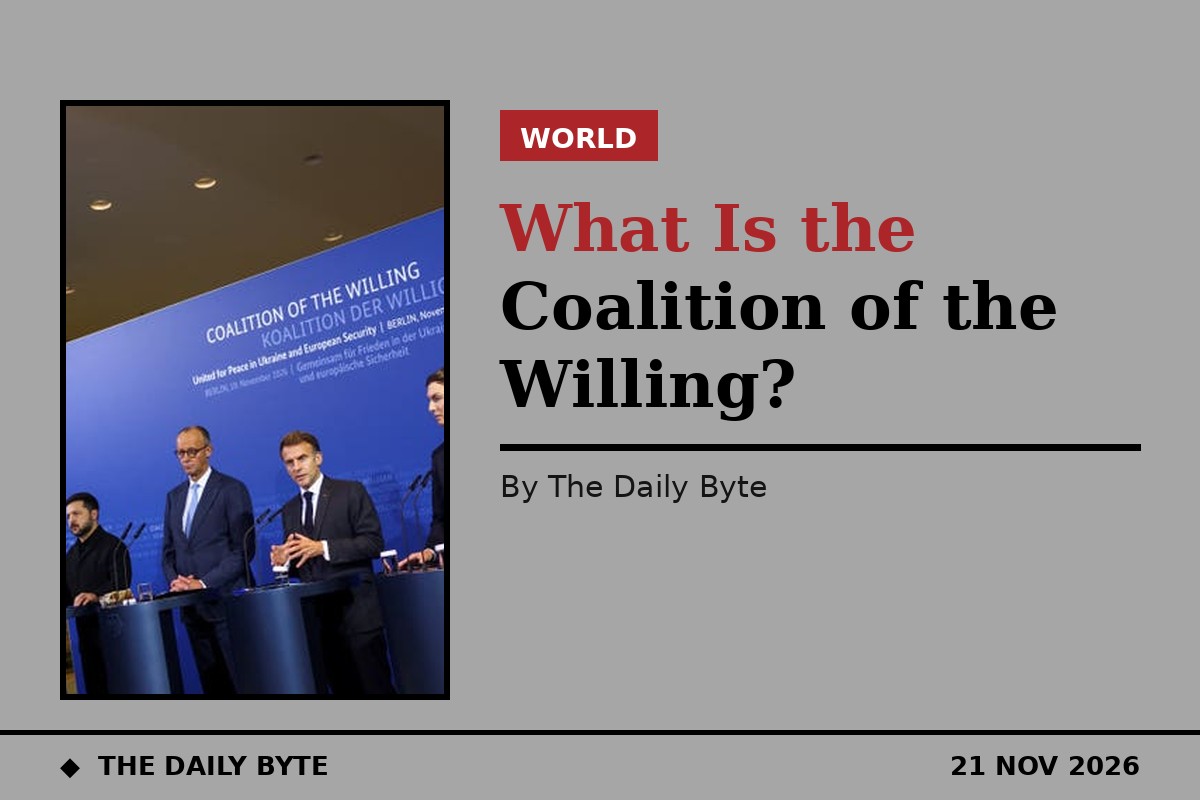
The Coalition of the Willing is a group of more than 30 countries, led jointly by France and the United Kingdom, that is planning the security guarantees Ukraine would receive once the war with Russia ends. It is not an army, a treaty organisation or part of NATO. It is a political and military planning forum: the place where Ukraine's supporters agree what they would do, together, to stop Russia attacking again after any ceasefire or peace deal. Its most concrete idea is a multinational force that would deploy in Ukraine, at Kyiv's request, once fighting has credibly stopped, backed by long-term support for Ukraine's own armed forces and by commitments to respond if Russia attacks again.
The group was set up in early 2025, as the United States under President Donald Trump pushed for a negotiated end to the war and European governments worried that a deal could be struck over their heads. It has met regularly ever since, most recently in Berlin on 19 November 2026, when leaders reaffirmed their commitment to what they call robust and legally binding security guarantees for Ukraine.
How did the Coalition of the Willing start?
The coalition's origins lie in a meeting of European leaders at the Elysee Palace in Paris on 17 February 2025, called by French President Emmanuel Macron to discuss the conditions for a just and lasting peace in Ukraine and the security guarantees that might accompany it. Two weeks later, on 2 March 2025, the then British prime minister, Keir Starmer, chaired a summit on Ukraine in London and announced the creation of a coalition of the willing to secure collective support for Kyiv and to contribute to the guarantees needed for an enduring peace.
The coalition held its first official meeting by video call on 15 March 2025, bringing together nearly 25 partner countries alongside the NATO secretary general, European Union leaders and representatives from Canada, Australia and New Zealand. That meeting laid the first foundations for a shared security-guarantee architecture, with two priorities: the sustainable development of Ukraine's military capabilities, and the preparation of a multinational reassurance force able to deploy on land, at sea or in the air once hostilities cease.
The group then became steadily more operational. On 10 July 2025, United States representatives took part for the first time, including the US special envoy, General Keith Kellogg, and Senators Lindsey Graham and Richard Blumenthal. At that meeting the leaders reaffirmed a pledge to provide at least 40 billion euros in military support for Ukraine in 2025. On 4 September 2025, a meeting in Paris chaired by President Macron and Prime Minister Starmer brought the membership to 35 countries, of which 26 had formally pledged security guarantees for Ukraine. On 6 January 2026, coalition members meeting in Paris with Ukraine and the United States present agreed the Paris Declaration, a common model for the guarantees. A 16th summit, held in Paris on 13 July 2026 and co-chaired by the French president, the British prime minister and the German chancellor, brought together 36 countries.
Who is in the Coalition of the Willing?
The coalition is jointly chaired by France and the United Kingdom. It brings together European Union member states, other European partners including Norway and Albania, and international partners and allies including Canada, Turkey, Japan, New Zealand and Australia. Ukraine itself sits at the table, and the NATO secretary general and European Union leaders take part. The United States is not a member, but American representatives have attended meetings since July 2025, and US special envoys Steve Witkoff and Jared Kushner attended the Berlin meeting in November 2026.
Membership is deliberately flexible. Countries contribute in different ways: some have pledged troops for a future force, others offer money, weapons, training, logistics, intelligence or air and naval support. That flexibility is the point of the name. Unlike NATO, where decisions are taken by consensus among all allies, the coalition is a group of the willing: states choose what they are prepared to do, and the group moves at the pace of those ready to act. The French foreign ministry describes it as a federator of countries determined to establish their support for Ukraine over the long term.
What security guarantees is it planning?
The coalition is the main forum for coordinating the security guarantees for Ukraine, and those guarantees rest on five components agreed in the Paris Declaration of 6 January 2026. First, participation in a US-led ceasefire monitoring and verification mechanism, to check that any halt in fighting actually holds. Second, long-term support for Ukraine's armed forces, in finance, equipment and cooperation, because Ukraine's own army is described by the coalition as its first line of defence. Third, a multinational force for Ukraine, deployed at Ukraine's request as soon as there is a credible cessation of hostilities. Fourth, commitments to support Ukraine if Russia attacks again, in order to restore peace. And fifth, commitments to deepen long-term defence cooperation with Ukraine.
The guarantees are designed to be politically and legally binding, and to be activated once a credible ceasefire enters into force. That sequencing matters to the coalition's members: they argue that a ceasefire without guarantees would simply give Russia time to rearm, and that Ukraine should not be asked to accept a deal that leaves it defenceless. The first pillar, the regeneration of Ukraine's armed forces, is treated as the most important: the aim is an army able not only to resist a fresh attack but to deter Russia from attempting one.
What is the Multinational Force for Ukraine?
The Multinational Force for Ukraine, known as the MNF-U, is the coalition's military arm. It would deploy on Ukrainian territory as a reassurance force, to deter any resurgence of Russian aggression, once a ceasefire or peace agreement has entered into force. It would operate on land, at sea and in the air, in Ukraine or in surrounding areas, and only at Ukraine's invitation. It is not a peacekeeping force in the United Nations sense: there is no UN mandate, and Russia, as a permanent member of the UN Security Council, would veto one. Moscow has also opposed the idea of European troops in Ukraine outright.
By September 2025, 26 countries had formally pledged to deploy troops as reassurance forces or to be present on the ground, at sea or in the air. Planning for the force is led by the United Kingdom and France, which have set up a joint operational headquarters. The force is already exercising. Exercise Koalicja 26.2, commanded by the United Kingdom and France, runs from 2 to 24 November 2026, with its key activities taking place from 9 to 22 November, and involves about 2,800 soldiers from 13 countries, according to the French foreign ministry. The exercise simulates logistics, force protection and the support needed for military training and the regeneration of Ukrainian forces, so that the force is ready to deploy if the Ukrainian government asks for it.
What happened at the Berlin meeting?
The coalition met in Berlin on Thursday 19 November 2026, bringing together the leaders of Germany, France, Britain, Poland and Italy, NATO Secretary General Mark Rutte, and the US envoys Witkoff and Kushner. The meeting was deliberately timed: only hours earlier, President Trump and Russian President Vladimir Putin had been expected to meet in China, alongside President Xi Jinping, and European governments were concerned that decisions affecting the war could be taken without European input.
According to German officials, the Berlin meeting focused on reaffirming a commitment to robust and legally binding security guarantees that would come into force following a ceasefire, alongside a comprehensive plan for economic reconstruction and preparations for the next round of multilateral negotiations. The day before, the European Commission had proposed a new 45 billion euro loan to Ukraine to help fill a funding gap of 70 billion euros for the following year. In a joint statement after the talks, the British, German, French and Ukrainian leaders said Ukraine needed robust and legally binding security guarantees in place once a ceasefire enters into force, which could include a European-led Multinational Force Ukraine composed of contributions from willing nations and supported by the United States.
President Trump phoned into the Berlin meeting after his talks in China, telling the assembled leaders that the war was a lose-lose for everybody and pointing to very significant casualties on the Russian side. His envoy Jared Kushner told the press conference afterwards that he believed Russia was now comfortable with post-war Ukraine having security guarantees based on NATO's Article 5, the principle that an attack on one ally is treated as an attack on all. Ukraine's President Volodymyr Zelenskyy said after the talks that cooperation between Europe, Ukraine and America in the negotiation process was becoming closer, and that Kyiv was counting on the American side to help organise the first multilateral meeting at team level, with full European participation, as soon as possible.
How is it different from NATO and the Ukraine Defense Contact Group?
The coalition is often confused with two other bodies, but it is distinct from both. NATO is a formal treaty alliance of 32 countries whose Article 5 commits members to collective defence; Ukraine is not a member, and NATO membership for Kyiv remains politically out of reach for now, which is precisely why the coalition's guarantees are being designed as an alternative. The coalition has no treaty, no headquarters of its own and no Article 5. What it offers instead is a network of political commitments and military plans, backed by the countries willing to make them.
The Ukraine Defense Contact Group, also known as the Ramstein group, is a separate coalition of countries coordinating military aid to Ukraine while the war continues. It deals with the present: weapons deliveries, training and funding for the fight now. The Coalition of the Willing deals mainly with the future: what happens the day after the fighting stops. The two work alongside each other, and the coalition says it coordinates with the contact group and with the European Union, but their jobs are different.
What happens next?
The coalition's plans only take effect if there is a ceasefire or peace agreement, and there is none yet. Russia has not agreed to a full and unconditional ceasefire, has opposed European troops in Ukraine, and has yet to agree to European participation in future rounds of talks. The coalition's answer is to keep preparing: the guarantees are already agreed in outline, the force is exercising, and the members say they are ready to implement them as soon as a credible cessation of hostilities arrives.
Whether that readiness deters Russia, or becomes the basis of a lasting settlement, will depend on negotiations the coalition does not control, above all the US-led talks with Moscow. What the coalition has changed, in the meantime, is the shape of the argument: instead of debating whether Ukraine should receive guarantees at all, its members are now debating what those guarantees should contain, who will provide them, and how they will be enforced. That is the question the coalition was created to answer, and it is the reason its meetings, from Paris in February 2025 to Berlin in November 2026, have become the central forum for planning Ukraine's post-war security.


