What Is the Conversion Practices Bill?
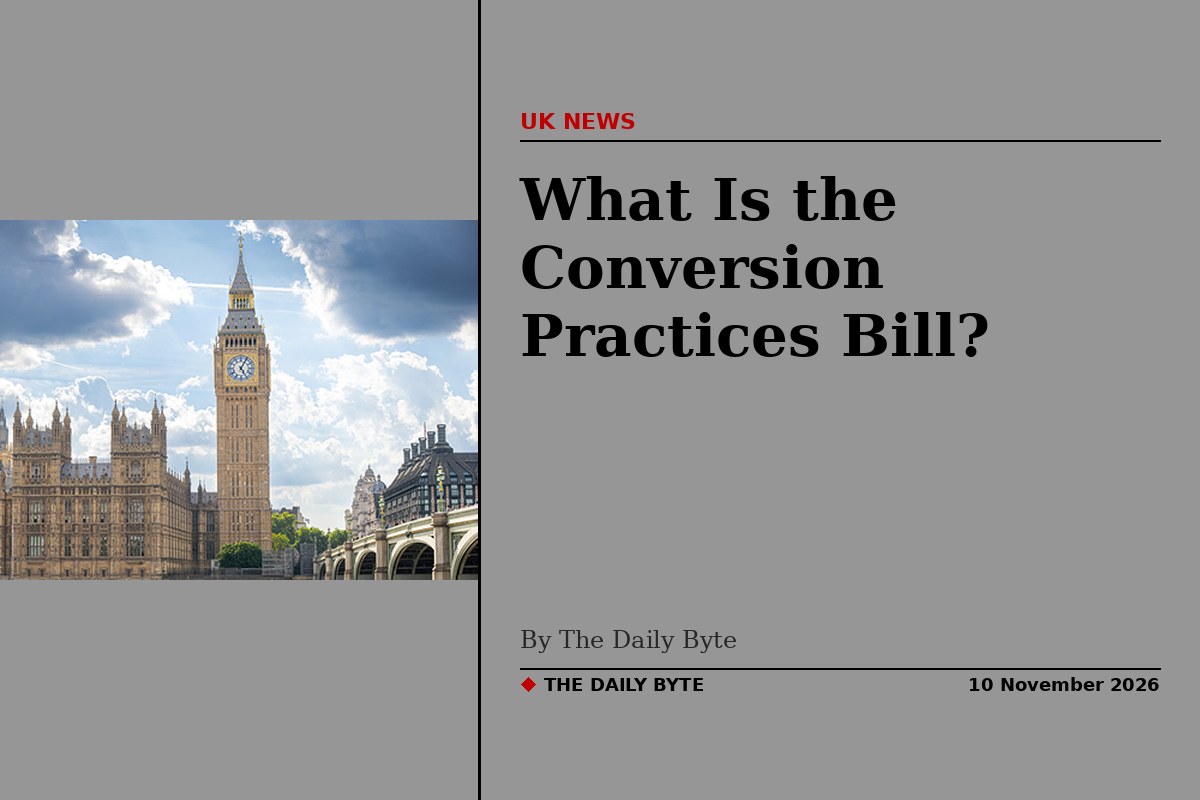
The draft Conversion Practices Bill is one of the most contested pieces of legislation before Parliament. Published in draft on 25 June 2026, it would create a new criminal offence of carrying out an abusive conversion practice in England and Wales, with a maximum sentence of five years in prison. Supporters say it would finally ban practices that try to change a person’s sexual orientation or gender identity. Critics, including a growing group of Labour MPs, say the draft as written could criminalise ordinary conversations between parents and their children.
This explainer sets out what the Bill is, what it would ban, what the penalties are, who is exempt, what both sides argue, and where it stands now.
What is a conversion practice?
The draft Bill defines a conversion practice as any conduct carried out with the intention of causing a person to have, or not to have, a particular sexual orientation or a “transgender identity”, or to believe that they have, or do not have, one. The definition is deliberately broad: it covers conduct, not only formal therapy, and it covers attempts to change either sexual orientation or gender identity.
Not every such practice would be a crime. The draft Bill creates an offence only where the practice is “abusive” and causes serious harm. Three things would all have to be proved beyond reasonable doubt: that the person acted with the intention of changing someone’s sexual orientation or transgender identity, or what they believe about it; that what they did amounted to abuse; and that the abuse caused serious harm to the person’s physical or mental health, or serious alarm or distress that had a substantial adverse effect on their day-to-day life.
Whether conduct is abusive is a question of fact for the court, judged on all the circumstances. The Bill asks courts to consider whether it involved sexual behaviour, violence or threats, control or coercion, or economic, psychological or emotional pressure. The Government’s explanatory notes equate “serious harm” with actual bodily harm or psychiatric injury, a high threshold that ministers say protects ordinary parenting and open conversation.
What offences would the Bill create?
The draft Bill, published as Bill CP 1604 by the Office for Equality and Opportunity, would create three new offences and a new civil order, applying in England and Wales only.
The principal offence is carrying out an abusive conversion practice. Tried in a magistrates’ court, it would carry up to 12 months’ imprisonment. Tried in the Crown Court, it would carry up to five years. That five-year maximum is the figure at the centre of the public debate, because critics say it is the sentence a parent could theoretically face for trying to dissuade a child from medical treatment.
The second offence is encouraging or assisting an abusive conversion practice carried out against a person outside England and Wales — in other words, helping to arrange conversion practices abroad. The third element is a new civil measure, the conversion practice protection order, which a court could impose to prevent serious harm before any criminal conviction. Breaching such an order without reasonable excuse would itself be a criminal offence carrying up to two years in prison. The Bill also makes provision for the liability of officers of a body corporate or unincorporated body where such a body commits an offence.
The draft Bill was published alongside a draft final-stage impact assessment, which the Government updated on 1 September 2026, and a draft equality impact assessment published on 27 August 2026. The Government’s impact assessment has itself been criticised: one estimate in it puts the benefit of the Bill at £783 million, on the assumption that the law would prevent all conversion practices.
Who would be exempt — and who would not?
The most disputed feature of the draft is what it does not contain. There is no express exemption for parents, nor for teachers, pastors, youth workers or anyone else acting in good faith. The only express carve-out in the draft protects medical professionals. Critics argue that this leaves parents exposed: a parent who confiscates a phone, cuts pocket money, refuses to buy a breast binder or tries to dissuade a teenager from pursuing medical treatment could, on their reading, be acting with the intention the Bill describes.
The Government disputes that reading. Ministers say the Bill is not about policing how parents parent, and that it does not criminalise beliefs or “explorative conversations”. The Equalities Minister, Simon Lightwood, wrote to the chair of the scrutinising committee on 13 October 2026 saying the legislation respected parents. Supporters of the Bill make the same point: the offence requires abuse and serious harm, and ordinary parenting — refusing a purchase on health grounds, raising concerns with a school, choosing a different school — involves none of the abusive conduct the Bill lists.
Ministers have also pointed to the Bill’s protections for legitimate healthcare. The exemption for medical professionals is intended to ensure that clinicians providing care in line with professional standards are not caught by the ban. But critics note that the exemption does not extend to therapists, counsellors or faith leaders, and that the assurances ministers have given about parental rights appear in letters and explanatory notes, not in the words of the Bill itself. A criminal court applies the words of the Act, not ministerial statements.
Why is the Bill so controversial?
The controversy has two roots. The first is the breadth of the definition. Earlier proposals for a ban focused on conversion “therapy”, a clinical setting. The draft Bill goes much wider: it covers “any conduct” with the relevant intention, in the family home, the therapist’s consulting room or a place of worship. Critics say that takes the criminal law into the most private settings there are. Supporters reply that abusive practices happen precisely in those settings, and that a narrow ban would leave victims unprotected.
The second root is the inclusion of “transgender identity”. The draft writes the concept into criminal statute and defines it loosely enough to include people who identify as neither male nor female. For critics, this is the provision that turns the Bill from a ban on abusive practices into a restriction on how parents, teachers and faith leaders may talk to children about gender. For supporters, it is essential: a ban covering sexual orientation but not gender identity would leave many of the people the law is meant to protect outside its scope.
The debate is sharpened by the findings of the Cass Review, the independent examination of NHS gender identity services for children and young people led by paediatrician Dr Hilary Cass, which found the evidence base for medical interventions to be weak. Critics of the Bill argue that it would deter the cautious, exploratory conversations the Cass Review called for. Supporters argue that the Bill targets abuse, not clinical exploration, and that properly conducted healthcare is protected.
What do supporters and critics say?
Supporters of the ban include LGBT+ organisations, which gave the first oral evidence to the scrutinising committee on 29 October 2026, describing experiences such as being forced to bathe in holy water. Humanists UK, which supports the Bill, has urged survivors, professionals and others with relevant experience to submit evidence to the committee before its deadline. The Equality Network in Scotland responded to the call for evidence on 6 November, calling for a stronger Bill and arguing that the protections should extend across the whole of the UK.
The Government’s case is that existing laws on domestic abuse, coercive control and communications do not cover all conversion practices, and that a clear and broad legal definition will help the police. It says the threshold of abuse and serious harm is high, and that the Bill reflects its manifesto commitment, made when the Government was elected in July 2024, to deliver a full, trans-inclusive ban on conversion practices. The commitment was reiterated in the King’s Speech in 2026.
Critics include campaign groups, faith organisations and a growing number of Labour MPs. The Evangelical Alliance, which opposes the Bill, says it takes a broad and sweeping approach that risks capturing legitimate parenting, prayer, pastoral support and ordinary conversations. The Free Speech Union argues that the Bill would criminalise well-intentioned conversations between parents and gender-questioning children, between therapists and the young people in their care, and between religious leaders and their congregations.
Inside the Labour Party, the pressure is mounting. At least a dozen Labour MPs have told party whips they are unhappy with the Bill, and have urged Prime Minister Andy Burnham to scrap it. Tonia Antoniazzi, the MP for Gower, said she feared the Bill would have a chilling effect on parents who want to give a child loving advice, and called on the Prime Minister to step in and drop the legislation. Lord Glasman, founder of the Blue Labour group, has also criticised the Bill. A former Labour health minister broke ranks in late October, warning that parents could be prosecuted for cautious and loving conversations with their own children. The Government insists parents would not be criminalised simply for questioning a decision by their child, and stresses that abuse would remain unlawful under any version of the law.
Where does the Bill stand now?
The draft Bill is not yet law, and it has not even been formally introduced to Parliament. It is undergoing pre-legislative scrutiny, the process by which Parliament examines a Bill in draft before its formal introduction. A 12-member Joint Committee of six MPs and six peers was appointed in September 2026 to carry out that scrutiny, chaired by Alex Barros-Curtis, the Labour MP for Cardiff West. Its members include MPs Olivia Bailey, Danny Beales, Marie Goldman, Naz Shah and Sir Jeremy Wright, and peers Lord Scriven, Baroness Brown of Silvertown, Baroness Browning, Lord Hope of Craighead, Lord Isaac and Baroness Prentis of Banbury.
The committee began taking oral evidence on 29 October and is taking written evidence until 5pm on Monday 16 November 2026. It has 12 weeks to consider the draft, hear witnesses and produce a report with recommendations, which it must deliver by 22 January 2027. The committee cannot amend the Bill; it can only recommend changes, which the Government will respond to before introducing a final Bill to Parliament. The Government has said legislation will follow when parliamentary time allows, without fixing an introduction date.
The Bill has a long history. Every prime minister since Theresa May has promised a ban on conversion practices. The Starmer government published the draft in the final days of its time in office, and the Burnham government has inherited it. A separate Bill to ban conversion practices is going through the Northern Ireland Assembly, introduced by Eóin Tennyson MLA on 30 June 2026, and the Scottish Government has said it is working with the UK Government to explore whether the Westminster Bill could be extended to Scotland.
What happens next?
The immediate deadline is 16 November, when the committee’s call for written evidence closes. After that, the committee will continue hearing witnesses and will publish its report by 22 January 2027. Its recommendations could include suggested drafting changes, and the Government will then decide whether to amend the draft before introducing it as a formal Bill.
The political question is whether the Bill survives in its current form. The revolt among Labour MPs leaves Burnham facing an early test of authority over a Bill he inherited rather than wrote, and the committee’s report will be the first formal verdict on whether the draft strikes the right balance between protecting people from abusive practices and protecting parents, therapists and faith leaders from prosecution for ordinary conversations. Until the Bill is introduced and passed, nothing in it is law — and anyone who wants to influence its shape has until 16 November to tell the committee so.