What Is COP30? Belem Climate Summit Explained
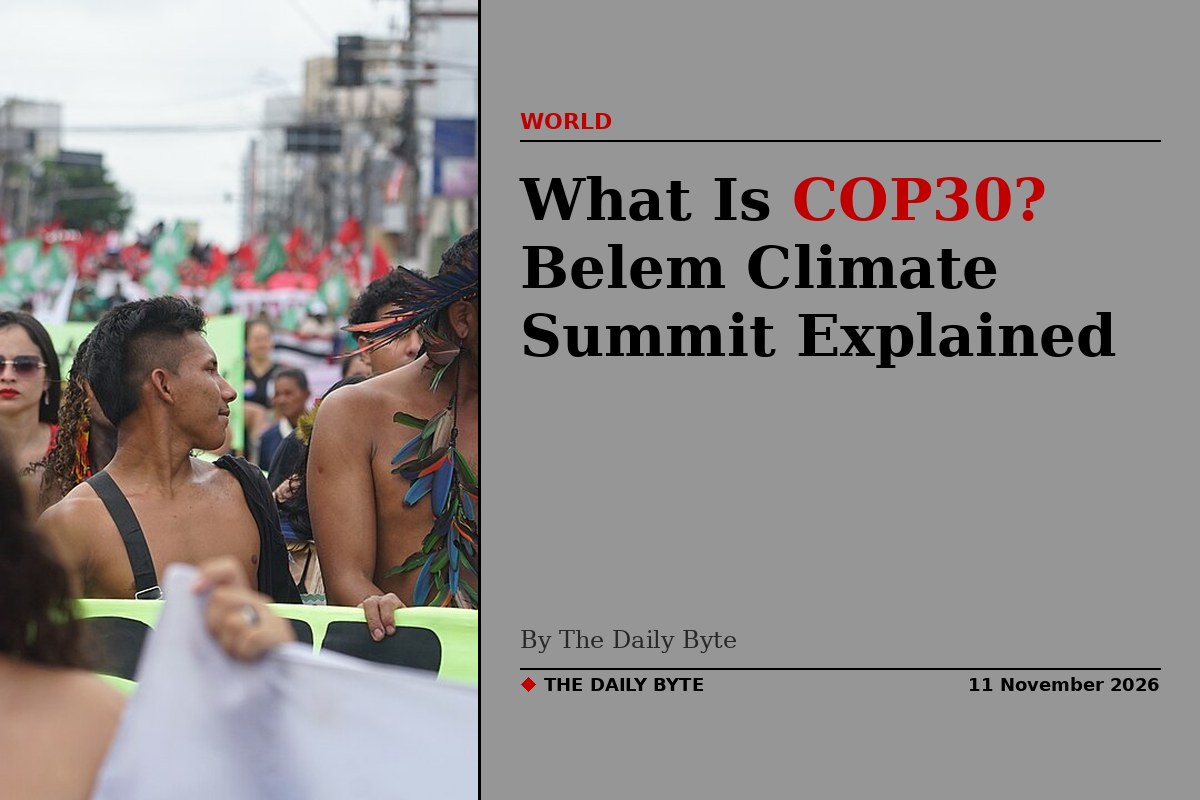
COP30 is the 30th United Nations Climate Change Conference, held in Belém, Brazil, from 10 to 21 November 2026. It brings together representatives of 198 parties to the UN Framework Convention on Climate Change (UNFCCC) to negotiate how the world turns climate pledges into action, ten years after the Paris Agreement was adopted and twenty years after the Kyoto Protocol entered into force.
This explainer answers the questions people are asking about COP30: what it is, where and when it is happening, what is on the agenda, what the key issues are, and what to watch for as the talks run to 21 November.
What does COP stand for?
COP stands for Conference of the Parties. The parties are the countries and the European Union that have signed the UN Framework Convention on Climate Change, the 1992 treaty under which the world negotiates its response to climate change. The conference meets every year to assess progress, agree new decisions and set the rules for climate action.
The first COP, COP1, was held in Berlin in 1995. Since then the conference has met annually, with two landmark agreements produced along the way: the Kyoto Protocol, adopted in 1997, and the Paris Agreement, adopted in 2015. COP30 is the thirtieth meeting in that series, and it is hosted by Brazil, which holds the COP30 presidency.
The conference is run by the UNFCCC secretariat, and the presidency is held by the host country. For COP30 the president is Brazilian diplomat André Corrêa do Lago, who has led the year-long presidency and chaired the negotiations in Belém.
Where and when is COP30?
COP30 is being held in Belém, the capital of the Brazilian state of Pará, at the edge of the Amazon rainforest. The main negotiations run from 10 to 21 November 2026. World leaders gathered in Belém earlier, on 6 and 7 November, for a leaders’ summit that opened the conference.
Belém was chosen deliberately. Brazil has presented COP30 as the “nature COP”, using a host city close to the Amazon to put forests, biodiversity and the people who live in and protect tropical forests at the centre of the talks. It is the first time a COP has been held in the Amazon region.
The European Union and its member states are among the 198 parties to the Convention, which counts 197 countries plus the EU. The EU delegation in Belém is led by the European Commission and the Danish presidency of the Council of the EU, and the EU was represented at the leaders’ summit by European Council President António Costa and European Commission President Ursula von der Leyen.
Why does COP30 matter?
COP30 matters because it marks two anniversaries and a shift in the climate process. It is ten years since the Paris Agreement was adopted, and twenty years since the Kyoto Protocol entered into force. The Paris Agreement committed countries to holding the rise in global temperature to well below 2°C above pre-industrial levels, and to pursuing efforts to limit it to 1.5°C.
The Brazilian presidency has framed COP30 as the conference of implementation: the point at which countries stop making new promises and start showing how they will deliver on the ones they have already made. That matters because the gap between pledges and action is still wide. The UNFCCC’s 2025 synthesis report found that 89 per cent of countries now include economy-wide targets in their climate plans, but that current pledges would cut emissions by only 17 per cent below 2019 levels by 2035, far short of the 60 per cent reduction needed to stay within 1.5°C.
The summit is also taking place against a difficult backdrop of geopolitical tension and economic uncertainty, which has made agreement harder at recent COPs. The presidency has argued that the conference is a chance to rebuild trust and reaffirm commitment to multilateral action on climate change.
What is on the COP30 agenda?
The Brazilian presidency set out six pillars for the COP30 agenda, covering mitigation, adaptation and the means of implementation. They are: transitioning energy, industry and transport; stewarding forests, oceans and biodiversity; transforming agriculture and food systems; building resilience for cities, infrastructure and water; fostering human and social development; and unleashing enablers and accelerators, including finance, technology and capacity building.
Three priorities run through the agenda. The first is implementation, turning climate pledges into real-world action through the Global Stocktake, the process that assesses collective progress towards the Paris goals. The second is inclusion, with more than 3,000 Indigenous representatives attending COP30, the largest Indigenous presence at a climate summit, alongside new bodies such as the International Indigenous Commission and the Circle of Indigenous Leadership. The third is innovation, including new approaches to climate finance and to measuring resilience.
What are the key issues at COP30?
National climate plans, known as nationally determined contributions or NDCs, are one of the main focuses. Under the Paris Agreement each country must submit an NDC setting out how it will cut emissions and adapt to climate change, and update it every five years. COP30 is assessing the third round of these plans, known as NDCs 3.0, which set targets for 2035.
The EU approved its updated NDC on 5 November 2025. It restates the EU’s goal of cutting net greenhouse gas emissions by 55 per cent by 2030 compared with 1990, and adds an indicative contribution of a 66.25 to 72.5 per cent cut by 2035, on the path to climate neutrality by 2050. The EU’s net emissions fell by 37 per cent between 1990 and 2023 even as its economy grew by 68 per cent.
Climate finance is the second big issue. The presidency has launched the Baku-to-Belém Roadmap, which aims to mobilise 1.3 trillion US dollars a year by 2035 for climate action in developing countries, far above the 300 billion dollar goal agreed at COP29. The EU, the world’s largest provider of climate finance, contributed 31.7 billion euros from public sources in 2024 and mobilised a further 11 billion euros in private finance.
Forests are the third. Brazil has proposed the Tropical Forests Forever Facility, a 125 billion dollar fund that would use returns from a sovereign fund to pay countries that preserve their tropical forests, with 20 per cent of the money earmarked for Indigenous peoples. The EU’s Council president welcomed the launch of the facility at the leaders’ summit in Belém.
The energy transition is the fourth. At COP28 in Dubai in 2023, more than 100 countries agreed to triple renewable energy capacity by 2030 and to transition away from fossil fuels. COP30 is expected to work on a roadmap for that transition, with countries assessing their energy systems up to 2028 and accelerating renewable deployment through the early 2030s.
What has happened so far at COP30?
World leaders gathered in Belém on 6 and 7 November for the summit that opened COP30. European Council President António Costa told the opening session that the conference was taking place at a decisive moment, and that the window of opportunity to act and avoid irreversible impacts on humanity and nature was closing fast. He reaffirmed the EU’s commitment to the Paris Agreement and to limiting the temperature rise to 1.5°C.
The main negotiations opened on 10 November and run to 21 November. Delegates are now working through the six pillars of the presidency’s agenda, with the aim of reaching decisions on mitigation, adaptation, finance and forests before the conference closes.
What should we watch for?
Watch whether countries agree a decision on the energy transition roadmap, and whether the final text keeps the 1.5°C goal at its centre. Watch the finance negotiations, and whether the Baku-to-Belém Roadmap’s 1.3 trillion dollar ambition is backed by concrete commitments from governments and from private finance.
Watch the forests file, including whether the Tropical Forests Forever Facility is adopted and funded, and whether the deforestation roadmap that Brazil proposed is agreed. And watch the final assessment of the new NDCs, which will show whether the world’s updated climate plans are enough to keep the Paris goals within reach, or whether a further round of ambition will be needed.
Frequently asked questions
What is COP30? The 30th United Nations Climate Change Conference, held in Belém, Brazil, from 10 to 21 November 2026, where 198 parties to the UN climate convention negotiate climate action.
What does COP stand for? Conference of the Parties, meaning the parties to the UN Framework Convention on Climate Change, the treaty that governs the global response to climate change.
Where is COP30 being held? In Belém, the capital of Pará state in Brazil, at the edge of the Amazon rainforest. World leaders met there on 6 and 7 November, and the main negotiations run from 10 to 21 November.
What is the 1.5°C goal? The Paris Agreement’s aim of limiting the rise in global temperature to 1.5°C above pre-industrial levels. Current pledges are projected to cut emissions by only 17 per cent below 2019 levels by 2035, far short of the 60 per cent needed.
What are NDCs? Nationally determined contributions: each country’s climate action plan under the Paris Agreement, updated every five years. COP30 is assessing the third round of plans, which set targets for 2035.
What is the Tropical Forests Forever Facility? A proposed 125 billion dollar fund that would pay countries to preserve their tropical forests, with 20 per cent of the money earmarked for Indigenous peoples.
Sources: European Council and BMO Capital Markets.


