What Is COP31? Antalya Climate Summit Explained
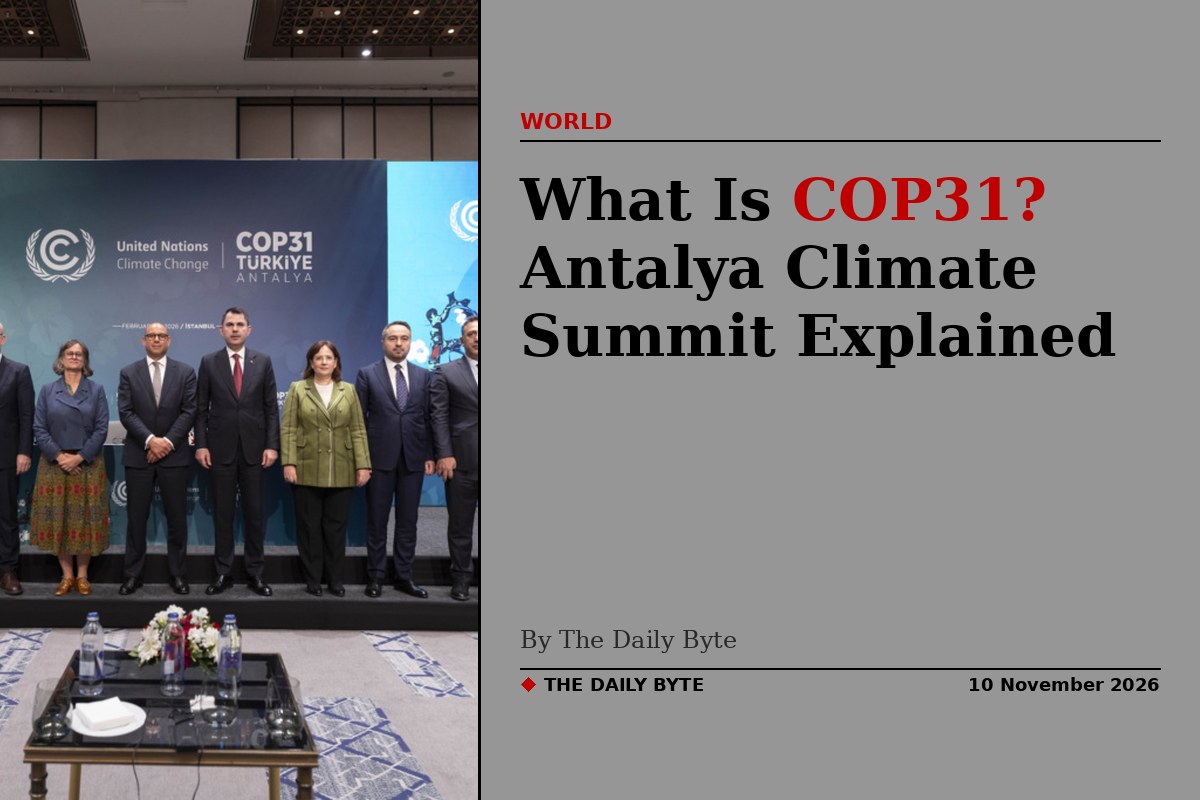
COP31 is the 31st United Nations climate conference, the annual meeting where almost every country in the world negotiates how to tackle climate change. It is taking place in Antalya, Türkiye, from 9 to 20 November 2026, with representatives of more than 190 countries attending. It matters because it is the first COP since scientists confirmed that the world is on track to exceed the Paris Agreement's 1.5°C warming threshold, and because it is presented by its hosts as a summit about putting existing promises into practice, rather than making new ones.
This guide explains what COP31 is, who is running it, what is on the agenda, what the UK and Pakistan want from it, and what it can realistically achieve.
What does COP stand for?
COP stands for Conference of the Parties. The parties are the countries that have signed up to the United Nations Framework Convention on Climate Change, known as the UNFCCC, the international treaty agreed in 1992 that is the parent treaty of the 2015 Paris Agreement.
Each COP is the main decision-making meeting of that treaty. Governments assess progress, negotiate new rules and commitments, and announce national climate plans. The talks produced the Paris Agreement at COP21 in Paris in 2015, when countries committed to keeping global warming well below 2°C above pre-industrial levels and pursuing efforts to limit it to 1.5°C.
COPs now extend well beyond government negotiations. Businesses, scientists, Indigenous Peoples, young people and civil society take part, reflecting the scale of the challenge. As the UN's Special Adviser on Climate Action and Just Transition, Selwin Hart, told UN News before the summit, there is now a clear recognition that addressing the climate crisis requires all hands on deck.
COP31 at a glance
- What: The 31st Conference of the Parties to the UNFCCC, the annual UN climate summit.
- When: 9 to 20 November 2026. The World Leaders Summit is scheduled for 11 and 12 November.
- Where: Antalya, Türkiye, at the Antalya Expo Centre.
- Who is in charge: Türkiye holds the COP31 presidency and hosts the conference. Murat Kurum, Türkiye's Minister for the Environment, Urbanisation and Climate Change, is COP31 President. Australia leads the negotiations, with Chris Bowen, Australia's Minister for Climate Change and Energy, as President of Negotiations.
- Who attends: Delegations from the UNFCCC's 198 parties, including heads of state and government, ministers, negotiators and representatives of public administrations, businesses and civil society.
- What it is billed as: A COP of implementation and acceleration, with an emphasis on turning climate commitments into bankable projects.
- What it will launch: The second global stocktake, the Paris Agreement's formal process for assessing collective progress towards its long-term goals.
The split leadership is unusual. It is the first time a COP has been jointly presided over by two countries in this way, after neither Türkiye nor Australia wanted to give up hosting. Türkiye is responsible for the Action Agenda, the practical programme of initiatives outside the formal negotiations, while Australia leads the formal negotiating texts and decisions.
Why does COP31 matter this year?
The context is stark. The United Nations says 2026 has been marked by catastrophic floods, deadly heatwaves and prolonged drought, in a year in which scientists confirmed that the world is on track to exceed the Paris Agreement's 1.5°C warming threshold. The UN also notes that a powerful El Niño is expected to intensify climate impacts further.
That does not mean the 1.5°C goal has been abandoned. Scientists warn that the world is set to temporarily exceed the threshold, a situation known as overshoot, but that how far temperatures rise, and for how long, still depends on the choices governments, businesses and societies make now. Selwin Hart put it plainly to UN News: overshoot is not surrender, and it should lead to a much greater degree of urgency.
There are also reasons for cautious optimism, according to the UN. Clean energy technologies are advancing faster than ever. In 2025, one in four new cars sold worldwide was electric, up from fewer than one in 100 a decade earlier, and that share is expected to reach 28 per cent in 2026. The world added more than 600 gigawatts of solar power capacity in 2025, accounting for over three-quarters of new renewable power capacity. Global battery storage capacity is now 11 times higher than in 2021.
The problem COP31 is being asked to solve is not a lack of solutions, but a lack of access to them. Emerging and developing economies outside China, home to nearly two-thirds of the world's population, received just 18 per cent of global clean energy investment in 2025. Africa, despite enormous renewable energy potential, attracts only a small share of global investment, while around 600 million people still lack access to electricity. Financing renewable energy in developing countries can cost several times more than in wealthier nations, even when the technology is identical.
What is on the agenda in Antalya?
Several major issues remain unresolved from earlier COPs, and they form the core of the formal negotiations.
Climate finance. Developing countries want wealthier nations to fulfil their financial commitments under the Paris Agreement, while disagreements persist over funding responsibilities, access to finance and how global financial flows can be directed towards climate action. African negotiators at COP31 have said the summit must deliver grant-based climate finance, with Africa needing up to $1.6 trillion by 2030, according to reporting from the summit. Finance that adds to heavy debt burdens is a particular concern for countries already struggling to invest in healthcare, education and climate protection.
Just transition. Countries agreed last year to establish a mechanism to support the shift to cleaner economies, but still need to decide how it will work in practice, including who it helps and how it is funded.
Adaptation. Negotiators will continue work on measuring progress on adaptation, while developing countries press for greater financial support to cope with impacts that are already happening, from floods to droughts.
Cutting emissions. Governments remain divided over how to strengthen emissions action and deliver on existing commitments, including how to close the gap between national climate plans and the Paris Agreement goals.
Alongside the negotiations, the Action Agenda is built around practical themes: accelerating electrification, turning climate commitments into bankable projects, mobilising public and private finance, strengthening climate adaptation and protecting oceans. Türkiye is promoting initiatives on clean energy, food security, resilient cities, greener industries, oceans and waste reduction.
One headline initiative is the 35 by 35 Global Electrification Pledge, which seeks a global commitment to raise electricity's share of final energy consumption to 35 per cent by 2035, up from about 23 per cent now. The summit will also address implementation of the Belém-Addis Vision on Adaptation and access to resources from the Fund for Responding to Loss and Damage, the fund set up to help countries hit by climate disasters.
What does the UK want from COP31?
The UK government's published priorities for COP31, set out in a policy explainer by the Department for Energy Security and Net Zero, emphasise global 1.5°C commitments, rapid electrification, super-pollutant reduction, ecosystem protection and climate adaptation finance. In practice, that means the UK is pressing for faster progress on clean power, for action on short-lived pollutants such as methane that warm the planet quickly, and for finance that reaches the countries most exposed to climate impacts.
Pakistan's interest is closely tied to finance and loss and damage. Prime Minister Shehbaz Sharif travelled to Antalya for COP31, leaving Islamabad on Tuesday 10 November, while Deputy Prime Minister Ishaq Dar remained in Islamabad to open the Margalla Dialogue. Pakistan is among the countries most exposed to climate extremes, including floods, and has a direct stake in whether the Loss and Damage Fund delivers money quickly and in grant form rather than as loans.
Australia, as President of Negotiations, faces a credibility test of its own. As COP31 opened in Antalya, 37 Australian and Pacific groups said Australia must show leadership on climate finance and fossil fuel levies, given its role in leading the talks and its close work with Pacific Island countries, for whom rising seas are an immediate threat.
What happened at COP30?
COP30 was held in Belém, Brazil, in November 2025, and marked ten years since the Paris Agreement was reached. It was largely viewed as a failure by many observers, because it did not produce the stronger commitments on emissions and finance that many countries and campaigners had sought.
That history shapes COP31. The hosts have deliberately framed Antalya as a summit about delivery rather than declaration, and the UN's climate adviser has said he is running a personal campaign to rename the Action Agenda the Implementation Agenda, to underline the need to move beyond promises. Whether that framing survives two weeks of negotiation will only become clear when the final texts are agreed, often after days of difficult discussion and last-minute compromise.
What can a COP actually achieve?
A COP is often judged by the agreement reached at the end, but the UN argues that tells only part of the story. Selwin Hart identifies three ways these conferences can make a difference: negotiated agreements, where countries seek consensus on finance, emissions reductions and adaptation; the Action Agenda, where governments, development banks, businesses and civil society work together on practical solutions, from expanding renewable energy to reducing methane emissions; and national commitments, where countries use COPs to announce actions at home, including new climate plans and contributions to climate funds.
There are limits. Decisions at a COP are generally reached by consensus, which means any one country can block an outcome. Geopolitical divisions often make ambitious outcomes difficult. And a COP cannot, on its own, build a solar farm, cut a country's emissions or pay for flood defences. What it can do is set rules, unlock finance and create political pressure that makes those things more likely.
As the UN puts it, COP31 will not solve the climate crisis in two weeks. But it could help remove some of the barriers standing between the solutions that already exist and the people who need them.
Frequently asked questions
Is the United States taking part in COP31? The United States will not be involved in the talks, having left the Paris Agreement at the start of the year. That absence is one of the geopolitical complications facing the summit, although the UNFCCC process continues with the remaining parties.
When will we know what COP31 decided? The summit runs until Friday 20 November 2026. Final decisions are usually agreed in the closing days, and talks can run beyond the scheduled end if negotiators have not reached consensus.
Does COP31 set binding targets for each country? No, not in the way a domestic law does. Countries negotiate collective decisions and submit their own national climate plans, known as nationally determined contributions. The global stocktake assesses collective progress, but each country's plan remains its own commitment.
What is the global stocktake? It is the Paris Agreement's formal process for assessing collective progress towards its long-term goals. COP31 will launch the second stocktake, following the first, which concluded at COP28.
What is the 35 by 35 pledge? It is an initiative promoted at COP31 to increase electricity's share of global final energy consumption to 35 per cent by 2035, up from about 23 per cent now, by accelerating electrification of transport, heating and industry.
Why is it in Antalya? Türkiye is hosting and presiding over COP31, while Australia leads the negotiations. Antalya, on Türkiye's Mediterranean coast, is the venue, with the main sessions at the Antalya Expo Centre.
Sources: United Nations, COP31 explained, 5 November 2026; Global Landscapes Forum, What is COP31?, 5 November 2026; Iberdrola, COP31.


