What Is CUSMA? The USMCA Trade Deal Explained
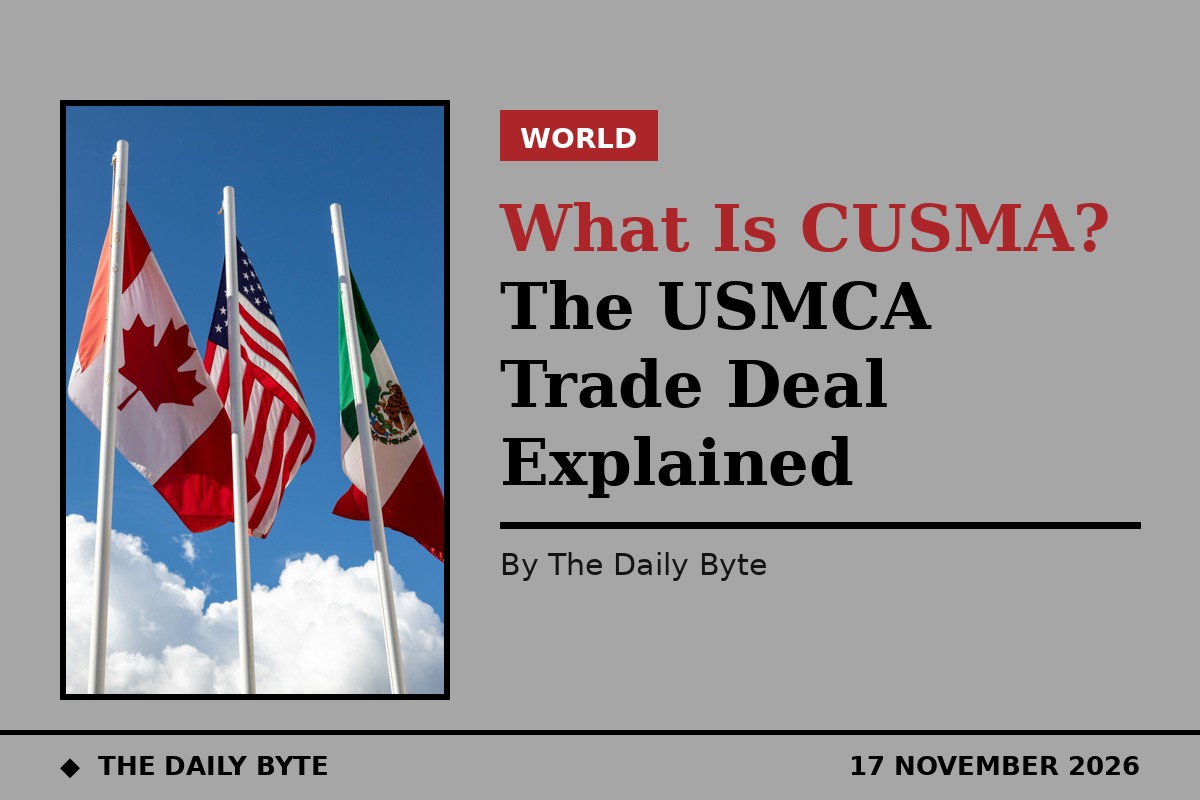
CUSMA is the Canada-United States-Mexico Agreement, the free trade deal that governs almost all trade between the three North American countries. In the United States it is called the USMCA, and in Mexico it is known as the T-MEC. It entered into force on 1 July 2020, replacing the North American Free Trade Agreement (NAFTA), and it covers a market of more than 500 million people.
The agreement matters because it decides which goods cross North American borders without tariffs, how cars must be built to qualify for duty-free treatment, and how trade disputes between the three countries are settled. In 2026 it reached its first formal joint review, and the three governments could not agree to renew it for another 16 years — so it now faces a review every year until it expires in 2036 unless all three countries agree to extend it.
What does CUSMA stand for?
CUSMA stands for the Canada-United States-Mexico Agreement. The same treaty has a different name in each country: Canada calls it CUSMA, the United States calls it the United States-Mexico-Canada Agreement (USMCA), and Mexico calls it the Tratado entre Mexico, Estados Unidos y Canada, or T-MEC. In French, Canada's other official language, it is the Accord Canada-Etats-Unis-Mexique (ACEUM).
The three names describe one agreement. It was signed by the three countries on 30 November 2018, amended by a protocol of amendment agreed on 10 December 2019, and entered into force on 1 July 2020 after each country completed its domestic ratification procedures. In Canada, the implementing legislation received royal assent on 13 March 2020, and in the United States Congress approved the implementing legislation in December 2019.
The deal is a large one. According to the Congressional Research Service, it is composed of 34 chapters and 12 side letters. It governs a free trade zone with a total population of more than 510 million people and an economy of about US$31 trillion in nominal GDP — nearly 30 per cent of the global economy, and the largest of any trade bloc in the world. The Government of Canada describes it as preserving the long-standing trading relationship between the three parties while adding new provisions on 21st-century trade issues for the nearly half a billion people who call North America home.
What did CUSMA replace — and what changed from NAFTA?
CUSMA replaced NAFTA, the North American Free Trade Agreement, which had been in force since 1 January 1994. Much of NAFTA was carried forward, but CUSMA modernised the deal in several important ways. NAFTA was negotiated before the internet became central to commerce, so it contained no chapter on digital trade. CUSMA added one, along with stronger rules on labour, the environment, intellectual property and cars.
The biggest changes were in the motor vehicle sector, in dairy, and in the way labour and environmental standards are enforced. Unlike NAFTA, CUSMA's labour and environment chapters are fully enforceable through the agreement's dispute settlement system. It also prohibits the import of goods produced by forced labour, and it added a currency chapter designed to reinforce transparency and stability in exchange-rate policy.
On intellectual property, CUSMA strengthened copyright protection and provides 10 years of data protection for biologic drugs, along with new protections against the theft of trade secrets. Canada also agreed under the deal to extend its general term of copyright protection from 50 years after the life of the author to 70 years, with a transition period running to the end of 2022.
The car rules: 75 per cent North American content
The most consequential change for manufacturers is the rules of origin for motor vehicles. Under NAFTA, 62.5 per cent of a vehicle's value had to originate in North America for it to qualify for tariff-free treatment. CUSMA raised that threshold to 75 per cent.
It also added a labour value content rule: 40 to 45 per cent of a vehicle's content must be made by workers earning at least US$16 an hour. And 70 per cent of a vehicle's steel and aluminium must originate in North America, with steel required to be melted and poured in North America. These rules were designed to encourage more vehicle and parts production inside the three countries, and particularly in the United States, and they are the provisions most often raised in the current review debate.
For businesses, the practical effect is that a car assembled in Mexico from mostly Asian parts no longer qualifies for duty-free access to the United States or Canada. Companies must track where their parts come from and how much their workers are paid, and certify that their vehicles meet the thresholds. The three countries issued joint uniform regulations on origin procedures and rules of origin to explain how the system works in practice.
Dairy, digital trade and workers' rights
On dairy, CUSMA gave the United States tariff-free access to about 3.6 per cent of the Canadian dairy market, up from 3.25 per cent under the never-ratified Trans-Pacific Partnership. Canada also agreed to eliminate its Class 7 pricing provisions on certain dairy products. But Canada's domestic supply management system — the system of production quotas and import controls that governs Canadian dairy, poultry and eggs — remains in place, and dairy access is still one of the most sensitive issues in the review.
The digital trade chapter is new. It prohibits customs duties on products transmitted electronically, protects cross-border data flows, and limits requirements to store data in a particular country. For online businesses, that means a software product or digital service sold from one CUSMA country to another cannot be hit with a customs duty simply because it crosses a border electronically.
On labour, the parties must adopt, maintain and enforce laws relating to the International Labour Organization's Declaration on Principles and Rights at Work. The agreement also includes a rapid response mechanism for labour disputes at specific facilities in Mexico, which has been used to address claims that workers were denied their rights. The environment chapter, Chapter 24, is a dedicated chapter with binding and enforceable dispute resolution, and it is complemented by a separate Environmental Cooperation Agreement.
How are disputes settled under CUSMA?
CUSMA kept a state-to-state dispute settlement system, so one government can bring a complaint against another if it believes the agreement has been broken. It also kept a binational panel system for trade remedy disputes — cases about anti-dumping and countervailing duties — which was a feature of NAFTA that Canada insisted on retaining.
What changed is investor-state dispute settlement. Under NAFTA, a company could sue a foreign government directly if it believed its investment had been treated unfairly. CUSMA largely eliminated that system between the United States and Canada, and narrowed it sharply for Mexico. Companies must now generally rely on domestic courts or on their own government to raise a dispute.
The 2026 review and the sunset clause: what happened on 1 July 2026?
CUSMA contains an unusual provision that no earlier United States trade agreement had: a built-in review and term extension mechanism, often called the sunset clause. It is Article 34.7 of the agreement. Under it, the agreement is set to expire automatically after 16 years, on 1 July 2036, unless the three parties agree to extend it.
The mechanism required the Free Trade Commission — the three trade ministers — to meet on the sixth anniversary of entry into force, 1 July 2026, and decide whether to extend the term. If all three confirmed in writing that they wished to continue, the term would reset to 16 years from that date, running to 2042, and the next review would fall six years later. If any party declined, the agreement would not end, but the Commission would have to conduct a joint review every year for the remainder of the original 16-year term.
That is what happened. On 1 June 2026, Canada formally asked the United States and Mexico to renew the agreement for another 16 years. At the virtual meeting of the Free Trade Commission on 1 July 2026, Canada and Mexico each confirmed their support for a 16-year extension. The United States did not. United States Trade Representative Jamieson Greer told his counterparts, Canada's Dominic LeBlanc and Mexico's Economy Secretary Marcelo Ebrard, that the United States would not renew the agreement in its current form. The agreement stays in force, with all tariff preferences, rules of origin and dispute settlement intact, but the three countries must now hold a joint review every year until they all agree to extend it or the agreement expires on 1 July 2036.
Separately, Article 34.6 allows any party to withdraw from the agreement on six months' written notice at any time. That power exists independently of the review process, and no party has used it.
What is at stake in the annual reviews?
Reporting on the review indicates the United States is using it to press for tighter rules of origin for cars — with suggestions of an 82 per cent North American content requirement, half of it American — as well as greater access to Canada's supply-managed dairy market and an end to provincial liquor bans in Canada. Canada has already given up its digital services tax and most of its counter-tariffs, and talks with the United States were reported frozen since 22 August 2026, with the next formal checkpoint expected on 1 July 2027.
In November 2026, Canadian Prime Minister Mark Carney and Mexican President Claudia Sheinbaum used the APEC summit to publicly unite behind renewing CUSMA, underlining that the two countries see the deal as worth defending together. For businesses, the annual review cycle means a longer period of uncertainty: investment decisions about where to build factories, source parts and hire workers now have to be made against the possibility that the agreement could lapse in 2036 if no extension is agreed.
Under United States law, the trade representative must report to the House Ways and Means and Senate Finance committees at least 70 days before each annual review in which a country has not confirmed an extension, and must brief those committees within 20 days after the parties meet.
Why does CUSMA matter for ordinary people?
For consumers, CUSMA is one reason many goods move between the three countries without tariffs, which keeps prices lower than they would otherwise be. It also raised the duty-free limit for Canadians buying goods online from the United States, and it affects the price and availability of cars, dairy products, medicines and digital services.
For workers, the labour value content rule and the enforceable labour chapter were designed to link trade benefits to wages and working conditions, so that companies cannot undercut higher-paid workers simply by moving production. For farmers, the dairy provisions remain contentious in Canada, where supply management is a politically sensitive system, and in the United States, where dairy farmers want more access to the Canadian market.
The short answer to "what is CUSMA" is therefore a practical one: it is the rulebook for trade across North America. It is in force, it is not expiring imminently, but its long-term future is now decided one year at a time.
Frequently asked questions about CUSMA
Is CUSMA the same as USMCA? Yes. CUSMA, USMCA and T-MEC are three names for the same agreement. Canada calls it CUSMA, the United States calls it the USMCA, and Mexico calls it the T-MEC.
Did CUSMA expire on 1 July 2026? No. The agreement remains fully in force until at least 1 July 2036, with all tariff preferences, rules of origin and dispute settlement intact. What changed on 1 July 2026 is that the United States declined to extend it for a further 16 years, so the parties must now hold a joint review every year.
When does CUSMA expire? The agreement expires on 1 July 2036 unless all three countries agree to extend it. If they do agree, the term resets for another 16 years.
What replaced NAFTA? CUSMA replaced the North American Free Trade Agreement (NAFTA), which had been in force since 1 January 1994. CUSMA entered into force on 1 July 2020.
Can a country leave CUSMA? Yes. Article 34.6 of the agreement allows any party to withdraw on six months' written notice. No party has done so.
Sources: Government of Canada — The Canada-United States-Mexico Agreement (CUSMA) Environment Chapter; Congressional Research Service — U.S.-Mexico-Canada (USMCA) Trade Agreement.


