What Is Delimitation in India? Explained
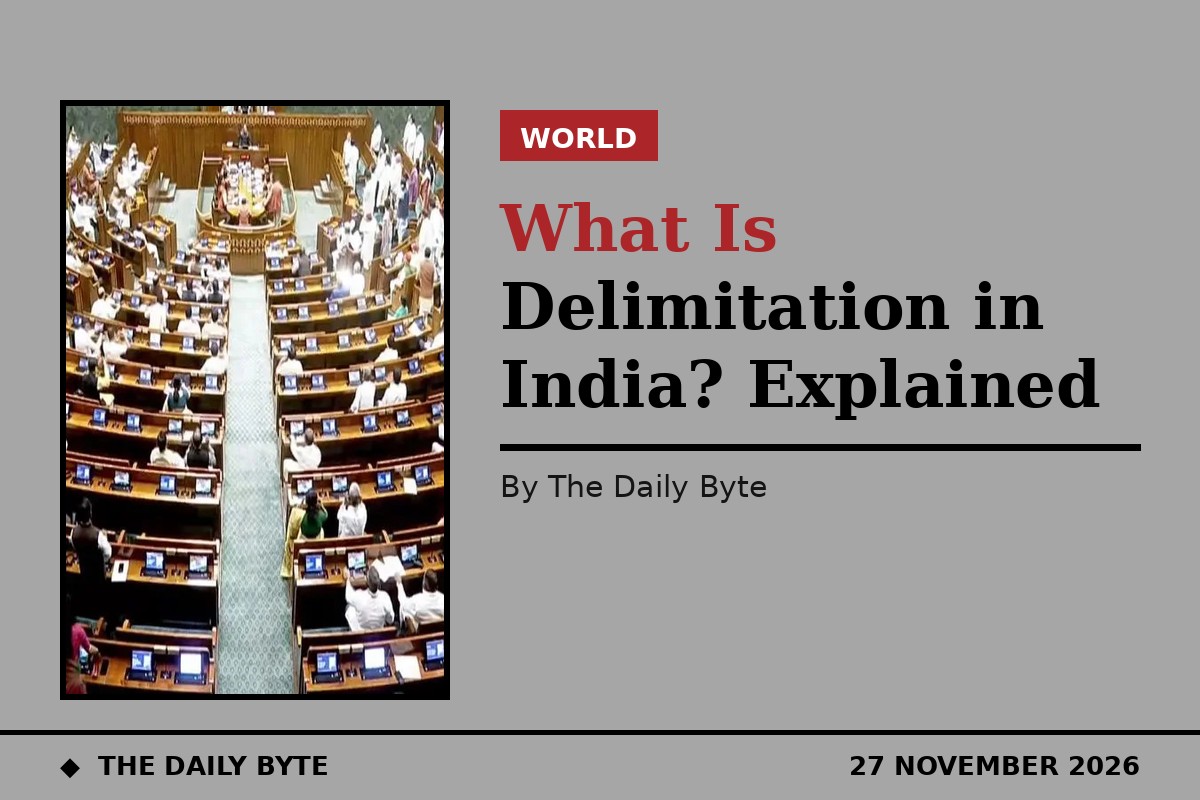
Delimitation is the redrawing of the boundaries of parliamentary and assembly constituencies in India, and, where the Constitution allows it, a change in how many seats each state gets. It is back at the centre of Indian politics because the Union Cabinet cleared a fresh delimitation-linked bill on Friday 27 November 2026, days before a special sitting of Parliament starting on 30 November. The bill proposes a uniform 50 per cent rise in Lok Sabha seats in every state, from 543 to around 815, and it is tied to the long-delayed promise of reserving one third of seats for women. This explainer sets out what delimitation is, why India has avoided a full exercise for decades, what the new plan would change, and what happens next.
What does delimitation mean?
In simple terms, delimitation means drawing the map of who votes where. India is divided into constituencies, and each constituency elects one member to the Lok Sabha, the lower house of Parliament, and one member to its state assembly. As populations grow and shift, some constituencies end up with far more voters than others, so the boundaries need to be redrawn to keep representation roughly equal. Delimitation is the legal process that does that. It is carried out by a Delimitation Commission, an independent body set up under a Delimitation Act, and its orders have the force of law and cannot be challenged in court. The commission looks at population figures from the census, redraws constituency boundaries, and reserves seats for scheduled castes and scheduled tribes in proportion to their population. Delimitation can also change the number of seats a state has in the Lok Sabha, but only if the Constitution permits it. That second part, the allocation of seats between states, is where Indian delimitation becomes politically explosive, because any change creates winners and losers among the states.
Why has India not done a full delimitation for decades?
India has had four Delimitation Commissions, in 1952, 1963, 1973 and 2002. The last one, set up in 2002, redrew constituency boundaries using the 2001 Census, but it was not allowed to change the number of seats each state holds. That restriction goes back to the 1970s. In 1976, the 42nd Constitutional Amendment froze the allocation of Lok Sabha seats between states on the basis of the 1971 Census, until after the 2001 Census. The reason was population control: states that had succeeded in slowing population growth, above all in the south, feared they would lose seats to states in the north where populations were growing faster. Freezing the allocation was meant to make sure states were not punished for running successful family planning programmes. In 2001, the 84th Amendment extended the freeze for another 25 years, until the first census after 2026. The 2002 commission therefore redrew boundaries within states but left the balance of seats between states untouched. The result is that today's Lok Sabha still reflects, in broad terms, the population balance of 1971, even though India's population has grown from about 548 million then to well over 1.4 billion now. The average number of voters per MP has risen sharply, and constituencies vary widely in size.
What has the Cabinet just approved?
On Friday 27 November 2026, the Union Cabinet, chaired by Prime Minister Narendra Modi, cleared a fresh Constitution Amendment Bill linking delimitation to women's reservation. The details have been reported from government sources rather than published in full, so the exact text will only be known when the bill is introduced, but the reported shape of the plan is clear. The Lok Sabha would grow by a uniform 50 per cent in every state, from the present 543 seats to around 815 or 816 seats. The constitutional ceiling on the size of the House would rise from 550 to 850, with up to 815 seats for states and 35 for union territories. Crucially, every state would gain seats in the same proportion, so no state would lose its share of the House relative to other states. The freeze on the balance of seats between states, currently anchored to the 1971 Census, would be extended for another 25 years, until 2051. Constituency boundaries within each state would be redrawn using the 2011 Census, rather than waiting for the next census. The stated aim is to clear the way for the 33 per cent reservation of seats for women in the Lok Sabha and state assemblies in time for the 2029 general election. The government says the formula answers the southern states' main fear, that a population-based redistribution would cut their voice in Parliament, while still expanding the House to reflect a much larger population.
Why is delimitation linked to the women's quota?
The link comes from the women's reservation law passed in 2023. The Constitution (106th Amendment) Act 2023, known as the Nari Shakti Vandan Adhiniyam, reserves one third of seats for women in the Lok Sabha and in state legislative assemblies. But the law says the reservation will take effect only after a delimitation exercise following the next census. That condition has kept the quota on paper for three years, because no delimitation has taken place and the census itself has been delayed. The new bill is designed to break that logjam. By using the 2011 Census to redraw boundaries within states, and by expanding the House at the same time, the government says the women's quota can be put into practice for the 2029 general election without waiting for a fresh census. In an expanded House of around 815 members, a one-third quota would mean roughly 270 seats reserved for women. The reservation would rotate between constituencies, so that the seats set aside for women change from one election to the next, in line with the 2023 law. Supporters of the plan say it finally turns a promise made in 2023 into seats that women can actually contest. Critics say the government is using the popular women's quota as the vehicle for a much bigger redrawing of Parliament, and that the two issues should be dealt with separately.
Why are southern states worried, and what does the 50 per cent formula do?
The fear in the south is simple arithmetic. If seats were handed out strictly on the basis of today's population, the northern states, where populations have grown fastest, would gain seats, and the southern states, which controlled population growth earlier and more successfully, would lose their share of the House. Tamil Nadu, Kerala, Karnataka, Andhra Pradesh and Telangana have argued for years that this would punish them for good governance. The Cabinet's answer is the uniform 50 per cent rise. Because every state gains seats in the same proportion, the relative balance between states stays broadly where it is. The five southern states, which currently hold 129 Lok Sabha seats between them, would rise to about 195 seats, keeping roughly a 24 per cent share of the House. The formula also extends the freeze on inter-state proportions until 2051, giving the south a long guarantee. But the change would still shift power inside Parliament in another way. Expanding the Lok Sabha to around 815 seats while the Rajya Sabha stays capped at 250 would change the balance between the two Houses from about 2.2 to 1 today to about 3.3 to 1. That matters for joint sittings of Parliament and for the election of the president, where the Lok Sabha's weight would grow. Opposition parties have also questioned whether a uniform rise is fair to states whose populations have grown fastest, and whether the 2011 Census is the right basis for boundaries in 2026.
What happens next in Parliament?
The government has called a four-day special sitting of Parliament: the Lok Sabha meets on 30 November and 1 December, and the Rajya Sabha on 2 and 3 December 2026. The Cabinet decision has raised expectations that the revised bill will be introduced during that sitting, although the government's announcement convening the Houses did not list the bill on the agenda. This is the second attempt. A delimitation-linked women's reservation bill was brought to a special sitting in April 2026 but failed in the Lok Sabha because the government could not muster the required two-thirds majority. A constitutional amendment needs a two-thirds majority in both Houses, and in the present Lok Sabha that means 361 votes out of 543 seats. The House currently has 540 members, with three vacancies. The ruling alliance holds around 320 seats, so it needs opposition support to cross the threshold. The government has claimed it now has the numbers, and reports say some regional parties are expected to back the bill, while the opposition INDIA bloc is against it and is due to meet on Saturday 28 November to discuss its strategy. If the bill passes both Houses, a Delimitation Commission would then be set up to redraw constituency boundaries, using the 2011 Census figures, and to identify the seats to be reserved for women. That process would take months, and its orders would fix the map for the 2029 election.
What would change for voters?
For most voters, the first visible change would be the map itself. Constituency boundaries would move, so some voters would find themselves in a different constituency with a different MP, and new constituencies would appear in fast-growing areas. With more seats, the average number of voters per MP would fall, which supporters say would make MPs more accessible and more accountable to smaller areas. One in three seats would be reserved for women, which would sharply increase the number of women in Parliament from its current level. Parties would have to find women candidates for those seats, and the rotation of reserved seats would mean that a constituency reserved for women at one election might be open to all candidates at the next. What would not change, under the reported plan, is the balance of power between states: a voter in Tamil Nadu and a voter in Uttar Pradesh would both see their state's representation grow by half, keeping the existing proportions intact until 2051. Whether the plan survives Parliament is now the question. The special sitting that opens on 30 November will give the first answer.
Frequently asked questions
What is delimitation in India? It is the legal process of redrawing constituency boundaries, and where the Constitution allows it, changing how many Lok Sabha seats each state has. It is done by an independent Delimitation Commission using census population figures.
When was the last delimitation? The last Delimitation Commission was set up in 2002 and redrew boundaries using the 2001 Census. It could not change the number of seats per state, because seat allocation has been frozen on the 1971 Census basis since 1976.
How many Lok Sabha seats are there now? There are 543 elected seats. The Cabinet's proposal would raise that to around 815, with a new constitutional ceiling of 850.
Why is delimitation linked to women's reservation? The 2023 women's reservation law says the one-third quota takes effect only after a delimitation following the census. The new bill would use the 2011 Census and expand the House, so the quota could apply from the 2029 general election.
Will any state lose seats? Under the reported plan, no. Every state would gain 50 per cent more seats, keeping the existing balance between states until 2051. That is the point of the uniform formula, and it is what distinguishes this proposal from a population-based redistribution.


