What Is Donbas? Why It Matters in Ukraine Talks
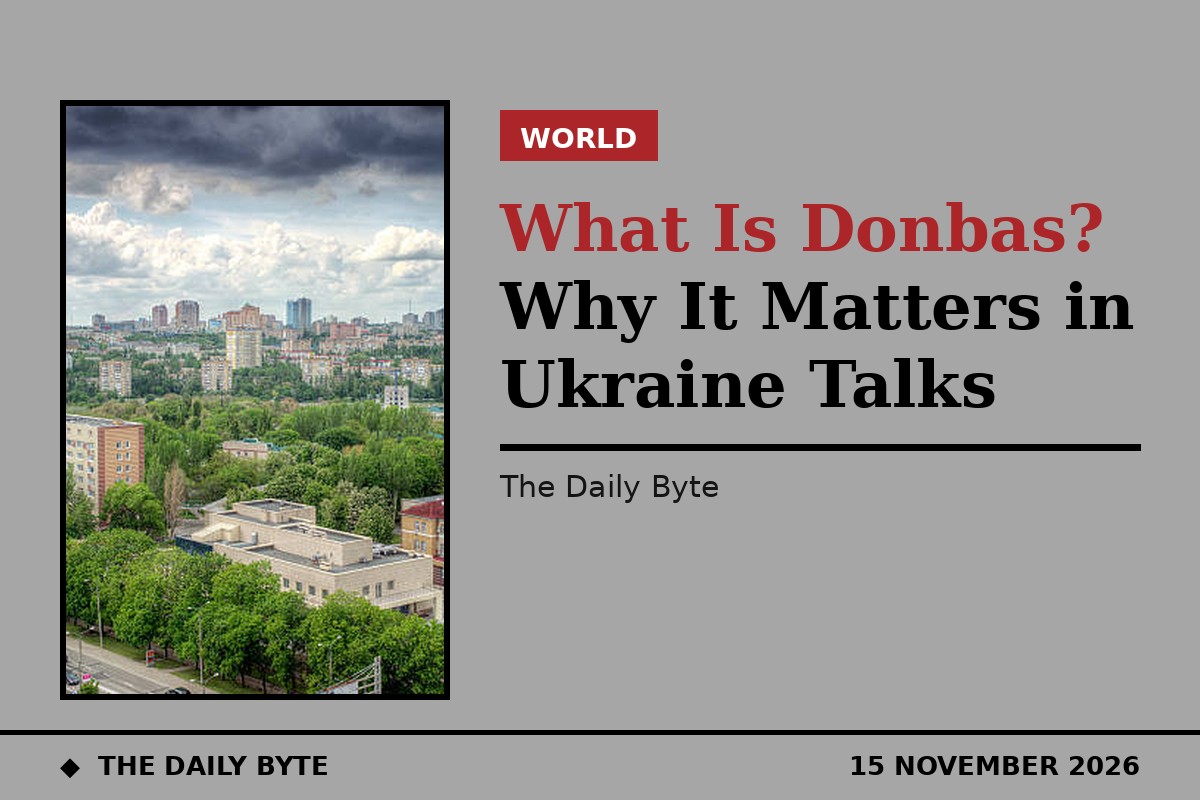
The Donbas is the eastern Ukrainian region made up of Donetsk and Luhansk oblasts, a coal-mining and industrial heartland on the border with Russia, and it is now at the centre of the hardest question in the Ukraine peace talks. On 14 November 2026, President Volodymyr Zelensky said US negotiators had asked, for the first time, whether Ukraine would withdraw from the part of the Donbas it still holds in exchange for joining NATO. Washington has not confirmed his account, and no deal has been agreed.
This explainer sets out what the Donbas is, who controls it, why it matters so much to both sides, what exactly was said in November 2026, and what would have to happen before any deal involving the region could take effect.
What is the Donbas?
Donbas is short for the Donets Basin, the coalfield around the Siverskyi Donets river in eastern Ukraine. It is not a single city or a formal administrative unit. The name is used for the two oblasts, or regions, of Donetsk and Luhansk, which together form Ukraine's industrial east. The region's main cities include Donetsk, the largest city and the administrative centre of Donetsk Oblast, Luhansk, the centre of Luhansk Oblast, and Kramatorsk and Sloviansk, the main cities in Donetsk Oblast still under Ukrainian control.
The Donbas was built on coal, steel and heavy industry, and it was one of the most densely populated and industrialised parts of the Soviet Union. Its mines and factories, its Russian-speaking population, and its position on the border with Russia have all shaped its politics. Before 2014, the region's economy depended heavily on coal and steel exports, and its mines were among the deepest and most dangerous in Europe.
The name is often used loosely in news reporting to mean the part of eastern Ukraine where fighting has taken place since 2014. Strictly, though, it refers to the whole Donetsk-Luhansk area, including large towns and cities that have been under Ukrainian control throughout the war, as well as areas occupied by Russia.
How did the Donbas become a war zone?
The Donbas has been at war, in one form or another, since 2014. After Russia annexed Crimea in March 2014, armed separatists backed by Moscow seized parts of Donetsk and Luhansk oblasts and declared self-proclaimed republics. Ukraine fought to regain the territory, and a front line settled across the region. The Minsk agreements of 2014 and 2015 were meant to end the fighting, with a ceasefire, a withdrawal of heavy weapons and a political settlement, but they were never fully implemented, and low-level fighting continued for eight years.
Russia launched its full-scale invasion of Ukraine in February 2022, and the Donbas was one of its main objectives. Russian forces took Mariupol, the port city in southern Donetsk Oblast, after a long siege in 2022, and have since captured most of Luhansk Oblast and a large part of Donetsk Oblast. In September 2022, Russia claimed to annex Donetsk and Luhansk, along with Zaporizhzhia and Kherson oblasts, after referendums that Ukraine and most of the international community rejected as illegal. The United Nations General Assembly rejected the annexations in Resolution ES-11/4 of 12 October 2022.
Fighting in the Donbas has been among the fiercest of the war, with months-long battles for cities such as Bakhmut, Avdiivka and Pokrovsk, and heavy casualties on both sides. The front line has moved slowly, at great cost, which is why the question of who holds the remaining Ukrainian-controlled part of the region has become so important in the peace talks.
Who controls the Donbas now?
Russia controls most of the Donbas, but not all of it. By November 2026, Russian forces held nearly all of Luhansk Oblast and roughly four-fifths of Donetsk Oblast, according to the Institute for the Study of War, which tracks the front line. The institute estimated on 11 November 2026 that Ukrainian forces retained control of about 20.12 per cent of Donetsk Oblast and 0.38 per cent of Luhansk Oblast.
That remaining Ukrainian-held slice of Donetsk is small in area, but it is not empty land. It includes Kramatorsk and Sloviansk, two of the region's main cities, along with a belt of fortified towns that Ukraine has built up over a decade of war. Military analysts describe this belt as one of the strongest defensive positions in Ukraine, and Russia has been trying to capture it since 2022. Ukraine's position is that giving it up would hand Russia, without a fight, ground that Russia has failed to take by force.
Russia, for its part, has demanded the whole of Donetsk and Luhansk oblasts as a condition of a settlement, a demand Ukraine has repeatedly rejected. That gap, between what Russia holds and what Russia demands, is the core of the territorial dispute in the talks.
What did the US ask, according to Zelensky?
The question at the centre of the story was raised during the latest round of US-mediated talks. American, Ukrainian and Russian negotiators met in Abu Dhabi on 10 and 11 November 2026, in talks that ended without a breakthrough but produced agreement on a prisoner exchange involving more than 1,000 people. US envoys Steve Witkoff and Jared Kushner then met Zelensky in Dublin later in the week, after earlier talks with President Vladimir Putin in Moscow.
Zelensky told reporters on 13 November, in remarks released by his office on Saturday 14 November, that the Americans had put a new question to him. "The Americans raised a question: 'What if Ukraine joins NATO? Would Ukraine withdraw from Donbas?'" he said. "This was the first time this had been raised. That is why I believe NATO is back on the agenda."
It is important to be precise about what that means. Zelensky described a question raised in discussion, not a signed agreement or a formal written proposal. He said no concrete proposal had been given to Kyiv, and that specifics were still missing. A US official told the BBC that "many ideas continue to be discussed but any final deal will have to be agreed to by both parties". The White House and the US State Department did not immediately respond to a request for comment, according to Politico. Washington has not confirmed Zelensky's account.
The question is nevertheless significant, because US officials had previously said that Ukrainian membership of NATO was off the table. Linking membership to a territorial concession would be a major change in the American position, if it is confirmed, and it would put NATO, which Kyiv has sought to join for years, back at the centre of the negotiation.
What would Zelensky accept, and what would he not?
Zelensky did not say yes to the idea, and he did not reject it outright. He said Ukraine would not give up its land, and repeated his long-held position that Ukraine is not retreating and is not giving up its territory. At the same time, he said he would put a deal to a national referendum if it contained what he called a comprehensive security package.
That package, as he described it, would have to include security guarantees from NATO and the European Union, modelled on Article 5 of the NATO treaty "as an absolute minimum"; a strong Ukrainian army, with no limits on its size or weapons, and funding for a set period; money to rebuild the country; and no formal recognition of occupied Ukrainian territory as Russian. "If the American side confirms precisely this to us, together with other NATO partners, then I will ask our Ukrainian society what it thinks: do we accept it or not? I have no right to make that decision on my own," he said, as quoted by Politico.
He also asked for a specific guarantee that American soldiers would be deployed on Ukrainian soil under such an arrangement, and said the US side answered "No", according to reporting of his remarks. That answer matters, because the value of a security guarantee depends on who is prepared to enforce it.
Zelensky also said the proposal made him believe "NATO is back on the agenda", but cautioned: "You have also heard Putin's signals, and this is an extremely difficult conversation." Russia has long described Ukrainian membership of NATO as a red line, and cited NATO's eastward expansion as one of its reasons for launching the full-scale invasion in 2022.
Why is NATO membership so hard to deliver?
Joining NATO is not a gift that the United States can give on its own. Membership requires the unanimous agreement of all 32 existing members, and each of them has a veto. Several European allies would need to be persuaded, and Russia would need to accept, or at least not be in a position to block, an outcome it has called a red line.
That is why Zelensky's conditions matter. A promise of membership without a timetable, without the agreement of all allies, and without forces on the ground to back it would be, in Kyiv's view, a paper guarantee. Ukraine has been given security assurances before, notably in the 1994 Budapest Memorandum, in which Russia, the United States and the United Kingdom promised to respect Ukraine's borders in exchange for Kyiv giving up its nuclear weapons. That assurance did not prevent the annexation of Crimea in 2014 or the full-scale invasion in 2022, and Ukrainian officials cite that history whenever a new guarantee is discussed.
The next round of talks is expected to include representatives of Britain, France, Germany, Italy and Poland, according to reporting on 15 November 2026, which suggests that the European allies will now be drawn directly into the discussion of what guarantees, if any, they are prepared to offer.
What happens next?
For now, the Donbas-for-NATO idea remains exactly what Zelensky described: a question raised in talks, not an agreed plan. There is no published text, no confirmed American proposal, and no Russian response on the record. The talks continue, but the gap between the sides is wide. Russia wants the whole Donbas and a guarantee that Ukraine will never join NATO. Ukraine wants NATO membership, or something as strong as it, and will not formally cede territory or recognise Russia's annexations.
What the question has done is to put the hardest trade-off in the war into public view: whether the security of NATO membership, the guarantee Ukraine has sought most, is worth the territory Ukraine has fought hardest to keep. Zelensky has said that is a question for the Ukrainian people, in a referendum, and not for him alone. Until a concrete proposal exists, with specifics on guarantees, forces, funding and borders, there is nothing for voters to decide, and the fighting in the Donbas continues.
Frequently asked questions
What is the Donbas? The Donbas is the eastern Ukrainian region made up of Donetsk and Luhansk oblasts, a coal-mining and industrial area on the border with Russia.
Who controls the Donbas? Russia controls nearly all of Luhansk Oblast and about four-fifths of Donetsk Oblast. Ukraine still holds about a fifth of Donetsk, including the cities of Kramatorsk and Sloviansk.
What did the US ask Ukraine about the Donbas? According to President Zelensky, US negotiators asked: "What if Ukraine joins NATO? Would Ukraine withdraw from Donbas?" Washington has not confirmed his account, and no deal has been agreed.
Would Ukraine give up the Donbas for NATO membership? Zelensky has said Ukraine will not give up its territory, and that any deal would need a comprehensive security package and would be put to a national referendum. No such deal exists yet.
Can NATO admit Ukraine without all members agreeing? No. NATO membership requires the unanimous agreement of all 32 member states.
Sources: The Observer, Pune Media and ASTIG. The remarks were reported by the BBC and Reuters on 14 November 2026; the US has not confirmed Zelensky's account.


