What Is Ebola? Symptoms, Spread and Survival
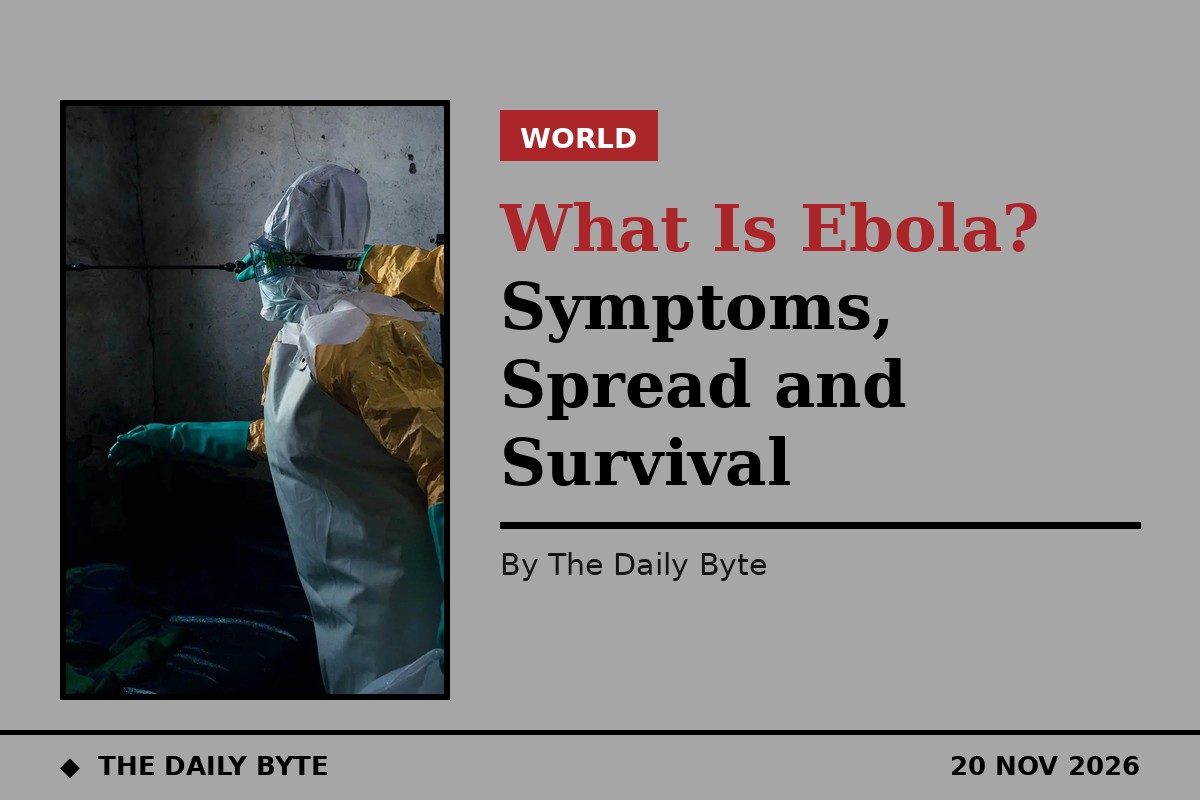
Ebola is a rare but severe viral illness that spreads through direct contact with the blood or body fluids of a person who is sick with it or has died from it. It is not spread through the air, and a person cannot pass it on before symptoms appear. That single fact shapes everything about how outbreaks are fought: find cases fast, isolate them, trace their contacts, and protect the people caring for them.
The question is being asked again because Ebola is back in the news. On 20 November 2026 Uganda suspended concerts, festivals and rallies in 34 high-risk border districts and ordered 21 days of quarantine or monitored self-isolation for Ugandans returning from the Democratic Republic of Congo (DRC), where a large outbreak has been running since May. The measures were announced by Uganda's health ministry on 19 November, and they took effect immediately.
What causes Ebola?
Ebola disease is caused by viruses in the Orthoebolavirus genus, part of the filovirus family, according to the World Health Organization (WHO). Four species are known to cause disease in people: Zaire ebolavirus, Sudan virus, Bundibugyo virus and Tai Forest virus. The current outbreak in the DRC is caused by Bundibugyo virus, a rarer strain first identified in Uganda in 2007. Fruit bats of the Pteropodidae family are thought to be the natural hosts. The virus reaches people through close contact with the blood, secretions, organs or other bodily fluids of infected animals such as fruit bats, chimpanzees, gorillas, monkeys, forest antelope or porcupines found ill or dead.
The disease was first recognised in 1976, in two simultaneous outbreaks: one of Sudan virus disease in Nzara, in what is now South Sudan, and one of Ebola virus disease in Yambuku, in what is now the DRC. The second outbreak took its name from the Ebola River near Yambuku. Since then outbreaks have occurred repeatedly in Central and West Africa, most of them small and contained, with a few very large ones, including the West African epidemic of 2014 to 2016 and the outbreak now under way in the DRC.
How does Ebola spread?
Once the virus is in a human population it spreads from person to person through direct contact, through broken skin or mucous membranes, with the blood or body fluids of a person who is sick with Ebola or has died from it, and with objects or surfaces contaminated with those fluids, such as bedding, clothing, needles or syringes. Burial ceremonies that involve direct contact with the body of a person who has died can also contribute to transmission, which is why safe burial teams are a standard part of every response. The virus can also be transmitted through semen from a man who has recovered; the WHO notes that transmission through infected semen has been documented up to fifteen months after clinical recovery.
Just as important is what does not spread it. Ebola is not an airborne disease. It is not spread through water or, in general, through food, and it does not spread through casual contact such as sitting next to a person who has the disease, unless there is direct contact with infectious bodily fluids or contaminated materials. People cannot transmit the disease before they have symptoms, and they remain infectious for as long as their blood contains the virus. That is why the people at highest risk are healthcare workers and family members in close contact with patients, and why infection control, including screening patients and using proper personal protective equipment, is the core of the response.
What are the symptoms, and how long does it take to appear?
The incubation period, from infection to the onset of symptoms, is 2 to 21 days, with an average of 8 to 10 days, according to the US Centers for Disease Control and Prevention (CDC). The symptoms can start suddenly and include fever, fatigue, weakness, muscle pain, headache and sore throat. Those early symptoms are followed by vomiting, diarrhoea, abdominal pain, a rash, and symptoms of impaired kidney and liver function. Some patients develop confusion, irritability and aggression, and unexplained bleeding or bruising can occur in the later stages, although bleeding is not universal.
The early symptoms are not specific to Ebola. Fever, headache and weakness are also seen in far more common diseases such as malaria and typhoid fever, which is why diagnosis depends on a combination of symptoms and a possible exposure within 21 days before the onset of illness, followed by laboratory testing. The virus can be detected in blood after symptoms begin, although it may take up to three days after symptoms start for the virus to reach detectable levels.
Is there a vaccine or treatment?
There are two vaccines approved against Ebola disease caused by Zaire ebolavirus: Ervebo and the two-dose Zabdeno and Mvabea combination. Ervebo is recommended as part of outbreak response. For treatment of Zaire ebolavirus disease, the WHO strongly recommends two monoclonal antibody treatments, mAb114 (ansuvimab) and REGN-EB3 (Inmazeb). Basic supportive care given early, including fluids and electrolytes, can significantly improve the chances of survival.
The position is different for the strain behind the current outbreak. There is no approved vaccine or specific treatment for Bundibugyo virus, and vaccines and treatments developed for other Ebola strains cannot automatically be assumed to protect against it. Two candidate vaccines developed specifically for Bundibugyo virus are being added to an ongoing vaccine trial, and the WHO has backed trials of the candidates, with results expected in early 2027. Frontline workers in Ituri have also been given Ervebo, the Zaire-strain vaccine, while a trial launched in Bunia in October 2026 is testing whether it can help against Bundibugyo. Until a proven vaccine exists for this strain, containment depends on finding cases fast, tracing contacts, isolating patients and winning the trust of communities in conflict-affected areas.
How is an outbreak stopped?
An outbreak is stopped by breaking the chains of transmission. That means isolating patients who are suspected or confirmed to have the disease, tracing everyone they have been in contact with and following those contacts up daily, making burials safe, and keeping health facilities able to treat patients without spreading infection. Contacts are followed for 21 days, the maximum incubation period. An outbreak is declared over only after 42 days, twice the maximum incubation period, have passed without a new confirmed case.
The measures Uganda announced on 19 November follow that playbook. Mass gatherings are suspended in the 34 designated high-risk districts, Ugandans returning from the DRC face mandatory health risk assessments followed by 21 days of quarantine or monitored self-isolation, screening has been tightened at Entebbe International Airport, and day scholars are barred from moving between the DRC and Uganda in the affected districts. Radio stations in the border districts have been directed to devote at least two hours a month to Ebola prevention messages.
The outbreak behind the headlines
The DRC outbreak was declared on 15 May 2026, and the WHO declared it a public health emergency of international concern two days later, its highest level of global health alert. The WHO's director-general said on 17 November that the outbreak had more than doubled in three months, with more than 11,000 cases and 5,400 deaths reported in 67 health zones across eight provinces. The DRC's National Institute of Public Health reported 11,376 cases and 5,568 deaths as of 16 November, a case fatality rate of about 49 per cent. More than 2,800 children had been infected and 1,320 had died, according to Save the Children figures to 10 November. Armed attacks on treatment facilities in North Kivu in early November forced patients to flee and broke contact-tracing chains, and Medecins Sans Frontieres warned on 12 November that undetected community transmission was keeping the outbreak out of control.
The outbreak has also crossed borders. Kenya confirmed its first case on 6 October, in a man who had travelled from the DRC through Kampala before reaching Nairobi. He died on 5 October, and his mother also died, taking Kenya's toll to two deaths from nine confirmed cases, with no new cases since 19 October. Kenya is now working towards a possible declaration of being Ebola-free around 23 December, provided no new infections are detected. Uganda declared its own earlier outbreak over on 28 July, with the WHO following on 27 August after 42 days without a new confirmed case, but the continuing transmission across its border with the DRC is what prompted the new measures announced on 19 November.
What should you do if you think you have been exposed?
Anyone who develops symptoms compatible with Ebola disease, such as fever, weakness, muscle aches, headache or sore throat, and who has travelled to an affected area or been in contact with a sick person in the previous 21 days, should seek medical attention promptly and mention the travel history or contact at once, so that they can be assessed and isolated while tests are done. Early care matters: the sooner supportive treatment begins, the better the chances of survival. People travelling to or living in affected countries should avoid contact with people who are symptomatic and with their bodily fluids, avoid contact with bodies and the bodily fluids of people who have died, avoid contact with wild animals including monkeys, forest antelopes, rodents and bats, alive or dead, and avoid eating bush meat, and wash their hands regularly with soap or antiseptics. Uganda's health ministry has asked the public to report suspected cases to the nearest health facility or to call its toll-free line on 0800 100 066.
Frequently asked questions
Is Ebola airborne? No. Ebola is not an airborne disease. It spreads through direct contact with the blood or other bodily fluids of a person who is sick with it or has died from it, or with contaminated objects. It is not spread by sitting next to someone, unless there is direct contact with infectious fluids.
Can you catch Ebola from someone who has no symptoms? No. A person infected with Ebola is not contagious until symptoms appear. That is why contact tracing focuses on the period after symptoms begin.
How long after exposure do symptoms appear? Symptoms may appear anywhere from 2 to 21 days after exposure, with an average of 8 to 10 days.
Is there a cure for Ebola? There is no single cure. For Zaire ebolavirus disease, two monoclonal antibody treatments are recommended, and early supportive care improves survival. There is no approved vaccine or specific treatment for the Bundibugyo strain behind the 2026 DRC outbreak, and trials of candidate vaccines are under way.
Why did Uganda ban gatherings? To limit opportunities for transmission in the 34 border districts most at risk from movement across the DRC border, including through unofficial crossing points. Concerts, festivals and rallies are suspended there until further notice unless the health ministry gives written clearance.
How do health officials know when an outbreak is over? An outbreak is declared over after 42 days, twice the maximum 21-day incubation period, without a new confirmed case.
Sources: World Health Organization, Ebola disease fact sheet; US Centers for Disease Control and Prevention, Ebola virus disease fact sheet; Capital FM, Uganda restricts cross-border movement amid Ebola threat.


