What is EU freedom of movement? UK explained
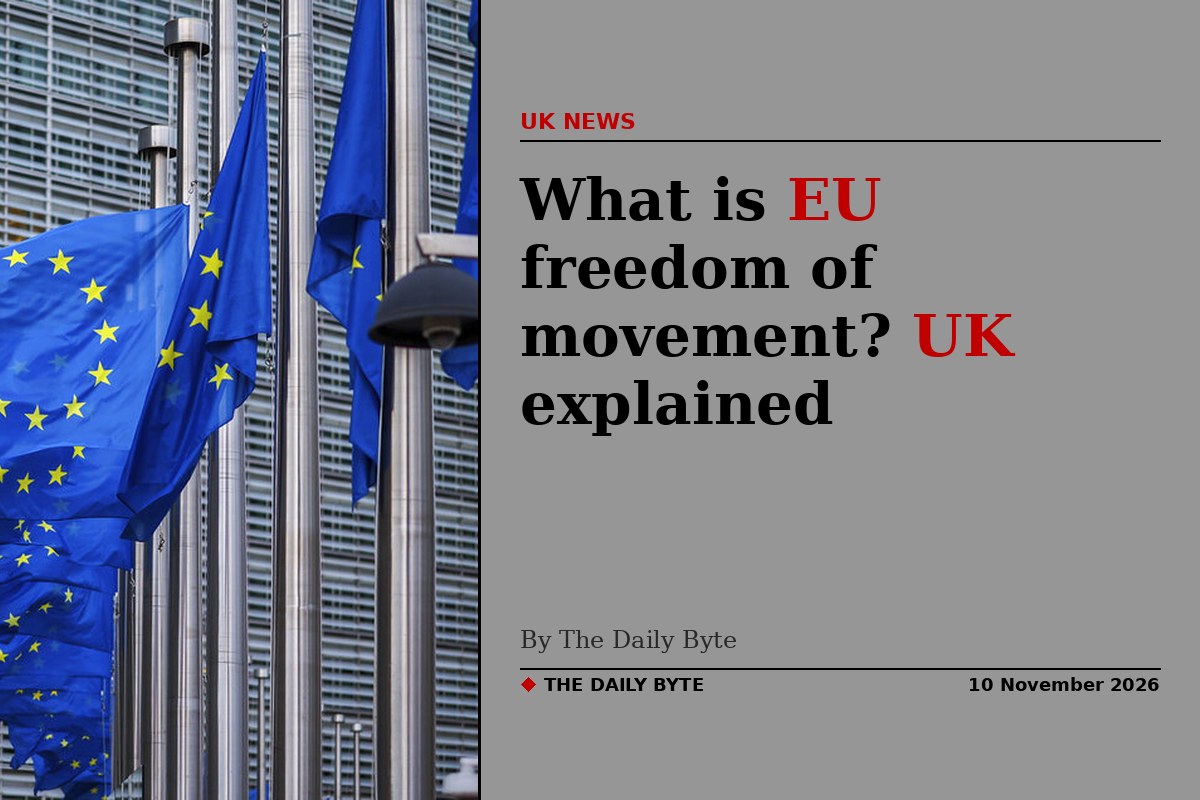
EU freedom of movement is the right of citizens of European Union countries to live, work and study in another EU country without needing a visa or a work permit first. It is one of the EU's founding freedoms, and it is the question at the centre of a renewed debate in Britain in November 2026, after Prime Minister Andy Burnham called for an honest discussion about the UK's relationship with Europe. In short, freedom of movement used to apply in the UK, it ended when Britain left the EU, and it has not returned. What is being discussed now is much narrower: a youth scheme for younger people, and a longer-term debate about the future relationship.
This explainer sets out what freedom of movement actually was, what it was not, what replaced it in the UK, and what could — and could not — change at the UK-EU summit in Brussels on 20 November 2026. It is general information only, not personal immigration advice. Immigration rules change, and anyone planning a move should check the official GOV.UK pages before acting.
What is EU freedom of movement, in simple terms?
Freedom of movement is the right for citizens of EU member states to move to another member state and to live, work, study or retire there. It is set out in EU law, principally in Directive 2004/38/EC, known as the Citizens' Rights Directive, which has applied since 30 April 2004. The same arrangements extend, through the European Economic Area, to Iceland, Norway and Liechtenstein. Switzerland has a separate agreement with the EU on free movement.
The idea is simple: an EU citizen does not need a visa to enter another EU country, and does not need a work permit to take a job there. A French citizen can accept a job in Germany, a Polish citizen can study in Spain, and an Italian citizen can retire to Portugal, on broadly the same terms as a citizen of the host country. Family members also have rights to join them and, in most cases, to work.
It is one of four freedoms of the EU single market, alongside the free movement of goods, services and capital. That link matters for the current debate, because EU leaders have repeatedly said the four freedoms go together. Former EU chief negotiator Michel Barnier has said in recent days that Britain could not pick only the parts of the single market it liked while rejecting the rest, and that rejoining the EU would mean accepting free movement.
What rights did it actually give people?
Under Directive 2004/38/EC, an EU citizen could live in another member state for up to three months with no conditions other than holding a valid passport or identity card. For a stay of more than three months, the citizen had to be a worker or self-employed, a student, or self-sufficient with enough money not to become a burden on the host country's social assistance system and with comprehensive sickness insurance.
That last point corrects a common misunderstanding. Freedom of movement did not give an unconditional right to settle anywhere indefinitely without working, studying or supporting yourself. After three months, a person who was not working, studying or self-sufficient did not have a continuing right of residence under the directive. After five years of exercising treaty rights — working, studying or being self-sufficient — a citizen could acquire a right of permanent residence.
People who did qualify were entitled to be treated on an equal footing with nationals of the host country in most areas, including access to employment, education and many public services. Family members, whatever their own nationality, were generally entitled to take up employment or self-employment in the host country. Host countries were not obliged to pay social assistance to people who were not working during their first three months, or to pay maintenance grants or loans to students before they had acquired permanent residence.
In practice, that meant free movement was mainly a right to move for work, study or retirement with the means to support yourself — not a right to move and immediately claim benefits. It also meant the system relied on registration and on the host country's own rules after the first three months, which varied from country to country.
What changed for the UK after Brexit?
Free movement between the UK and the EU ended at 11pm GMT on 31 December 2020, when the Brexit transition period ended. The Immigration and Social Security Co-ordination (EU Withdrawal) Act 2020 ended free movement in UK law, and a new points-based immigration system took effect on 1 January 2021. From that date, EU citizens arriving in the UK generally needed permission to enter, live and work, in the same way as citizens of most other countries.
People who were already living in the UK by 31 December 2020 were protected by the Withdrawal Agreement. They could apply to the EU Settlement Scheme for settled status, usually after five years of continuous residence, or pre-settled status if they had lived in the UK for less than five years. The main application deadline was 30 June 2021, although late applications have been accepted in some circumstances. Settled status gives indefinite permission to stay, and the right to work, use the NHS and access public funds if eligible.
Irish citizens are a special case. Because of the Common Travel Area between the UK and Ireland, Irish citizens do not need permission to enter or live in the UK, regardless of when they arrived. That right does not depend on their status as EU citizens, and it survived the end of free movement.
For British citizens, the change was equally sharp. A UK passport no longer gives a right to live or work in the EU. British visitors can generally spend up to 90 days in any 180-day period in the Schengen area without a visa, but a longer stay, or a stay to work or study, usually needs a visa or permit from the country concerned. The exact rules depend on the country and on the purpose of the visit, which is why the official guidance for each destination matters.
What is the position today, 10 November 2026?
As of Tuesday 10 November 2026, there is no return to freedom of movement in the UK, and no negotiation to restore it is under way. Prime Minister Andy Burnham has said plainly: "I have not proposed freedom of movement coming back." He told ITV that he was committed, for this Parliament, to Labour's manifesto red lines, which rule out a return to the single market, the customs union or freedom of movement.
At the same time, Burnham has called for an "honest discussion" about how immigration to the UK has changed since Brexit, and about Britain's longer-term relationship with the EU. That discussion is the reason freedom of movement is in the news again, not because a deal to restore it is on the table. Downing Street has clarified that the government is not currently negotiating a return to free movement, and that officials are working within the manifesto red lines.
The figures behind the debate are striking. Long-term net migration to the UK fell to 171,000 in 2025, according to the Office for National Statistics, down from 331,000 a year earlier. Supporters of closer ties argue that the fall shows the current system is too restrictive for some employers and sectors. Critics argue that lower migration is what voters wanted, and that any return to free movement would reverse it. Both sides are now arguing about the same numbers in very different ways.
The next milestone is the second UK-EU summit, in Brussels on 20 November 2026, where Burnham is due to meet European Council President António Costa and European Commission President Ursula von der Leyen. The summit is expected to focus on practical deals — easier trade in food and agricultural products, linking emissions trading systems, and a youth mobility scheme — not on restoring full freedom of movement.
What is the youth experience scheme, and how is it different?
The youth experience scheme is the closest thing to free movement on the summit agenda, but it is not the same thing. The UK and EU agreed in 2025 to work towards a scheme that would let young people work, study, take part in au pairing or volunteering, or travel for a limited period, with a dedicated visa and a number of places acceptable to both sides. It would be time-limited, age-limited and capped — the opposite of the open-ended right that free movement gave to citizens of all ages.
The details are still being negotiated, and reported figures differ, so they should not be treated as settled. Some reports have put the age range at 18 to 30, for up to three years. Others have reported a wider age range in draft texts. On numbers, reports have said the UK has offered between 75,000 and 80,000 places a year, while the EU has pushed for 100,000. None of that is final, and disagreements also remain over university tuition fees and healthcare charges. A separate explainer on the youth scheme is already on this site.
The distinction matters. A youth scheme would give a defined group of young people a defined period in another country. Full freedom of movement would give every EU citizen the right to live and work in the UK, and every British citizen the same right across the 27 EU member states, without a cap, an age limit or a time limit. That is why supporters describe the youth scheme as a modest first step, and why opponents of a return to free movement describe it as something quite different.
Could full freedom of movement return?
In theory, yes — but not quickly, and not without major political decisions. A full return would, in most models, require the UK to rejoin the EU single market, which would mean accepting its rules, including the four freedoms, and a lengthy negotiation with the EU's 27 member states. Burnham has said he would not revisit the red lines until after the next general election, which must take place by 2029 at the latest, and has said a return to the single market would require a referendum.
There is also a cost question. Barnier has said that if Britain sought to rejoin the EU, the annual rebate negotiated by Margaret Thatcher, worth about £5 billion a year, would not be renewed. Rejoining would also mean accepting the EU's budget rules and the jurisdiction of its courts in the areas covered by membership. None of that is agreed, and none of it is on the agenda for the 20 November summit.
For now, the realistic path is incremental: the food and farming deal, emissions trading, youth mobility, and closer cooperation on security and research. Whether that builds towards a bigger reset after the next election, or stays as a practical reset within the current red lines, is the political argument that will run for the rest of this Parliament.
What should UK and EU citizens check now?
If you are an EU citizen living in the UK, check your status under the EU Settlement Scheme, and whether you need to move from pre-settled to settled status after five years of continuous residence. If you are a British citizen planning to work, study or stay in the EU for more than 90 days in 180, check the visa and permit rules for the country you are going to, and the official GOV.UK travel advice for that destination. The 90-day Schengen limit applies to short visits, not to a right to work.
If you are a young person interested in the youth scheme, do not apply yet and do not pay anyone who claims to be able to secure a place. No scheme is open, no places have been allocated, and no application route has been published. When a deal is agreed, the official GOV.UK pages will set out who can apply, for how long, and what it costs.
And if you are an employer, the current system remains the points-based system. EU citizens who do not have settled or pre-settled status generally need a visa sponsored by an employer, with salary and skill thresholds that depend on the role. That is the system Burnham has said he will keep for this Parliament.
Frequently asked questions
Is freedom of movement back in the UK? No. It ended on 31 December 2020 and has not returned. The Prime Minister has said he has not proposed bringing it back in this Parliament.
Can I still move to the EU without a visa? For a short visit, British citizens can generally spend up to 90 days in any 180-day period in the Schengen area without a visa. To live, work or study there for longer, you usually need a visa or permit.
What is the difference between the youth scheme and freedom of movement? The youth scheme would be limited by age, time and numbers, with its own visa. Freedom of movement was an open-ended right for citizens of all ages, with no cap.
Does the 20 November summit restore freedom of movement? No. The summit is expected to cover food trade, emissions trading and youth mobility. A wider discussion about the longer-term relationship may follow, but no return to free movement is being negotiated.
Where can I check the official rules? On GOV.UK, for the EU Settlement Scheme and for visas and immigration, and on the European Commission's pages for Directive 2004/38/EC. Rules change, so check the official page for your own circumstances.