What Is Fannie Mae? US Mortgage Giant Explained
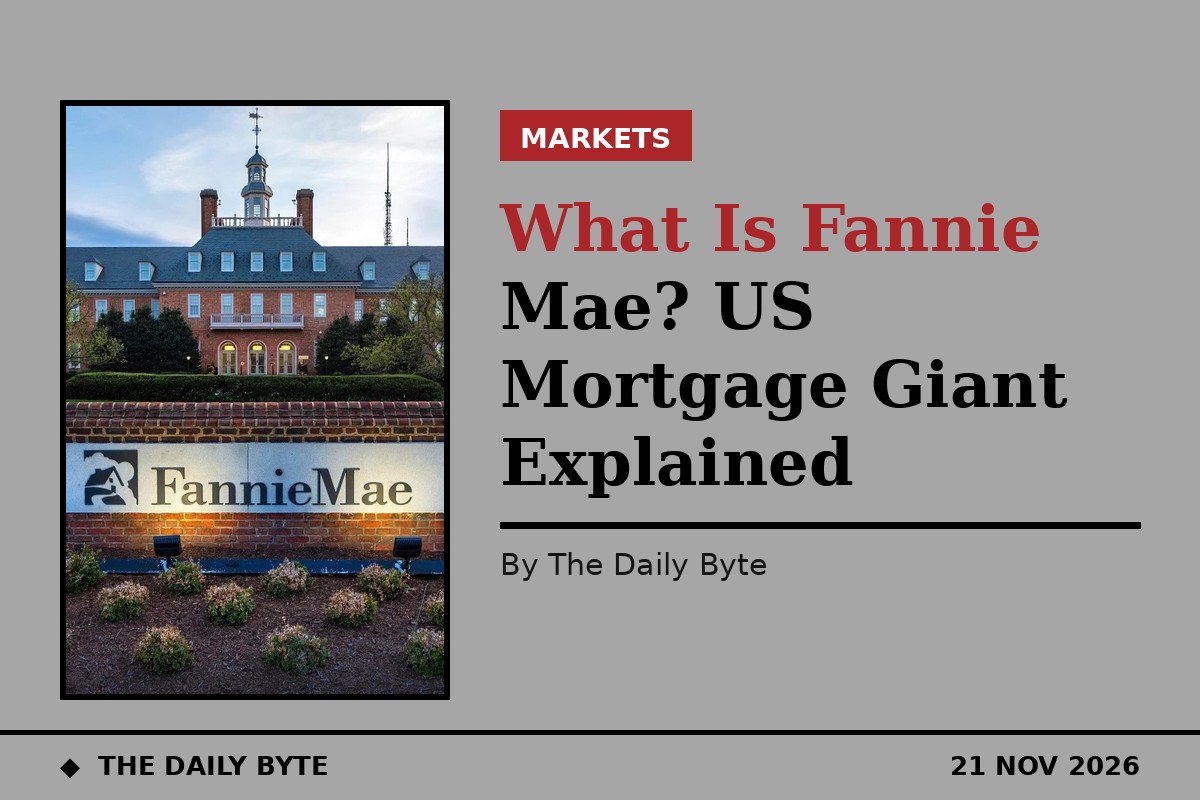
Fannie Mae is the mortgage giant at the centre of the American housing market. Its full name is the Federal National Mortgage Association, and it is one of two government-sponsored enterprises that buy home loans from banks, package them into securities and guarantee them for investors. It does not lend money to homebuyers directly, and most borrowers will never deal with it. Yet the 30-year fixed-rate mortgage that defines homebuying in the United States would scarcely exist without it. The company is back in the news in November 2026 because a long-running plan to take it out of government control and return it to private ownership has effectively stalled, and its shares have fallen sharply from their highs.
Understanding Fannie Mae means understanding three things: what it does in the mortgage market, why the government took it over in 2008, and why it has proved so hard to hand back. Each part of that story explains why the company matters to anyone buying a home, paying a mortgage or watching American interest rates.
What is Fannie Mae?
Fannie Mae is a United States government-sponsored enterprise, commonly known as a GSE. It was created by Congress in 1938, during the Great Depression, as part of President Franklin D. Roosevelt's New Deal. The idea was simple. At the time, most home loans were short-term deals that ended with a large balloon payment, and when the Depression hit, roughly a quarter of homeowners lost their homes to foreclosure. Banks were unwilling to lend for long periods, so ordinary families could not get the steady, long-term mortgages they needed. Fannie Mae was set up to change that by creating a secondary mortgage market: a place where lenders could sell the home loans they had already made, freeing up their money to lend again.
The company was originally chartered as the National Mortgage Association of Washington. In 1954 it became a mixed-ownership corporation, with the federal government holding preferred stock and private investors holding common stock. In 1968 it was converted into a privately held company so its debts would no longer sit on the federal budget, and the same change split off a new government agency, the Government National Mortgage Association, known as Ginnie Mae. In 1970 the government authorised Fannie Mae to buy conventional loans that were not insured by the federal government, and created a second, competing company, the Federal Home Loan Mortgage Corporation, better known as Freddie Mac.
Today Fannie Mae is headquartered in Washington, D.C., employs around 7,000 people and holds more than 4.3 trillion dollars in assets, making it the largest company in the United States by that measure. Its sister company, Freddie Mac, plays a similar role. Together the two carry a loan portfolio estimated at about 7.5 trillion dollars and underpin roughly 70 per cent of the American housing market.
How does Fannie Mae work?
Fannie Mae works behind the scenes of the mortgage market. When a bank or another lender makes a home loan, it can sell that loan to Fannie Mae. Fannie Mae either holds the loan on its own books or bundles hundreds or thousands of similar loans together into a mortgage-backed security, known as an MBS, which it sells to investors such as pension funds and insurance companies. Crucially, Fannie Mae guarantees those securities: if a borrower stops paying, Fannie Mae, not the investor, absorbs the loss.
That guarantee is what keeps the system moving. Because lenders know they can sell a loan onward, they are willing to make more loans. Because investors know the securities carry Fannie Mae's guarantee, they are willing to buy them at lower interest rates than they would otherwise demand. The result is cheaper, steadier credit for homebuyers, and in particular the long-term fixed-rate mortgage. As the Commercial Observer put it in November 2026, without Fannie Mae and Freddie Mac, the 30-year mortgage and much of the American affordable housing market would not exist.
Fannie Mae does not set the interest rate a borrower pays directly, and it does not decide who gets a loan. Lenders make those decisions within rules Fannie Mae sets about which loans it will buy, including limits on the size of a loan and standards for the borrower's creditworthiness. Loans that meet those rules are known as conforming loans. The company also has a duty, set by Congress, to support affordable housing for low- and moderate-income families, and it runs programmes aimed at renters and first-time buyers as well as homeowners.
Why is Fannie Mae in conservatorship?
Fannie Mae has been under government control since 7 September 2008, when the Federal Housing Finance Agency, the FHFA, placed it and Freddie Mac into conservatorship at the height of the global financial crisis. In the years before the crisis, both companies had taken on too much risk, guaranteeing mortgages made to borrowers who could not afford them. When house prices collapsed, their capital was wiped out. The government stepped in to stop the mortgage market from freezing altogether, dismissed the chief executives and boards, and took a large stake in the form of senior preferred stock.
Conservatorship was supposed to be temporary. More than 18 years later, it is still in place. The Treasury has collected more than 300 billion dollars in profits from the two companies since the bailout, an amount that exceeds what the government originally put in. But the structure created in 2008 has proved extraordinarily difficult to undo, because the Treasury's 192 billion dollar senior preferred stake sits ahead of private shareholders. Any private investor buying into the companies would rank behind the government, and the government would keep most of the upside. That is the core of the problem that has blocked every attempt to release the companies since.
What happened to the privatisation plan?
President Donald Trump has talked about ending the conservatorship since his first term, and the idea gained momentum when he returned to the White House in 2025. In May 2025 he posted that the two companies were doing very well and throwing off a lot of cash, and that the time seemed right to privatise them. In July 2025 the administration summoned the chief executives of the six largest banks to outline a plan to sell up to 30 billion dollars of preferred shares in the two companies on the open market, which would have been the largest initial public offering in history.
That plan has now effectively collapsed. Reporting in November 2026 found that the administration had gone quiet on privatisation even before the midterm elections, in which Democrats won control of Congress. Mizuho Financial Group cut its estimated probability of privatisation by 2028 by about 12 percentage points, to 30 per cent for Fannie Mae and 20 per cent for Freddie Mac. On 11 November, Fannie Mae shares traded at around 4.43 dollars, down 63 per cent from their 52-week high, while Freddie Mac shares traded at around 3.98 dollars, down nearly 65 per cent.
Treasury Secretary Scott Bessent has suggested the government could take the matter up again in 2027 or 2028. But starting in January, the administration faces a Congress controlled by Democrats, many of whom oppose releasing the companies without legislation protecting affordable housing and taxpayers. Representative Maxine Waters, who is in line to chair the House Financial Services Committee, has consistently opposed administrative efforts to release the companies quickly, arguing that Congress must ensure they keep providing liquidity and affordability to all housing markets at all times.
Why is privatisation so difficult?
The first obstacle is money. Fannie Mae needs about 187 billion dollars of capital to meet regulatory requirements, and Freddie Mac needs about 141 billion dollars. The Treasury's 192 billion dollar senior preferred stake does not count towards that regulatory capital, because it is taxpayers' money that must be repaid. That leaves a combined shortfall of about 328 billion dollars, far more than the 30 billion dollars any share sale could raise. Donald Layton, a former chief executive of Freddie Mac, has called this a trap: even a successful offering would leave the government in control for years, or decades, while the companies retained earnings to build up their capital base. He has described the structure as a poison pill for investors.
The second obstacle is mortgage rates. The whole reason Fannie Mae and Freddie Mac can fund cheap mortgages is the market's belief that the government stands behind them. If that backing were removed, investors would demand higher returns to hold their securities, and mortgage rates would rise. That would be hard to defend at a time when the administration is pressing for housing affordability, and when mortgage rates have already topped 7 per cent. Economists have warned repeatedly that privatisation without a government guarantee could push rates higher, and the Mortgage Bankers Association has said any release must include an explicit federal backstop for the companies' mortgage-backed securities, passed by Congress and paid for by the companies themselves.
The third obstacle is politics. Releasing the companies by executive action alone would almost certainly face legal challenges and fierce opposition in Congress. The Commercial Observer quoted one expert saying the likeliest outcome now is incremental administrative change over the next couple of years, with a full exit from conservatorship left to a future Congress and a future administration.
Who runs Fannie Mae now?
Day-to-day control of both companies sits with the Federal Housing Finance Agency, and in particular with its director, Bill Pulte, who was confirmed by the Senate in March 2025 and then appointed himself chairman of both Fannie Mae and Freddie Mac. Pulte has used the companies as tools to try to improve housing affordability, including directing them to buy 200 billion dollars of mortgage-backed securities in an effort to bring mortgage rates down.
The regulator has also moved to support lending in other ways. Late in 2025 the FHFA announced that the 2026 multifamily loan purchase caps for Fannie Mae and Freddie Mac would be set at 88 billion dollars each, a 20.5 per cent increase on the 2025 caps, signalling that the agencies were prepared for renewed lending on apartment buildings. But the market has moved against them: sales of existing homes fell to a 16-year low in October 2026, according to the Wall Street Journal, and both companies reported lower profits, with Fannie Mae's fourth-quarter 2025 net income down 14.6 per cent year on year and Freddie Mac's down 14 per cent.
What does Fannie Mae mean for homebuyers?
For most homebuyers, Fannie Mae is invisible, and that is the point. Its guarantee is what allows a bank to offer a 30-year fixed-rate mortgage at a rate a family can plan around, rather than a short-term loan that must be refinanced every few years. If the guarantee were weakened or removed, mortgages would become more expensive, harder to get, or both, and the effect would fall hardest on first-time buyers and lower-income households.
That is why the debate about Fannie Mae matters beyond Wall Street. The company's future is not only a question of share prices and capital ratios. It is a question about who bears the risk in the American housing market: taxpayers, private investors, or homebuyers themselves. For now, the answer remains the one set in 2008. Fannie Mae stays in government hands, the privatisation plan is on ice, and the 30-year mortgage continues to rest on a guarantee that no private company has yet been willing, or able, to replace.
This article is general information only. It is not personal mortgage or investment advice.