What Is Fracking?
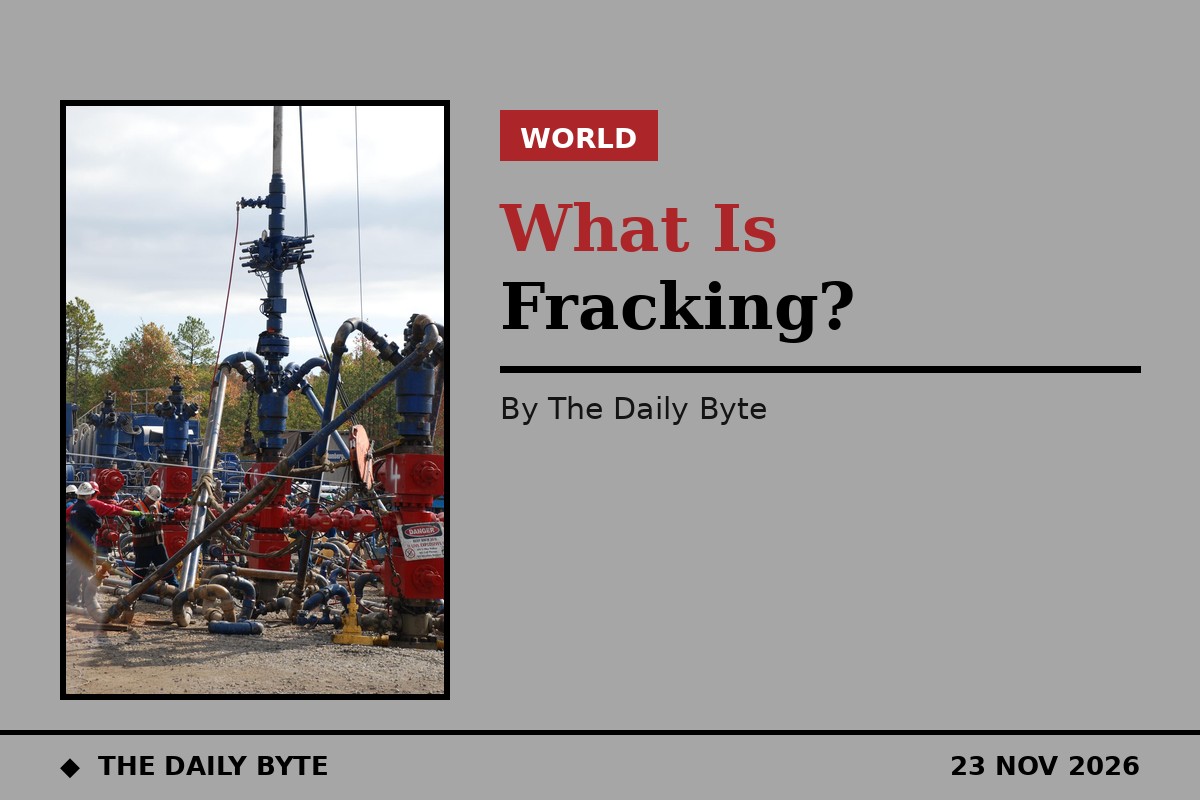
Fracking is one of the most argued-over words in energy. To its supporters it is the technique that freed America from dependence on foreign gas, created jobs, and kept energy bills down. To its critics it is a polluting process that risks drinking water, shakes the ground, and locks the world into fossil fuels. In Britain the argument has a particular edge: fracking has been effectively stopped since 2019, yet in September 2026 MPs were still debating whether the law as written even bans it at all.
This guide explains what fracking actually is, how it works step by step, what is in the fluid that is pumped underground, why it became so important, what the environmental arguments are, and where the law stands in the UK today.
What is fracking in simple terms?
Fracking is short for hydraulic fracturing. It is a way of getting oil and natural gas out of rock that would otherwise hold on to them too tightly to be worth drilling. A well is drilled deep underground, and then water mixed with sand and a small amount of chemicals is pumped down it at very high pressure. The pressure cracks the rock, creating a network of thin fractures, and the grains of sand wedge those cracks open so that gas or oil can flow through them and up the well to the surface.
The key point is that fracking is not drilling. Drilling makes the hole; fracking comes afterwards, and it is used to stimulate a well that has already been drilled, coaxing more oil or gas out of the rock around it. The technique is also used for other purposes, including geothermal energy, where hot rock is fractured so that water can circulate through it and bring heat to the surface. As Newcastle University's ReFINE research programme explains, the man-made cracks connect the tiny pores inside the rock so that trapped gas can escape, and the sand, known as proppant, stops the cracks closing again once the pressure is released. You can read their introduction in the ReFINE guide to what fracking is.
What is shale gas, and why does it need fracking?
Most of the gas and oil the world has used for the past century came from reservoirs: porous rocks, such as sandstone, in which the fuel had collected in large underground pools that could be tapped with a single well. Shale gas is different. Shale is a mudstone, a sedimentary rock formed over millions of years as layers of mud were buried, squeezed and heated until the organic matter inside them turned into gas. That gas is still there, trapped in the shale itself, but the rock is full of tiny pores that are not connected to each other, so the gas cannot flow.
In the language of geology, shale is porous but not permeable: it holds gas, but it will not let it move. That is why fracking is needed. Without fracturing, a well drilled into shale would produce almost nothing. With fracturing, the cracks link the pores together and turn the source rock itself into the reservoir. This is also why shale is called an unconventional resource. Conventional drilling goes looking for gas that has already gathered somewhere; shale gas has to be released from the rock where it was formed, and that takes fracking.
How does fracking work, step by step?
A shale gas well is built in stages. First a vertical hole is drilled down through the layers of rock, often two to six kilometres deep, far below the groundwater that supplies drinking water. Steel casing is cemented into the hole to seal it off from the surrounding rock and aquifers. Then the drill turns sideways, and a horizontal section is drilled through the shale layer itself, sometimes for a kilometre or more, so that a single well can reach a large area of rock.
Next comes perforation. Small shaped charges are fired to punch holes through the steel casing at intervals along the horizontal section, giving the fracking fluid a way out of the well and into the rock. Then the fracking itself begins. Millions of litres of water, mixed with sand and chemicals, are pumped down the well at enormous pressure. The pressure overcomes the strength of the rock, and fractures open up and spread outwards from each perforation. Sand carried in the fluid lodges in the fractures and props them open. When the pumping stops, some of the fluid flows back to the surface, a mixture known as flowback, and gas begins to flow out of the newly connected pores, through the fractures, and up the well.
A single well is usually fracked in stages, with each section of the horizontal well treated in turn, and a single site, known as a well pad, can host several wells drilled in different directions. Once production starts, the well can produce gas for years, although output typically falls steeply after the first year or two, which is why shale fields need a constant supply of new wells to keep production steady.
What is in fracking fluid?
Fracking fluid is mostly water, usually well over ninety per cent, with sand making up most of the rest. The chemicals are a small fraction of the total, typically less than one or two per cent, but they attract the most attention, and for good reason: a single operation uses millions of litres of fluid, so even a small percentage amounts to a large quantity of chemicals in absolute terms.
The chemicals have specific jobs. Friction reducers, often based on polyacrylamide, let the fluid be pumped faster with less energy. Gelling agents thicken the fluid so that it can carry sand deep into the fractures. Biocides kill bacteria that could clog the well or produce corrosive gases. Acids, usually dilute hydrochloric acid, clean out the perforations and dissolve minerals that block the flow. Scale inhibitors stop mineral deposits building up in the pipes. Operators in many countries are now required to disclose the chemicals they use, and regulators publish lists of them, but the exact recipe varies from well to well and some ingredients have historically been treated as trade secrets, which is one reason the fluid remains controversial.
A short history of fracking
Hydraulic fracturing began as an experiment in 1947, when engineers in Kansas first tried pumping fluid into a gas well to stimulate production, and the first commercially successful application followed in 1950. For decades afterwards it was a niche technique, used to revive old wells. The revolution came in the 2000s, when American engineers combined it with horizontal drilling and applied it systematically to shale formations such as the Barnett in Texas, the Marcellus in Pennsylvania, and the Bakken in North Dakota.
The results transformed the energy map. The United States, which had been expected to become a major importer of natural gas, instead became the world's largest producer of both oil and gas, gas prices fell sharply, and American liquefied natural gas began to be shipped around the world, including to Britain. Other countries followed: China developed large shale gas fields in Sichuan province, Argentina built up the Vaca Muerta formation in Patagonia, and Canada expanded production from its own shale and tight rock. By the 2010s, fracking was producing a large share of the world's gas, and it had become one of the most politically charged technologies on the planet.
Why do supporters back fracking?
Supporters make four arguments. The first is energy security. A country that can produce its own gas is less dependent on imports from unstable regions, and less exposed to price spikes when pipelines are cut or wars break out. That argument has grown stronger since Russia's invasion of Ukraine in 2022, which sent European gas prices soaring and forced governments to scramble for alternative supplies.
The second is price. American households and industry benefited from years of cheap gas after the shale boom, and supporters argue that British consumers could have enjoyed similar benefits if the shale gas under Lancashire and Yorkshire had been developed. The third is jobs and tax revenue: drilling, engineering and supply chain work in the areas where wells are built. The fourth is climate, or at least a version of it: gas burns more cleanly than coal, producing about half the carbon dioxide for the same amount of electricity, so supporters present shale gas as a bridge fuel that can replace coal while renewable energy scales up.
Critics dispute every one of those claims, particularly the last, but they are the reasons fracking retains political support in the United States and in several other producing countries, and why the question keeps returning to the British political agenda even after years of moratorium.
What are the environmental concerns?
The environmental case against fracking has several strands, and they need to be separated, because they differ greatly in how well they are proven. The clearest is water use. A single shale well can use millions of litres of water, and a field of wells uses far more, which puts pressure on supplies in dry regions and generates large volumes of wastewater that must be stored, treated or disposed of, usually by injecting it deep underground.
The second concern is contamination. The fractures themselves are typically kilometres below the water table, and regulators generally say they are very unlikely to reach drinking water directly. The greater risk, in the view of most independent scientists, is at the surface and in the well itself: spills of chemicals or wastewater, leaks from storage pits, and faulty steel casing or cement that lets gas or fluid escape into shallow groundwater. Several studies in the United States have found methane in drinking water wells near shale gas sites, although researchers disagree about how often this is caused by fracking and how often by naturally occurring gas or old wells.
The third concern is methane. Natural gas is mostly methane, a greenhouse gas that traps far more heat than carbon dioxide over a short period, and methane can leak from wells, pipes and processing equipment at every stage from drilling to delivery. If enough methane escapes, it can wipe out the climate advantage gas has over coal. The fourth set of concerns is local: noise, heavy truck traffic, light pollution, and the industrialisation of rural landscapes, which is why opposition to fracking is often strongest in the communities that would host the wells.
Does fracking cause earthquakes?
Yes, fracking can cause earth tremors, and that is the reason Britain stopped it. The tremors are usually tiny, far below anything people can feel, and they happen because pumping fluid underground changes the pressure on existing faults in the rock. Most are so small that only sensitive instruments detect them. But occasionally a fault slips more substantially, and the resulting tremor can be felt at the surface.
Britain learned this the hard way at Preston New Road in Lancashire, where the energy company Cuadrilla fracked the country's only two shale wells in 2018 and 2019. Some 57 tremors were recorded during two months of fracking in 2018, and in August 2019 a tremor measuring 2.9 on the Richter scale was felt across the local area, the largest ever caused by fracking in the UK. The then Oil and Gas Authority concluded that it was not possible to predict reliably how large a tremor fracking might trigger, and the government imposed a moratorium. There is an important nuance here: the largest wastewater disposal wells, where vast volumes of water are injected underground over long periods, have been linked to larger earthquakes in the United States than fracking itself, notably in Oklahoma, so the two activities are not the same risk.
Is fracking legal in the UK?
The short answer is that fracking for shale gas is effectively stopped in England, but the law is messier than that sentence suggests. In November 2019 the government imposed a moratorium on fracking in England, after the Oil and Gas Authority's report on the Preston New Road tremors concluded that the probability and magnitude of seismic events could not be predicted with confidence. The regulator later ordered Cuadrilla to permanently plug and abandon the UK's only two shale wells at Preston New Road, and no fracking for shale gas has taken place since.
But a moratorium is a pause, not a ban, and the law has a loophole. Under the Petroleum Act 1998, fracking is defined by the volume of fluid injected: more than 1,000 cubic metres at any single stage, or more than 10,000 cubic metres in total. Pump less than that, and the law does not treat the operation as fracking at all, even though the technique is identical. That loophole was at the centre of a debate in the House of Commons on 15 September 2026, when MPs argued that the government should legislate for a full ban defined by the purpose and effect of the operation rather than by fluid volume. As the debate heard, the 2.9 magnitude tremor at Preston New Road followed a fracking stage that used just 142 cubic metres of fluid, far below the legal threshold, and a company called Europa Oil and Gas has proposed a low-volume operation known as a proppant squeeze at Burniston, on the edge of the North York Moors, designed to sit under the threshold. You can read the debate in Hansard's record of the fracking ban debate. The government has said it will legislate to ban fracking, but as of that debate no ban had been passed into law.
Where in the world is fracking used, and where is it banned?
Fracking is used at industrial scale in the United States, Canada, China and Argentina, which together account for the overwhelming majority of shale gas and tight oil production. It is also used in smaller amounts in several other countries, and the same fracturing technique is used in conventional oil and gas fields around the world, including in the North Sea, where it has been used for decades without the controversy that surrounds shale.
On the other side, France banned fracking in 2011, becoming the first country to do so, and several other European countries have followed with bans or moratoria, including Germany, Ireland, the Netherlands and Bulgaria. Scotland and Wales also have effective moratoria, so the English position is the outlier within the UK itself. The split reflects a genuine policy choice: countries with large shale reserves and a tradition of onshore oil and gas, such as the United States, have generally embraced the technique, while countries with smaller reserves, denser populations and stronger climate commitments have generally rejected it.
Fracking and climate change
The climate argument is where the fracking debate becomes hardest to settle, because both sides can point to real evidence. Gas really does produce about half the carbon dioxide of coal when burned to generate electricity, and the switch from coal to gas in the United States was one of the largest single reasons American carbon emissions fell in the 2010s. From that point of view, shale gas looks like a useful bridge to a low-carbon future.
The counter-argument is that a bridge can become a destination. Every new gas well locks in decades of fossil fuel infrastructure, every tonne of methane that leaks on the way to the burner adds to warming, and every pound invested in gas is a pound not invested in wind, solar and storage. Climate scientists also point out that the world's remaining carbon budget for holding warming to 1.5 degrees is now so small that there is little room for new fossil fuel development of any kind. That is why the debate in Britain in 2026 is no longer just about tremors in Lancashire, but about whether a country committed by law to net zero can justify opening a new front of fossil fuel extraction at all.
The bottom line
Fracking is a proven engineering technique that works exactly as its supporters say: it cracks deep rock, releases gas and oil that would otherwise stay trapped, and it transformed the United States into the world's largest producer of both. It is also a technique with real environmental costs, from the water it uses to the methane it can leak and the tremors it can trigger, and in Britain those costs, above all the earthquakes at Preston New Road, were enough to stop it in its tracks.
Whether it stays stopped depends on politics as much as geology. The moratorium has held since 2019, the only shale wells have been ordered plugged and abandoned, and yet the law still contains a volume loophole that could let low-volume fracking through, and a full legal ban is still waiting to be passed. Until Parliament closes that gap, fracking in Britain is not quite banned, not quite allowed, and still very much an open question.


