What Is the FTSE 100? UK Stock Index Explained
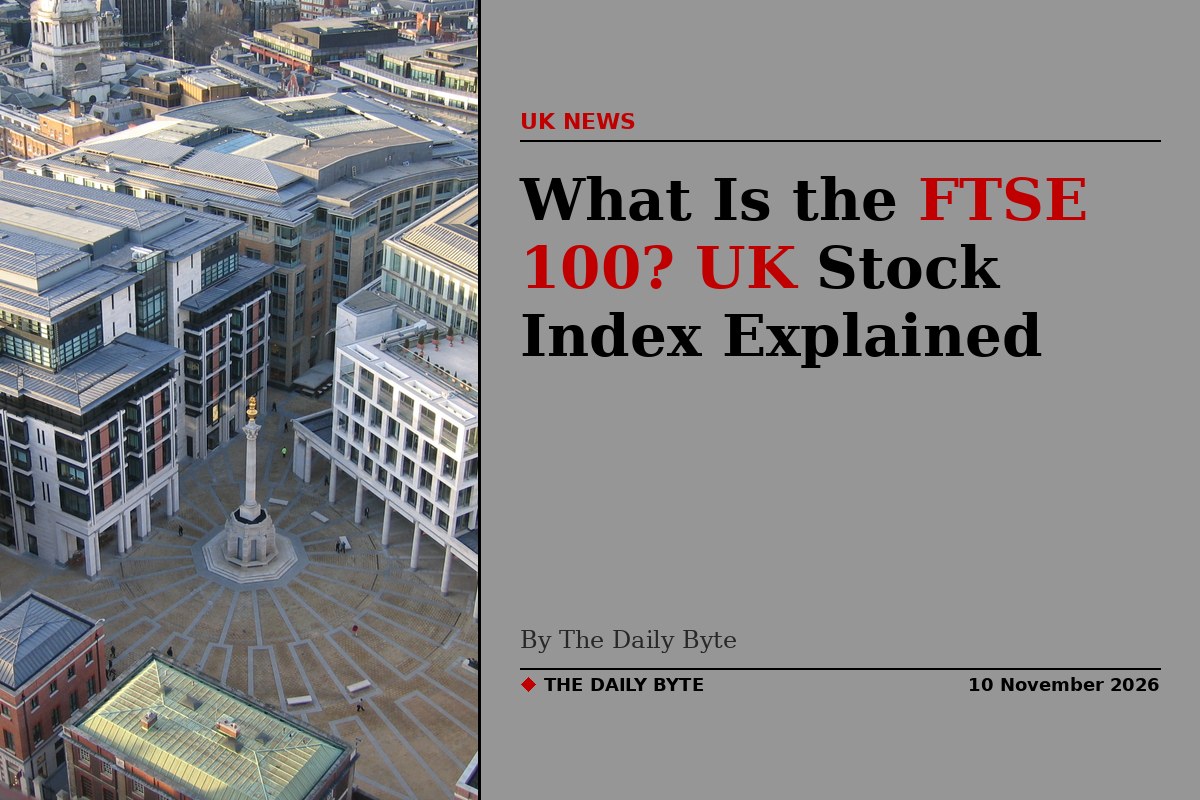
The FTSE 100 is an index of the 100 largest companies listed on the London Stock Exchange, ranked by the value of their shares. It is the most widely quoted measure of the UK stock market, and when the news says "the Footsie is up" or "the Footsie is down", this is the number it means. It was launched on 3 January 1984 with a starting value of 1,000 points, and in early November 2026 it stood above 10,000 points.
Understanding the FTSE 100 matters because it shows up everywhere: in pension statements, in news about the economy, and in the savings products many people hold without realising it. This guide explains what the index is, how it is worked out, which companies are in it, and what it can and cannot tell you about the British economy.
What does FTSE stand for?
FTSE stands for Financial Times Stock Exchange. The name comes from the two organisations that launched the index in January 1984, the Financial Times newspaper and the London Stock Exchange. The "100" is simply the number of companies in the index. Its nickname, the "Footsie", comes from the way FTSE sounds when spoken aloud.
The index replaced an older measure, the FT30, which tracked just 30 companies and had been the main guide to the London market since the 1930s. The FTSE 100 was designed to give a fuller picture of the market, and it is now calculated and maintained by FTSE Russell, part of the London Stock Exchange Group.
How is the FTSE 100 calculated?
The FTSE 100 is weighted by market capitalisation, which means bigger companies count for more. A company's market capitalisation is its share price multiplied by the number of its shares. Only shares available to the public, known as free float, are counted, so shares locked up by governments or founding families do not carry the same weight.
Each company's influence on the index is roughly in proportion to its size. That is why a sharp move in a giant such as HSBC or AstraZeneca can move the whole index, while a similar percentage move in one of the smallest members barely registers. The index is calculated in real time during trading hours, so its level changes second by second while the market is open.
The level itself is a number, not a sum of money. It started at 1,000 in 1984, and its rise since then reflects the growth in the value of its member companies, adjusted for companies joining and leaving. A rise of 100 points means something different depending on the level: at 10,000 points, 100 points is a move of 1 per cent.
Which companies are in the FTSE 100?
The index holds the 100 largest eligible companies on the London Stock Exchange's main market. Among the largest by weight in recent years have been HSBC, AstraZeneca and Shell, alongside other household names such as Unilever, BP, Lloyds Banking Group and British American Tobacco. Banks, energy companies, drug makers and consumer goods firms are among the biggest sectors.
A company does not have to be British to join. It must be listed on the London Stock Exchange, meet minimum size, free float and liquidity requirements, and have its shares priced in pounds. That is why the index includes companies headquartered overseas but listed in London, as well as British multinationals that earn most of their money abroad.
Membership is not permanent. Companies grow, shrink, merge or fall out of favour, and the make-up of the index changes over time. Only a minority of the original 100 companies from 1984 remain in the index today, which is a reminder that the FTSE 100 tracks the market as it is now, not as it was decades ago.
How often does the FTSE 100 change?
The index is reviewed four times a year, in March, June, September and December, under rules published by FTSE Russell. At each review, companies are ranked by market capitalisation, and changes take effect after the close of trading on the third Friday of the review month.
To avoid constant churn, the rules use buffers. As a general rule, a company is promoted into the index if it rises to 90th place or higher in the ranking, and a current member is removed if it falls to 111th place or lower. Companies ranked between 91st and 110th generally stay where they are. These thresholds mean the index changes gradually rather than flipping with every market swing.
Companies can also leave between reviews, for example if they are taken over or delisted, and FTSE Russell applies its rules to fill the gap. Investors who track the index, including funds that aim to copy it, must then buy or sell shares to match the new line-up.
What does the FTSE 100 tell you, and what does it not?
The FTSE 100 is a good guide to the value of Britain's biggest listed companies, and because those companies are so large, it is often treated as a shorthand for the health of the UK stock market. When it rises, the largest London-listed firms are, on balance, worth more; when it falls, they are worth less. It is also the benchmark against which many UK fund managers are judged.
But it is not a pure measure of the British economy. Many of its biggest members earn most of their revenue overseas: oil companies sell globally, drug makers sell medicines worldwide, and banks operate across continents. A weak pound can even push the index up, because overseas earnings are worth more when translated back into sterling, even while UK households feel poorer.
Nor does it cover the whole market. The FTSE 100's members are large, established firms, while smaller and medium-sized companies, which often depend more on the UK economy, sit in other indices. That is why the FTSE 100 and the wider economy can move in different directions, and why economists look at jobs, wages and output figures, not just the stock market, to judge how the country is doing.
How do people invest in the FTSE 100?
You cannot buy the FTSE 100 itself, because it is only a number. Instead, people invest through funds that track it, such as index tracker funds and exchange-traded funds, which buy shares in the same companies in the same proportions. Many workplace pensions and Stocks and Shares ISAs hold such funds, so millions of people are invested in the FTSE 100 without ever choosing it directly.
Tracker funds aim to match the index, not beat it, and they usually charge lower fees than funds run by managers who pick individual shares. Some investors also trade derivatives based on the index, such as futures and spread bets, but those are higher-risk products that can lose more than the amount put in. This article is general information, not financial advice, and anyone considering investing should read the fund's own documents and consider independent advice.
FTSE 100, FTSE 250 and FTSE All-Share: what is the difference?
The FTSE 100 is part of a family of indices. The FTSE 250 holds the next 250 largest companies after the FTSE 100, and together the two make up the FTSE 350. The FTSE All-Share goes further still, covering almost all eligible companies on the London Stock Exchange's main market.
The FTSE 250 is often seen as a better guide to the domestic UK economy, because its companies tend to earn more of their money at home than the global giants of the FTSE 100. When the two indices move apart, it can signal that investors are feeling differently about Britain than about the global economy. The FTSE SmallCap covers still smaller firms, and there are also indices for the Alternative Investment Market, where younger and smaller companies list.
Frequently asked questions about the FTSE 100
Is the FTSE 100 the whole UK stock market? No. It covers only the 100 largest companies on the London Stock Exchange's main market. The FTSE All-Share covers far more companies, and the FTSE 250 covers the next 250 after the top 100.
Can I buy the FTSE 100? Not directly, because it is an index, not a share. You can invest in funds that track it, such as index trackers and exchange-traded funds, usually through a pension, ISA or investment account.
What is the Footsie? "Footsie" is the nickname for the FTSE 100, from the pronunciation of the letters FTSE, short for Financial Times Stock Exchange.
When was the FTSE 100 launched? On 3 January 1984, with a starting value of 1,000 points. It replaced the older FT30 index.
When does the FTSE 100 trade? The London Stock Exchange is open from 8am to 4.30pm, Monday to Friday, excluding public holidays, and the index is calculated throughout the trading day.