What Is Gas and Air in Labour?
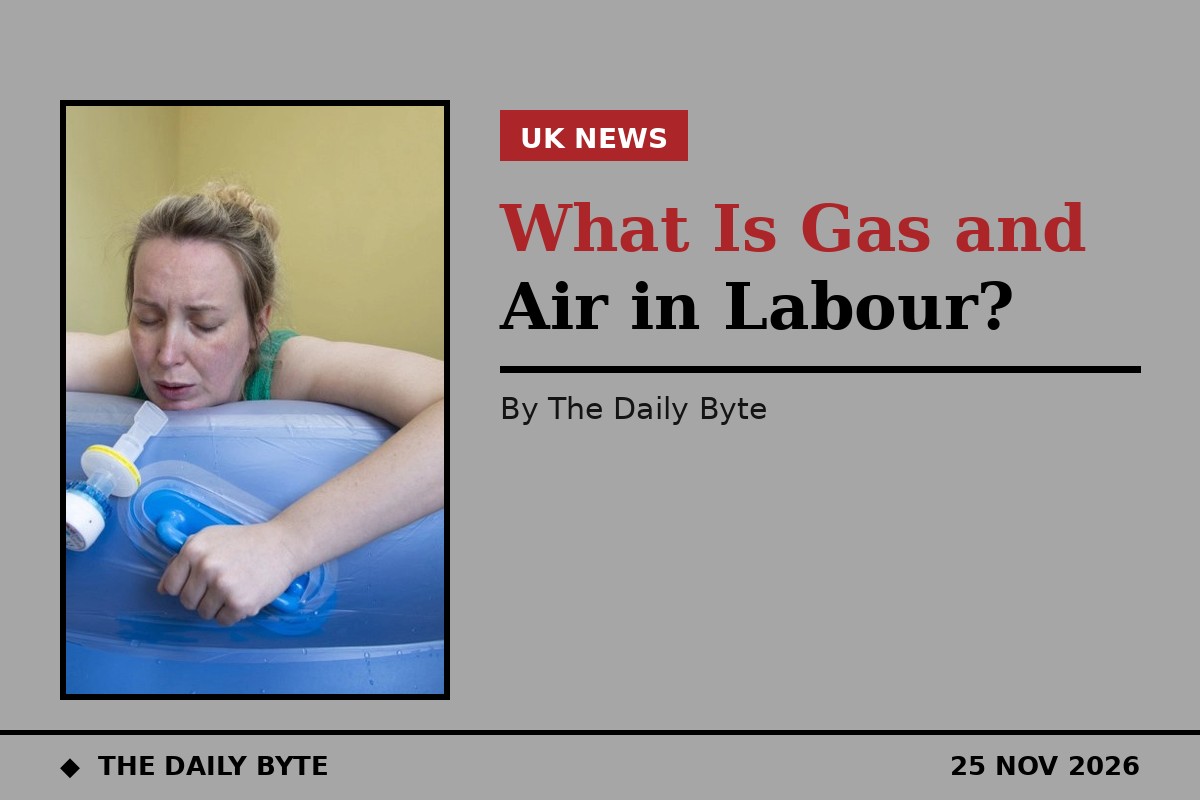
Gas and air is a pain relief mixture of nitrous oxide and oxygen, breathed in through a mouthpiece or mask during labour. It is also known by its brand name, Entonox, and it is the most commonly used drug method of pain relief in UK maternity care. You control it yourself: you breathe it in as a contraction begins, it takes about 15 to 20 seconds to work, and the effect wears off quickly once you stop. Basildon Hospital in Essex has suspended its use in the maternity suite from Thursday 26 November 2026, after years of difficulty keeping nitrous oxide levels in the air safe for staff — a decision that has left many expectant parents asking what gas and air is, how it works, and what they can use instead.
What is gas and air?
Gas and air is a colourless, odourless gas made up of 50% nitrous oxide and 50% oxygen. The mixture is supplied either through a portable cylinder or through piped apparatus on the ward, and it is breathed in through a mouthpiece or mask that you hold yourself. The NHS describes it as a mixture of oxygen and nitrous oxide gas that will not remove all the pain of labour, but can help to reduce it and make it more bearable. It is also sometimes called laughing gas, although in maternity care its proper name is Entonox.
Entonox has been used as a painkiller for more than 150 years, and it is used well beyond the delivery room. Ambulance crews carry it, and hospitals use it for short, painful procedures such as stitching. In labour it is used once labour is established, and it can be used throughout labour and for procedures after the birth, such as stitches. Because the person in labour holds the mouthpiece, the dose is self-controlled: you breathe it in when you need it and stop when you do not.
How does gas and air work in labour?
Gas and air is breathed in through a mouthpiece, and the nitrous oxide travels to the brain and spinal cord, where it is thought to help stop pain being felt. The nitrous oxide can also make you feel a little sleepy and more relaxed, while the oxygen helps keep oxygen levels in your blood topped up. The NHS advises that the gas takes about 15 to 20 seconds to work, so you should start breathing it in just as a contraction begins, taking slow, deep breaths. Breathing it in steadily also helps you focus on your breathing, which many people find helps them feel calm and in control during contractions.
Timing matters. If you wait until the contraction is at its worst, the gas will not have had time to take effect. Midwives usually suggest starting to breathe it in at the first sign of a contraction. Because the effect fades within a few minutes of stopping, you can use it contraction by contraction, and you can stop at any point — for example, if you want to move around, get into a birthing pool, or try something else. NHS maternity guidance notes that gas and air can be used while you are in water, and that it can be used alongside other methods of pain relief.
How well does gas and air work?
Gas and air does not take the pain of labour away. The NHS is clear on this point: it will not remove all the pain, but it can help to reduce it and make it more bearable. That is an important distinction, because people who expect complete pain relief are often disappointed. What it does well is take the edge off contractions quickly, without the need for an injection or a drip, and without the longer recovery associated with stronger drugs. It is fast-acting, easy to use, and you remain in control of it.
It is also flexible. You can use it on its own, or alongside other methods such as a TENS machine, a birthing pool, massage or other medicines. It does not affect your ability to move around in the way an epidural does, and it does not require an anaesthetist. NHS maternity leaflets describe no side effects for the baby, and the gas leaves your body quickly once you stop breathing it in. For many people it is the first pain relief they try, and some use it for the whole of their labour.
What are the side effects of gas and air?
The NHS lists the main side effects as feeling lightheaded, sick, sleepy or unable to concentrate. If this happens, you can stop using it, and the feelings usually pass very quickly. Some people also get a dry mouth, so it helps to have a drink to hand. Using gas and air for more than 24 hours can reduce levels of vitamin B12 in the body, which can cause a range of problems including vitamin B12 anaemia — a reason it is not used continuously for very long periods.
There are also some people for whom gas and air may not be suitable. NHS maternity guidance says it may not be right for you if you have lung disease, including severe asthma, or sickle cell disease. If either applies to you, your midwife or doctor will discuss other options with you. As with all pain relief in labour, the choice is yours, and your midwife will talk through the options with you during your appointments so you can make an informed decision.
What alternatives to gas and air are available?
There is a wide range of other pain relief for labour. Non-drug options include birthing pools, massage, aromatherapy and TENS machines, which pass small electrical impulses through pads on your back. Drug options include paracetamol, codeine and oral morphine, and stronger medicines given by injection such as pethidine or morphine. An epidural — an infusion of local anaesthetic through a small tube in your back — is the strongest pain relief available in labour, but it needs an anaesthetist and limits how much you can move.
At Basildon Hospital, the trust says a wide range of alternatives will be offered while gas and air is suspended, including birthing pools, massage and aromatherapy, paracetamol, codeine and oral morphine, and higher-strength alternatives such as morphine, pethidine, epidurals and local anaesthetic. Midwives are contacting people who are due to give birth and had planned to use gas and air, to talk to them about the suspension and the alternatives.
Why has Basildon Hospital suspended gas and air?
Mid and South Essex NHS Foundation Trust, which runs Basildon Hospital, has suspended the use of Entonox in the maternity suite from Thursday 26 November 2026. The problem is not the gas itself, and it is not a risk to the people giving birth. The trust says the environment has always been perfectly safe for families using the unit. The concern is for the midwives and medical staff, who can be exposed to high quantities of the gas over long periods because the exhaled gas escapes into the air of the room.
The trust says it has been trying for several years to manage the levels of nitrous oxide in the unit. It has brought in special units to remove the gas from the air and followed specialist advice, but regular testing is still showing levels that are sometimes higher than it would like. Information sent to the BBC under a Freedom of Information request showed that the legal workplace exposure limit was exceeded on two separate occasions between January and July 2026, and that there were elevated readings in five people in October, although none of those exceeded the legal limit. The trust's own specialist was still recommending a long-term ventilation fix as a high priority, and shortly after receiving that advice the trust decided to suspend use.
The decision follows a settlement last month after 120 maternity staff brought a group action against the trust, which admitted exposing staff to dangerously high levels of the gas. The Royal College of Midwives has described the halt as completely unacceptable, saying the hospital's managers have had years to make the maternity unit safe and have not done it, and that the decision reduces choice and the level of service for women. The union is urging the trust to find a long-term fix and to build it with staff and union representatives.
Christine Blanshard, the trust's chief medical officer, said the trust had made the difficult decision to suspend the use of gas and air in the maternity suite, and acknowledged the change would be extremely disappointing for families using the unit as well as for staff who want to provide the best possible birth experience. No date has been given for gas and air to return. The trust says it needs a permanent solution, and has warned that could require a significant programme of building works, so it does not yet know how long the suspension is likely to last.
Can I still use gas and air if I am due to give birth at Basildon?
Gas and air is still available in some settings run by the same trust. The trust says gas and air will still be available for home births and in other birthing centres. People who would like to continue using gas and air will have their case assessed individually. If it is considered appropriate and the pregnancy is low risk, they may choose to give birth at home or at the trust's free-standing WJC midwifery unit in Braintree. The trust says it can also explore transferring people to other hospitals, such as Southend Hospital, where gas and air is available. Anyone affected should speak to their midwife, who can talk through the options and help them decide.
Is gas and air safe for the baby?
For the baby, gas and air is considered safe. NHS maternity leaflets describe no side effects for the baby, and the gas clears from the mother's body quickly once she stops breathing it in. The trust has stressed that there is no risk to women, birthing people or their visitors from exposure to gas and air, because the exposure is relatively short-term and any effects wear off quickly. The safety concern at Basildon is specifically about staff, who may breathe in low levels of the gas over a whole shift, day after day, in a room where the air is not being cleared well enough.
There is one wider environmental point worth knowing. Nitrous oxide is a powerful greenhouse gas, and some NHS guidance notes that Entonox has many times the global warming effect of carbon dioxide. That is one reason some maternity units have been looking at ways to capture and break down the gas rather than letting it escape into the atmosphere, although that is a separate issue from the staff safety problem at Basildon.
Frequently asked questions
Can I use gas and air at home? Yes. Gas and air can be used at home with a midwife present, as well as in hospital. It is supplied in a portable cylinder for home births.
Will gas and air affect my baby? NHS maternity leaflets describe no side effects for the baby. The gas leaves your body quickly once you stop breathing it in.
Can I use gas and air with other pain relief? Yes. It can be used alongside other methods, including TENS, water, and medicines. Your midwife can advise on combinations.
How long can I use gas and air for? You can use it throughout labour, contraction by contraction. Using it for more than 24 hours can lower vitamin B12 levels, so it is not used continuously for very long periods.
What should I do if I am booked to give birth at Basildon? Speak to your midwife. The trust is contacting people who had planned to use gas and air, and can discuss alternatives, a home birth, the Braintree midwifery unit, or a transfer to another hospital such as Southend.