What Is Geothermal Energy? How It Works Explained
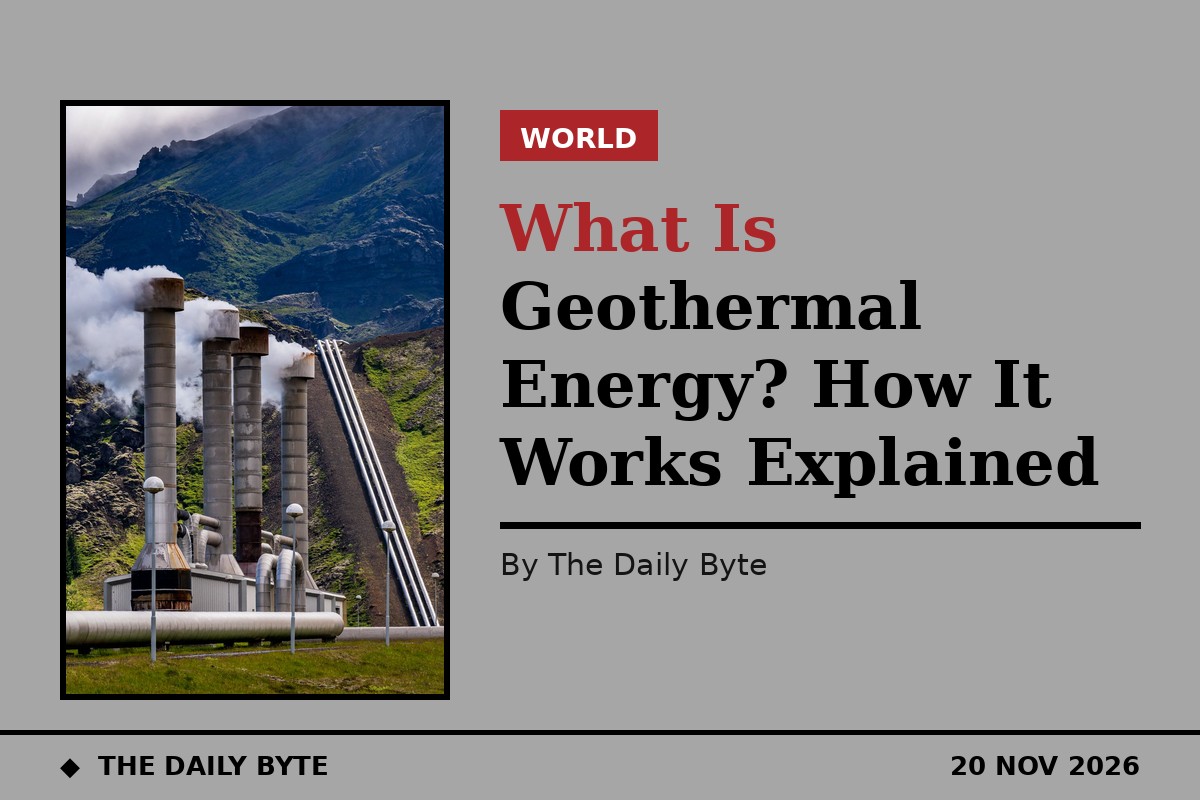
Geothermal energy is heat from inside the Earth, used to generate electricity and to heat buildings directly. It counts as renewable energy because the planet keeps producing the heat, and unlike wind and solar power it does not depend on the weather, so a geothermal plant can run day and night, in any season. The name comes from the Greek words geo, meaning earth, and therme, meaning heat.
People have used this heat for centuries, bathing in hot springs and warming homes near volcanic ground. Turning it into electricity is newer: the first geothermal power plant began operating at Larderello in Italy in 1904, using steam rising naturally from the ground. Today geothermal plants run in more than two dozen countries, and engineers are finding ways to use the heat in places that have no volcanoes at all.
Where does the Earth's heat come from?
Most of the Earth's internal heat comes from the slow breakdown of radioactive particles deep inside the planet, a process that has been going on since the Earth formed and continues today. The US Energy Information Administration (EIA) explains that rocks and water absorb heat from hot rock deep underground, and that the deeper you go, the hotter the rocks and water become.
The temperatures involved are extreme. The EIA puts the Earth's inner core, a solid ball of iron about 1,500 miles wide, at about 10,800 degrees Fahrenheit, roughly as hot as the surface of the Sun. Temperatures in the mantle, the layer of hot rock surrounding the core, range from about 392 degrees Fahrenheit near the crust to about 7,230 degrees Fahrenheit closer to the core. The crust itself, the solid outer layer that forms the continents and ocean floors, is about 15 to 35 miles thick under the continents.
That heat does not reach the surface evenly. The crust is broken into large pieces called tectonic plates, and where the plates meet, hot rock can sit close to the surface. That is where volcanoes occur, and it is also where geothermal energy is easiest to reach. In most places, though, useful heat lies kilometres down, and reaching it means drilling.
How does a geothermal power plant work?
A geothermal power plant drills wells into an underground reservoir of hot water or steam. The US Department of Energy says these wells can range from a few feet to several miles deep. Hot water or steam is brought to the surface, its heat is used to spin a turbine, the turbine drives a generator that produces electricity, and the cooled water is usually pumped back underground to be heated again.
There are three main designs, and which one is used depends on the temperature of the water and whether it arrives as steam or liquid.
| Plant type | How it works | Where it is used |
|---|---|---|
| Dry steam | Natural steam is piped straight from the reservoir to spin the turbine. This is the oldest design. | Larderello in Italy, which opened in 1904, and The Geysers in northern California, the world's largest geothermal field. |
| Flash steam | High-pressure hot water, generally above 180 degrees Celsius, is brought to the surface. As the pressure drops, some of the water flashes into steam, which drives the turbine. | The most common type of geothermal plant worldwide. |
| Binary cycle | Hot water passes through a heat exchanger and boils a second fluid with a much lower boiling point, such as isobutane. That fluid vaporises and spins the turbine while the geothermal water stays in a closed loop. | Lower-temperature resources; most new geothermal projects use this design. |
The binary design matters because it opens up cooler resources that the other two designs cannot use, and because the geothermal water never touches the turbine or the open air, the plant releases almost no gases into the atmosphere.
What else can geothermal heat be used for?
Electricity is only one use. The Department of Energy lists three broad applications: generating electricity, heating and cooling buildings, and direct use of hot water. Geothermal heat pumps use the stable temperature of the ground as a heat source in winter and a heat sink in summer, providing heating and cooling for individual buildings. District heating systems link heat pumps together to warm groups of buildings, campuses and even whole communities.
Direct use means taking hot water from wells, usually deeper than the wells used for heat pumps, and using it as it is: to heat buildings and greenhouses, to warm water for fish farming, and to supply heat for industrial processes such as drying pulp, paper and lumber. In the UK, the Boiler Upgrade Scheme offers grants towards ground source heat pumps, including water source pumps and those on shared ground loops, according to GOV.UK.
What is enhanced geothermal energy?
Conventional geothermal plants need three things underground: hot rock, water, and cracks the water can move through. Many places have the heat but not the water or the cracks. Enhanced geothermal systems, known as EGS, aim to fix that by creating the reservoir artificially. Engineers drill into hot, dry rock, open cracks in it, and circulate water through the cracks to collect heat and bring it back to the surface.
The International Energy Agency (IEA) says techniques developed by the oil and gas industry, including a strong understanding of the subsurface, drilling and completing wells, and managing large-scale projects, can rapidly drive down costs and help tap geothermal resources deeper in the ground. Its 2024 report on the future of geothermal energy estimates that, with continued cost reductions, geothermal could meet up to 15 percent of global electricity demand growth to 2050, or as much as 800 gigawatts of capacity.
The US Department of Energy's 2019 GeoVision analysis put the potential for the United States alone at up to 60 gigawatts of electricity-generating capacity, more than 17,000 district heating systems and up to 28 million geothermal heat pumps by 2050. A later analysis, under its Enhanced Geothermal Shot programme, put the potential higher still, at 90 gigawatts of geothermal electricity by 2050 if aggressive cost reductions in enhanced systems can be achieved.
Where in the world does geothermal energy work best?
Geothermal power is most developed where the Earth's heat sits close to the surface: Iceland, the western United States, Indonesia, the Philippines, New Zealand, Kenya and Italy. The United States has the largest installed geothermal capacity in the world. Iceland heats homes and streets with geothermal water, and Kenya gets a large share of its electricity, about 43 percent in 2022 according to US EIA figures, from geothermal plants in the Rift Valley.
The UK has no volcanoes, but it does have hot granite. Cornwall sits on a 300-million-year-old granite spine, and the British Geological Survey has described the granites of south-west England as a significant untapped geothermal resource. Two projects there have now moved from research to reality.
At United Downs, near Redruth in Cornwall, the UK's first deep geothermal power plant started generating electricity in February 2026. The plant uses a binary cycle system, has a gross capacity of 3 megawatts, and draws water above 180 degrees Celsius from a production well 5,275 metres deep in measured depth, the deepest well ever drilled in the UK. The site also extracts lithium from the hot water. At the Eden Project near St Austell, a single well drilled 4,871 metres vertically has been supplying heat at 85 degrees Celsius to the project's biomes and other buildings since June 2023. Augusta Grand, chief executive of Eden Geothermal, has called deep geothermal "the missing piece of the jigsaw", describing it as a renewable source that provides baseload power and heat from a very small piece of land.
What are the strengths and the limits of geothermal energy?
Geothermal energy's biggest strength is that it is always on. A geothermal plant provides baseload power, running steadily through the night, through winter and through calm, cloudy weather, which makes it a useful partner for wind and solar power. Plants also take up little land compared with other energy sources, can run for decades, and produce far lower emissions than fossil fuels, with binary plants releasing almost nothing because their water stays in a closed loop.
The limits are real. Drilling deep wells is expensive, and the geology underground cannot be seen in advance, so a project can spend heavily before knowing whether it will work. That upfront risk has held the industry back, and it is why the IEA says permitting, licensing and project development risks still need to be addressed for geothermal to scale up. Conventional plants can only be built where hot water already exists underground, which is why enhanced systems matter: they could open up far more of the map, but fracturing rock deep underground has raised concerns about small tremors, and projects are monitored for seismic activity.
Even with those limits, the direction of travel is clear. The technology to drill deeper and cheaper already exists, borrowed from the oil and gas industry, and the heat itself is not going anywhere: the Earth will keep producing it for as long as anyone needs to plan for.
Frequently asked questions
Is geothermal energy renewable? Yes. The EIA classes it as renewable because the Earth constantly produces the heat, mainly through the slow breakdown of radioactive particles deep inside the planet.
Can geothermal energy power a whole country? No country runs entirely on geothermal power, but Iceland heats most of its homes with it and Kenya gets about two-fifths of its electricity from it. Globally it remains a small share of electricity, with the IEA estimating it could reach 800 gigawatts by 2050.
Is geothermal energy expensive? Drilling and building a plant costs a lot upfront, and there is a risk that a well disappoints. Once built, running costs are low because there is no fuel to buy, and costs are expected to fall as drilling techniques improve.
Does geothermal energy cause earthquakes? Most geothermal plants operate without earthquakes that people can feel. Enhanced systems, which fracture hot rock underground, can cause small tremors, which is why projects monitor seismic activity and regulators set limits on it.
Sources: US Energy Information Administration, Geothermal Explained | International Energy Agency, The Future of Geothermal Energy (2024)


