What Is HIPAA? US Health Privacy Law Explained
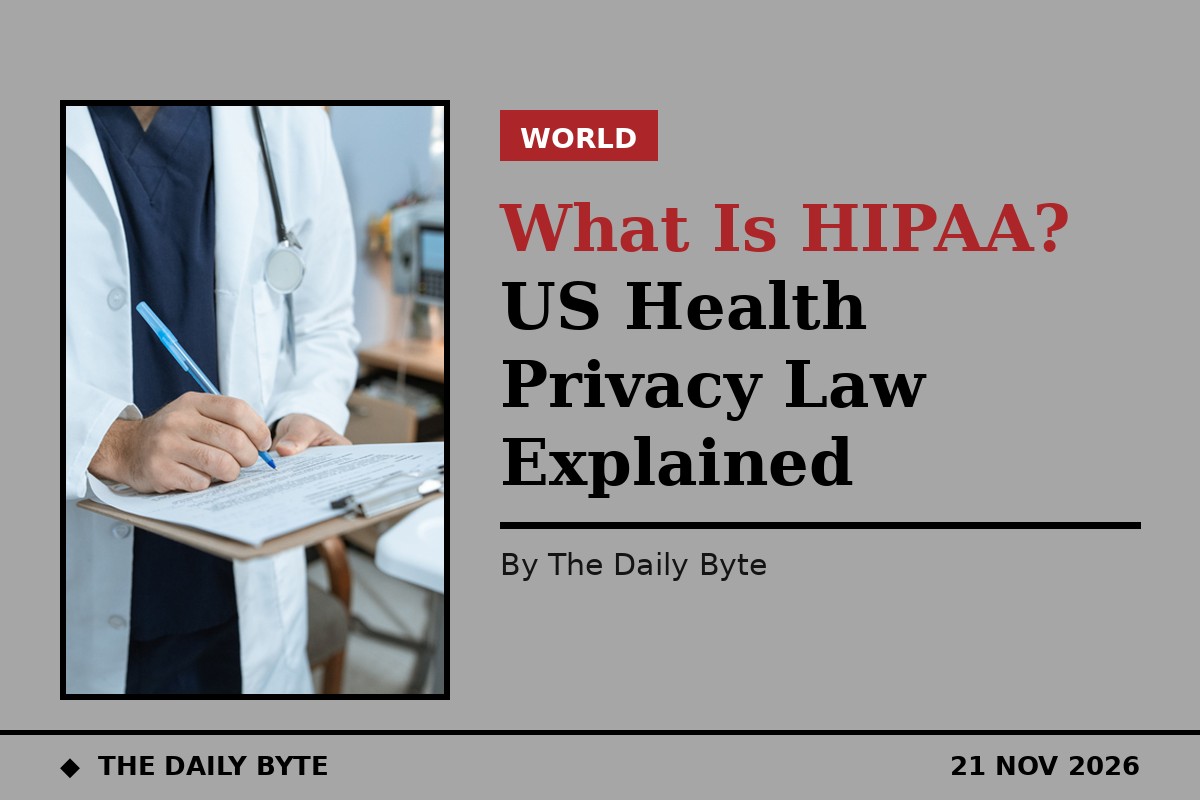
HIPAA is the United States federal law that sets the rules for who can see, use and share your medical records. Its full name is the Health Insurance Portability and Accountability Act of 1996, and it is the reason hospitals, doctors and health insurers in America must ask for your permission before passing your health information to someone else. The law is back in the news because the US Department of Health and Human Services issued a major final rule on 16 November 2026 that changes how quickly patients can get their own records, cutting the waiting time in half.
Most Americans encounter HIPAA as a form they sign at a doctor's surgery or a hospital reception desk. That form is a privacy notice, and it explains how the organisation will use and protect their information. But HIPAA is much wider than a signature on a clipboard. It covers the whole system of rules that decides when a hospital can share a patient's test results with another doctor, when an insurer can look at a claim, and when a patient can demand to see everything held about them.
Understanding what HIPAA does, and what it does not do, matters because the law is often misunderstood. It does not make medical records secret from everyone in every situation, and it does not cover every organisation that holds health information. This explainer sets out what HIPAA is, who has to follow it, what rights it gives patients, and what changed in November 2026.
What does HIPAA stand for?
HIPAA stands for the Health Insurance Portability and Accountability Act of 1996. It was enacted on 21 August 1996 as Public Law 104-191. The name reflects the law's two original aims. The first was portability: making it easier for people to keep their health insurance when they changed jobs. The second was accountability: setting national standards to protect sensitive health information.
HIPAA itself is a wide-ranging statute. The parts that most people hear about come from rules that the Department of Health and Human Services, known as HHS, was required to write under the Act. The most important of these is the Privacy Rule, formally called the Standards for Privacy of Individually Identifiable Health Information. There is also a Security Rule, which deals with electronic health information, and a Breach Notification Rule, which requires organisations to tell patients when their information has been improperly accessed or disclosed.
The Privacy Rule was published in the Federal Register in December 2000 and modified in August 2002. It was the first set of national standards in the United States for the protection of certain health information, and it is the part of HIPAA that governs day-to-day decisions about sharing medical records.
What is the HIPAA Privacy Rule?
The Privacy Rule sets national standards for how health information may be used and disclosed. It applies to information called protected health information, or PHI, which is individually identifiable information about a person's health, the care they have received, or payment for that care. That can include a diagnosis, a prescription, a test result, an appointment record or an insurance claim, in paper, electronic or spoken form.
The rule works on a simple principle. A covered organisation may not use or disclose a person's PHI except as the rule permits or requires, or as the person authorises in writing. There are important exceptions. A hospital does not need a patient's written authorisation to use their information to treat them, to run its own operations, or to get paid. It can also share information without authorisation in defined situations such as public health reporting, law enforcement requests that meet the rule's conditions, and emergencies where sharing is needed to protect someone's health or safety.
At the same time, the rule gives individuals rights over their own information. Patients have the right to see and get a copy of their health records, to ask for corrections, to receive a notice explaining how their information is used, and to ask for an account of certain disclosures. The November 2026 final rule strengthens the most used of these rights, the right of access.
Who has to follow HIPAA?
HIPAA does not apply to everyone. The Privacy Rule applies to organisations called covered entities. There are three kinds. The first is health care providers, such as doctors, hospitals, clinics and pharmacies, that transmit health information electronically in connection with certain transactions. The second is health plans, including health, dental, vision and prescription drug insurers, health maintenance organisations, Medicare and Medicaid, and employer-sponsored group health plans. The third is health care clearinghouses, which process health information into standard formats.
Organisations that work for covered entities and handle PHI on their behalf are called business associates. A medical billing company, a cloud storage provider holding patient records, or a law firm advising a hospital can all be business associates, and they must also follow the Privacy Rule's safeguards.
Many organisations that hold health information are not covered entities at all. An employer is generally not a covered entity, although an employer that runs a self-insured health plan can be one in that capacity. A life insurer, a school, a fitness app, or a wearable device company is generally outside HIPAA unless it is acting for a covered entity. That is why a health app on a phone may not be bound by HIPAA even though a hospital's own patient portal is.
What counts as protected health information?
Protected health information is health information that can be linked to a specific person. It includes information about a person's past, present or future physical or mental health, the health care they have received, and payment for that care. A name, address, date of birth or medical record number attached to a diagnosis is PHI. The same diagnosis with all identifying details removed is not.
The rule also applies the minimum necessary principle. When a covered entity uses or discloses PHI, it must generally limit itself to the smallest amount of information needed for the purpose. A hospital sending a bill to an insurer should send the billing details, not the patient's full medical history.
There are limits to what the rule can do. Once information has been properly disclosed with a patient's authorisation, HIPAA no longer controls what the recipient does with it. And the rule does not override state laws that give patients stronger privacy protections; where a state law is stricter, the state law applies.
Your right to see your own medical records
One of the most practical rights under HIPAA is the individual right of access. A patient can ask a hospital, doctor or health plan for a copy of the health information it holds about them in a designated record set, which broadly means the records used to make decisions about their care. The organisation must respond as soon as practicable and, until now, no later than 30 calendar days after receiving the request, with one extension of up to 30 days allowed.
Patients can also ask for their electronic health information to be sent to a person or an app of their choice. This is how someone can have their test results sent directly to a personal health app rather than collecting a paper copy. Fees for copies are limited by the rule, and organisations cannot charge patients for looking at their own records in person or for accessing them through a patient portal or other internet-based method.
In practice, many patients have found the 30-day limit slow, and complaints about delays in getting records are among the most common that the HHS Office for Civil Rights receives. That frustration is one of the reasons the 2026 final rule focused on access.
What changed in the November 2026 final rule?
On 16 November 2026, the HHS Office for Civil Rights issued a final rule titled HIPAA Privacy Rule: Changes to Support Coordinated Care and Individual Engagement and Reduce Regulatory Burdens. The rule runs to 363 pages and finalises, with changes, proposals first published in a notice of proposed rulemaking in January 2021. It was scheduled for publication in the Federal Register on 19 November 2026, and it takes effect 60 days after publication, with regulated organisations required to comply 180 days after the effective date.
The headline change is speed. Covered entities must now act on an individual's request for access to their own records as soon as practicable and no later than 15 calendar days after receiving the request, down from 30 days. The existing option of one extension of up to 30 calendar days is retained. The 15-day period is an outer limit, not a waiting period, and it includes the time spent verifying the requester's identity and obtaining information from business associates.
The rule also clarifies that a patient's request to send their electronic health information to a personal health app is an exercise of their own right of access, not a disclosure to a third party. It adds formal definitions of an electronic health record and a personal health application to the regulations. On fees, organisations that charge for copies must post a fee schedule, and they may not charge for in-person inspection or for access through internet-based methods such as patient portals.
Other changes make it easier for health plans and providers to share information for individual-level care coordination and case management, and streamline the Notice of Privacy Practices that organisations must give patients, including removing the requirement to obtain a written acknowledgement that the patient received the notice. Taken together, the changes are designed to make it faster and simpler for patients to get their own health information, and easier for the organisations that care for them to coordinate that care.
What HIPAA does not cover
Because HIPAA is so widely mentioned, its limits are worth stating plainly. It is a United States law, so it does not govern hospitals or health systems in other countries, including the United Kingdom, where the UK GDPR and the Data Protection Act 2018 perform a similar role. It does not give patients a right to have their records deleted. It does not prevent a doctor from discussing a case with another clinician involved in the patient's care. And it does not stop public health authorities from receiving the information they need to track infectious diseases.
It also does not cover every privacy worry. An employer asking an employee about a health condition, a school holding a child's medical form, or a shop selling a fitness tracker are all generally outside HIPAA, even though other laws may apply to them. When someone says a request for information violates HIPAA, the first question is usually whether the organisation making the request is a covered entity at all.
What happens if the rules are broken?
HIPAA is enforced by the HHS Office for Civil Rights, which investigates complaints from patients and can audit covered entities and business associates. The office can impose civil money penalties for violations and can refer the most serious cases, such as knowingly obtaining or disclosing health information under false pretences, for criminal prosecution. Patients who believe their rights have been violated can file a complaint with the Office for Civil Rights.
The November 2026 final rule does not change that enforcement framework, but it does change what patients can expect in practice. A request for medical records that once could lawfully take a month must now be answered within 15 days, and a patient who wants their results in a health app of their choosing has a clearer right to ask for that. For a law that is now 30 years old, that is a significant modernisation, and it is why the rule has become one of the most consequential health privacy changes in the United States in years.