What Is Hybrid Warfare? Meaning, Tactics, Examples
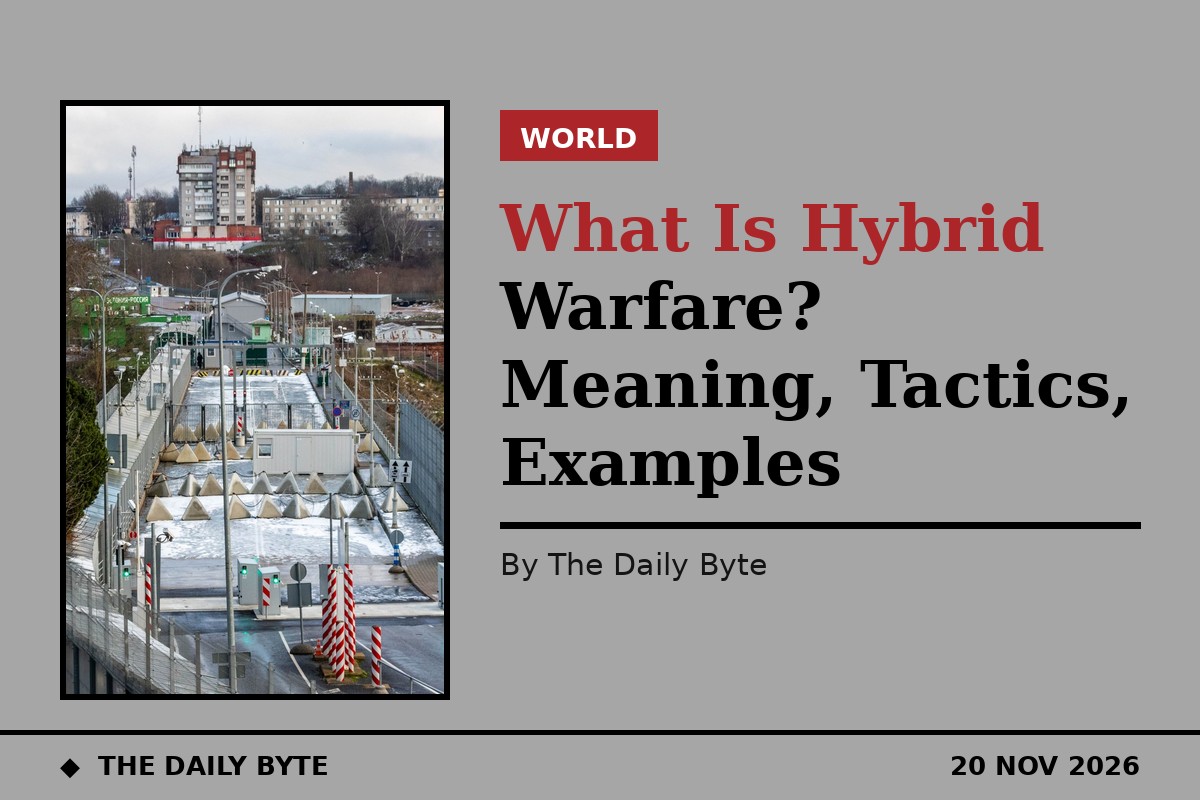
Estonia is closing its border with Russia. Poland says Russian missiles have landed on its territory. Denmark's military intelligence says the hybrid war is escalating. The phrase "hybrid warfare" is now appearing in headlines almost every day, but what does it actually mean? It is a term that covers a wide range of hostile actions, from cyberattacks and disinformation to sabotage and airspace violations, all carried out in a way that stops short of open war.
Understanding the term matters, because it describes the kind of conflict Europe is actually experiencing: not tanks crossing borders, but a steady accumulation of incidents that are individually deniable and collectively damaging, designed to pressure, divide and exhaust the countries they target.
What does hybrid warfare mean?
There is no single, universally accepted definition of hybrid warfare, and analysts disagree about how useful the term is. The definition most often quoted by governments comes from NATO. In its 2016 Warsaw communique, NATO defined hybrid threats as a "broad, complex, and adaptive combination of conventional and non-conventional means, and overt and covert military, paramilitary, and civilian measures, employed in a highly integrated design by state and non-state actors to achieve their objectives."
The idea itself is older than the label. The term was defined in its modern form by the American military analyst Frank Hoffman in 2007, to describe adversaries who use several types of warfare at the same time, blending conventional fighting with irregular tactics, cyberattacks, criminal activity, terrorism and information operations as part of one coordinated campaign.
Two features run through almost every definition. The first is combination: hybrid warfare mixes many different tools at once, rather than relying on a single weapon. The second is deniability: the actions are usually designed to stay below the threshold of open war, and to be hard to attribute to any one actor, so that the target finds it difficult to respond.
The hybrid toolkit
The tools of hybrid warfare are deliberately varied, because variety is what makes the campaign hard to pin down. Disinformation and propaganda are among the most common: fake news websites, manipulated social media, deepfakes and state-backed media outlets used to spread false stories, inflame divisions and undermine trust in democratic institutions.
Cyber operations are another core tool, ranging from espionage and the theft of data to destructive malware aimed at power grids, financial systems, hospitals and other critical infrastructure. Economic pressure is also used, including energy coercion, trade restrictions and the manipulation of markets, as is political pressure, such as supporting separatist or extremist movements and interfering in elections.
Physical sabotage has become increasingly prominent. In the Baltic Sea, undersea pipelines and cables have been damaged in incidents Western officials often describe as sabotage, most notably the attack on the Nord Stream gas pipelines in September 2022, whose perpetrators have never been identified. More recently, GPS jamming and spoofing have disrupted civilian aviation and shipping, drones have intruded into the airspace of NATO countries and around military bases and airports, and arson attacks have targeted defence companies and logistics hubs.
Military pressure is usually kept just below the level of war: unmarked special forces, as in Crimea in 2014, when undeclared Russian personnel known as "little green men" seized key sites; proxy militias and mercenaries; and the use of organised crime or other intermediaries to carry out attacks while the state behind them keeps its distance.
Why is hybrid warfare so hard to answer?
Hybrid warfare is effective precisely because it exploits the gap between peace and war. A single cyberattack, a damaged cable, a drone incursion or an arson attack is rarely, on its own, an act of war. It may not even be possible to prove who did it. Russia consistently denies responsibility for such incidents, and attribution often requires months of intelligence work. By the time one incident is investigated, several more may have happened.
That ambiguity creates a dilemma for the countries targeted. Responding too forcefully risks escalation into a conflict nobody wants. Responding too weakly invites more of the same. Denmark's Defence Intelligence Service captured the problem in an assessment published in September, warning that Russia had intensified its use of sabotage and destructive cyberattacks and was attacking targets in Europe with drones, and concluding bluntly that "the hybrid war is escalating". Dutch military intelligence has warned separately of a real risk of unintended escalation, as suspicious incidents and military encounters accumulate.
There is also a legal problem. NATO's Article 5, the collective-defence pledge, is triggered by an armed attack. It is not obvious that a cyberattack, a sabotaged cable or a disinformation campaign counts as one, even if the damage is serious. That is why NATO has spent years debating when, if ever, a hybrid attack could trigger a collective response, and why much of the response to hybrid threats has taken place outside the framework of Article 5 altogether.
Recent examples in Europe
The pattern is visible across several recent incidents. In Crimea in 2014, unmarked soldiers, cyberattacks, sponsored protests and disinformation were combined in a single campaign to seize territory while denying that any invasion was taking place. It remains the textbook example of hybrid warfare.
In the Baltic Sea, a series of damaged undersea cables and pipelines in late 2024 prompted NATO to launch Operation Baltic Sentry in January 2025, combining frigates, maritime patrol aircraft and naval drones to protect critical infrastructure. According to a senior NATO official who briefed the European Parliament in November, the last such incident was in January 2026, and the operation has made further sabotage too costly to attempt.
In Estonia, the government said on Friday 20 November 2026 that it would close its road border crossings with Russia from 1 December for at least six months, on security grounds. The decision follows an alleged arson attack on Threod Systems, an Estonian defence company, which Tallinn said on 15 November was staged by Russian security services. Estonia's foreign minister said the closure was not a response to a single incident but the next step after Russia's attack on Ukraine and a growing number of sabotage and hybrid operations across Europe. Russia accused Estonia of trying to erect a new Iron Curtain and said it would respond with political and diplomatic measures.
On the same day, Poland reported that two suspected Russian missiles and a jet-powered drone had violated its airspace during a large-scale Russian attack on Ukraine, the second such incursion in just over a year. Poland invoked NATO's Article 4 consultation mechanism after a similar drone incursion in September 2025.
How are NATO and Europe responding?
The response has been built around deterrence, resilience and attribution. NATO has launched dedicated operations such as Baltic Sentry in the Baltic Sea and Eastern Sentry on its eastern flank, giving commanders standing authority to adjust patrols and surveillance quickly when a threat emerges. The alliance has also built networks linking governments, the military, industry and the European Union to protect undersea infrastructure, and the EU has adopted a cable-security action plan and sanctions against Russia's so-called shadow fleet of tankers.
Governments have also become more willing to name the actor they believe is responsible. Public attribution, once rare, is now routine: Estonia publicly blamed Russia for the attempted arson attack on Threod Systems, and Western governments have repeatedly attributed cyberattacks and sabotage to Moscow, even when Russia denies it. The aim is to strip away the deniability that hybrid warfare depends on.
Resilience is the third pillar. NATO's 2026 resilience requirements cover the ability of societies to keep functioning through disruption, from power and communications to food and medical supplies. The logic is that a country which can absorb a cyberattack or a sabotaged cable without panic is a harder target than one which cannot.
What hybrid warfare is not
Not every cyberattack or fake news story is hybrid warfare, and the term has its critics. Some analysts argue that it is too vague to be useful, a catch-all label applied to almost any hostile act that is not a conventional military attack. Others point out that states have always mixed military, economic and information pressure, and that what is new is the technology, particularly cyber and social media, rather than the concept.
Those criticisms are worth keeping in mind. Hybrid warfare is a description of a pattern, not a legal category, and it does not by itself determine what response is justified. But as a description of what Europe is experiencing, from damaged cables in the Baltic to a closed border in Estonia and missiles over Poland, it captures something real: a campaign of pressure, conducted across many domains at once, deliberately kept below the threshold of war.
Sources: UK Parliament: Ministry of Defence evidence on the UK response to hybrid threats | Military Times: On NATO's lake, Nordic allies worry about escalation with Russia | Reuters: Russia accuses Estonia of erecting new Iron Curtain with border closure