What Is ILO Convention 190? Workplace Safety Explained
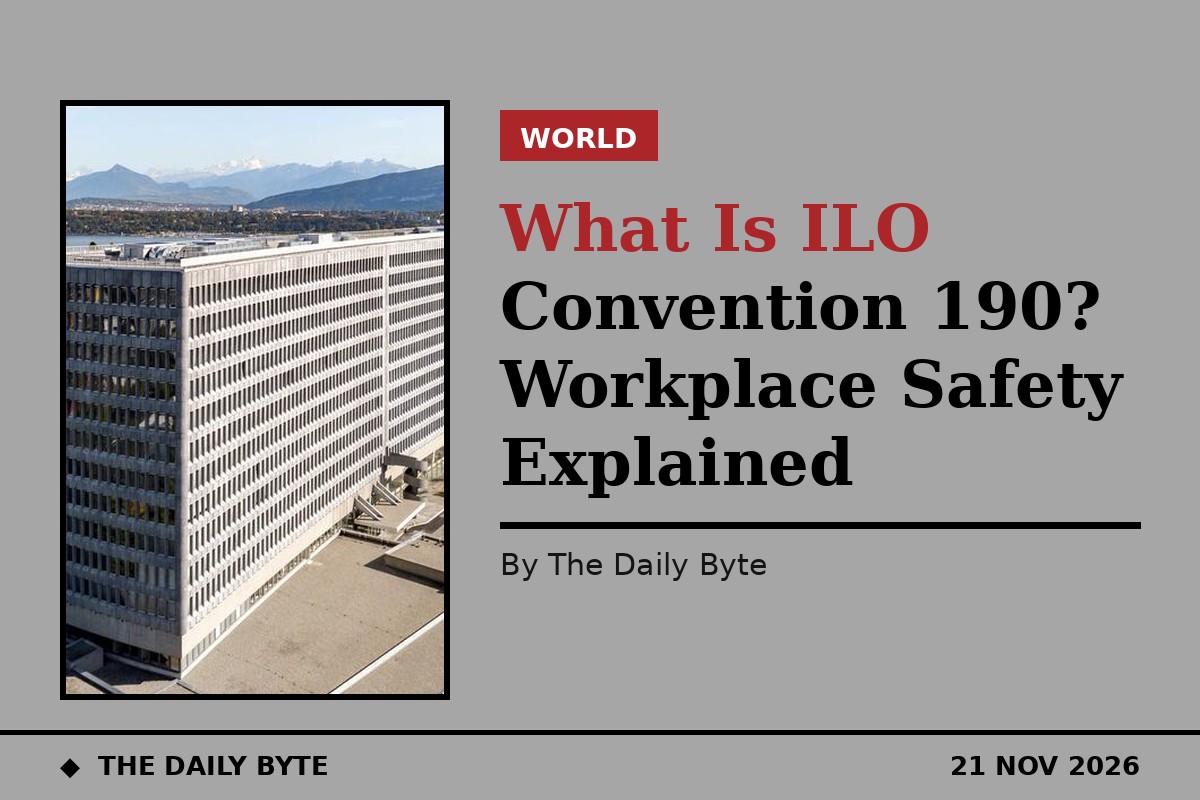
On 19 November 2026, the Netherlands became the 58th country in the world to ratify ILO Convention No. 190, the global treaty against violence and harassment at work. The Dutch government deposited its instrument of ratification with the International Labour Organization (ILO) in Geneva, joining a fast-growing list of countries that have signed up to the treaty since it was adopted in 2019. But what is ILO Convention 190, what does it actually require, and what difference does ratification make? This explainer sets out the answers.
In short, Convention No. 190 is the first international treaty to set out a clear and comprehensive framework for preventing and addressing violence and harassment in the world of work, including gender-based violence and harassment. It does not itself write any country's laws. Instead, it binds every government that ratifies it to put laws, policies and enforcement systems in place, and to hold employers to account for preventing abuse at work.
What is ILO Convention 190?
Convention No. 190 is formally called the Violence and Harassment Convention, 2019 (No. 190). It was adopted by the ILO, the United Nations agency for the world of work, in 2019. It is accompanied by Recommendation No. 206, which gives governments practical guidance on how to put the Convention into effect. Together, the two instruments set out what the ILO describes as an inclusive, integrated and gender-responsive approach to the problem.
The Convention matters because, before it existed, there was no single international treaty dealing with violence and harassment at work as a whole. Countries tackled the issue through a patchwork of equality laws, health and safety rules and criminal law, and many workers fell through the gaps. The ILO says Convention No. 190 is the first international instrument to establish a clear and comprehensive basis for preventing and addressing violence and harassment in the world of work, including gender-based violence and harassment. It is also, according to the ILO, the fastest ratified ILO convention of the past decade.
The treaty applies to violence and harassment in the world of work, a deliberately broad phrase. It covers behaviour in the course of, linked with or arising out of work, which means it is not limited to what happens at a desk or on a factory floor. It can cover work-related trips, work-related communications, employer-provided accommodation and the commute in some circumstances, depending on how each country writes its own laws. The focus is on the connection to work, not on a single place.
What counts as violence and harassment at work?
The Convention deals with violence and harassment broadly, including gender-based violence and harassment. That covers a wide range of unacceptable behaviour, from physical assault and threats to bullying, sexual harassment and other forms of abuse that cause harm or are likely to cause harm. The ILO's own guidance stresses that the problem is not only about individual misconduct. It is also about the conditions that allow abuse to happen, including psychosocial hazards such as excessive workload, poor work organisation, discrimination and abuses of power.
In the Netherlands, the debate has centred on what the Dutch call sexually transgressive behaviour, a term covering sexual harassment and other inappropriate sexual conduct at work. Wilm Geurts, the Dutch Director of International Affairs who deposited the ratification, told the ILO that violence and harassment at work remains a major problem in the Netherlands as well as worldwide, and that research shows it still occurs far too often and that its consequences are frequently severe. In 2025, 17% of employees in the Netherlands experienced such behaviour, according to the ILO's interview with Geurts.
Who does ILO Convention 190 protect?
The protection is deliberately wide. The Convention is designed to protect workers and other persons in the world of work, including people who may not be covered by ordinary labour law. That breadth matters, because harassment often affects the most precarious people in a workplace: temporary staff, trainees, job applicants, volunteers and people working in supply chains.
The ILO's guide to the Convention explains that the inclusive approach refers to this broad personal scope, as well as to the need for governments to consult employers' and workers' organisations so that different needs and realities are captured. The gender-responsive element means countries must tackle the root causes of gender-based violence and harassment and reduce their harmful effects, rather than treating all abuse as identical. The integrated element means the issue must be addressed across labour and employment law, occupational safety and health, equality and non-discrimination law and, where appropriate, criminal law.
What must countries and employers do?
Ratifying countries must adopt laws and regulations requiring employers to take appropriate steps, commensurate with their degree of control, to prevent violence and harassment in the world of work. Article 9 of the Convention sets out four specific duties. Employers must adopt and implement a workplace policy on violence and harassment, drawn up in consultation with workers and their representatives. They must take violence and harassment and the associated psychosocial risks into account in managing occupational safety and health. They must identify hazards and assess the risks of violence and harassment, with the participation of workers and their representatives, and take measures to prevent and control them. And they must provide workers and other people concerned with information and training, in accessible formats where appropriate, on the hazards and risks identified and on the prevention and protection measures, including on the rights and responsibilities of workers.
The Convention also requires enforcement and remedies. Article 10 deals with enforcement, and the ILO's guidance says prevention and risk management will not succeed without training and awareness-raising. Article 11 requires governments to address violence and harassment in relevant national policies, to provide guidance, tools, education and training, and to run awareness-raising campaigns. Awareness-raising on its own is not treated as enough; it is one part of a wider strategy.
Importantly, the employer's duties are qualified. The measures must be appropriate and correspond to the employer's degree of control, and they should be taken so far as is reasonably practicable. An employer cannot be held responsible for situations beyond its control, and the measures expected of a small business will differ from those expected of a large employer. Each ratifying country must decide how to define that degree of control and how the duties will be enforced in its own legal system.
Why did the Netherlands ratify it now?
The Netherlands deposited its instrument of ratification on 19 November 2026. Wilm Geurts, Director of International Affairs at the Dutch Ministry of Social Affairs and Employment, handed it to the ILO Director-General, Gilbert F. Houngbo, in Geneva. Geurts said the Netherlands was pleased to have ratified the Convention, describing it as dealing with something fundamental: a just, respectful and safe workplace for all, free from violence and harassment. He said the international labour standards in the Convention were vital to that goal, along with social dialogue between governments, employers and workers.
Houngbo welcomed the move, noting that violence and harassment is a pervasive phenomenon that can affect all people in the world of work, in all sectors and all countries. By ratifying, he said, the Netherlands commits to a world of work free from violence and harassment, based on dignity and respect for all. The Netherlands becomes the 58th country in the world, and the 17th member state of the European Union, to ratify Convention No. 190.
The Dutch government has pointed to its National Action Programme to combat sexually transgressive behaviour and sexual violence, which started in 2023 and runs until the end of 2026. The programme brings together healthcare, education, the justice system, national and local government, civil society and the social partners. The government also provides free e-learning for managers and supervisors to help them recognise, prevent and address sexually transgressive behaviour at work, and support continues through guidance materials and a subsidy scheme for demanding work.
The Netherlands has said it already complies with the Convention in its legislation and regulations, but that this is no reason for complacency. Geurts said the Convention provides important standards against which the Netherlands will continue to assess its policies. The country has now ratified 67 ILO Conventions and one Protocol in total.
How widely has Convention 190 been ratified?
With the Netherlands, 58 countries have now ratified Convention No. 190, including 17 of the European Union's member states. The ILO describes it as the fastest ratified ILO convention of the past decade, a sign of how quickly governments have moved on an issue that was once treated as a private matter between individuals rather than a workplace safety issue.
Ratification numbers matter because the Convention only binds the countries that ratify it. Each ratification extends the treaty's reach and adds to the pressure on other governments to follow. The ILO supervises how ratifying countries apply the Convention, and workers' and employers' organisations can raise complaints if a government fails to live up to its commitments.
What changes for workers after ratification?
Ratification is a commitment, not an instant change to the law. The Convention binds the government that ratifies it, and the practical change for workers comes through national law, workplace policies and enforcement. In the Netherlands, the government says its laws already meet the Convention's standards, so the immediate effect is a public commitment and a benchmark for future policy, rather than a sudden rewrite of the rules.
For workers elsewhere, the Convention's value lies in the standard it sets. It gives unions, employers and governments a shared framework: a written workplace policy, risk assessments that include harassment, training for staff and managers, and clear routes to complain and seek a remedy. It also makes clear that prevention is the employer's job, not the victim's. That is why the treaty is cited in workplaces far beyond the 58 countries that have ratified it, and why each new ratification, including the Netherlands on 19 November 2026, is treated by the ILO as a step towards a world of work free from violence and harassment.


