What Is Inflation? UK CPI at 3.5% Explained
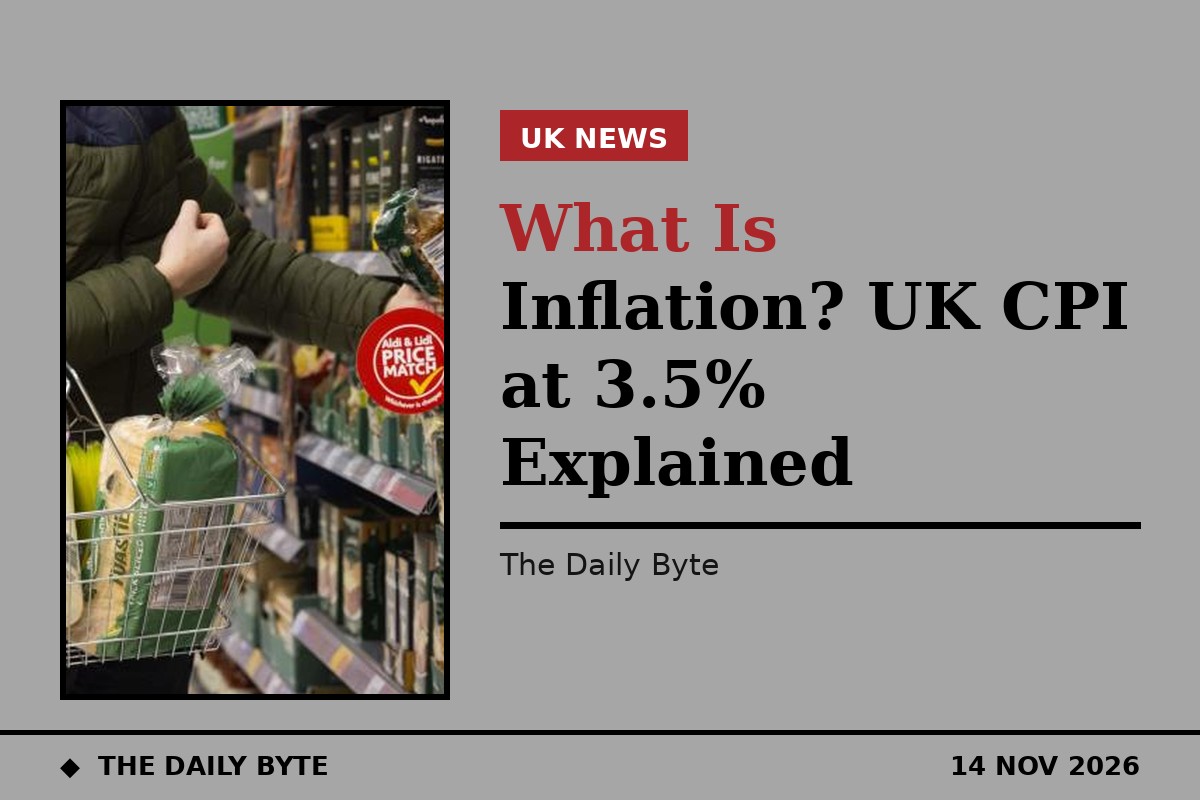
Inflation is the rate at which the prices of goods and services rise over time. In the UK it was 3.5% in the year to September 2026, according to the Office for National Statistics (ONS), up from 3.1% in August. That means prices were, on average, 3.5% higher than a year earlier — so something that cost £100 in September 2025 cost about £103.50 in September 2026.
How is inflation measured?
The ONS collects around 180,000 prices of about 700 items every month, from food and fuel to haircuts and train tickets, and combines them into the Consumer Prices Index (CPI). CPI is the measure the Bank of England targets. A broader measure, CPIH, also includes owner-occupiers' housing costs; it rose by 3.6% in the year to September, up from 3.3% in August.
What pushed UK prices up in September?
Motor fuels made the largest upward contribution to the change in the annual rate. Average petrol rose 8.2p a litre to 169.5p between August and September, diesel rose 10.7p to 192.5p, and motor fuel prices were up 29.8% on a year earlier. Transport inflation rose from 4.6% to 6.6%. Core CPI, which strips out energy, food, alcohol and tobacco, rose from 2.6% to 2.8%, services inflation rose from 3.4% to 3.7%, and goods inflation rose from 2.7% to 3.2%.
Why does the Bank of England target 2%?
The Government sets the Bank of England a target of keeping CPI inflation at 2%. The aim is for prices to rise gradually and predictably, while avoiding both high inflation and deflation, when prices fall. If inflation misses the target by more than one percentage point in either direction, the Bank's Governor must write an open letter to the Chancellor explaining why. At 3.5%, inflation is above the target and outside the one-point band.
How does the Bank try to control inflation?
Raising Bank Rate makes borrowing dearer and saving more rewarding, cooling spending and, over time, easing pressure on prices. On 5 November 2026 the Bank's Monetary Policy Committee voted eight to one to raise Bank Rate from 3.75% to 4%, the first rise since August 2023. The Bank blamed higher energy prices linked to the Middle East conflict, and expects inflation to reach around 5% by the middle of 2027 before easing back.
Does falling inflation mean prices fall?
No. If inflation falls from 3.5% to 2%, prices are still rising, just more slowly. Prices only fall when inflation turns negative, which is called deflation. That is why a lower rate can still feel like the cost of living is rising: the weekly shop costs more than a year ago, even if it is rising less quickly.
What happens next?
The ONS publishes October inflation figures on Wednesday 18 November 2026. The Bank's next rate decision is due on 17 December 2026.
Frequently asked questions
What is the difference between CPI and CPIH? CPI is the main measure. CPIH is the same basket plus owner-occupiers' housing costs. In September CPI was 3.5% and CPIH was 3.6%.
Is 3.5% inflation high? It is above the Bank of England's 2% target and the highest since October 2025. It is well below the 11%-plus peak of 2022.
What is core inflation? Core CPI leaves out energy, food, alcohol and tobacco, whose prices swing sharply. It was 2.8% in September, up from 2.6% in August.
Sources: Office for National Statistics and Bank of England.