What Is the International Criminal Court (ICC)?
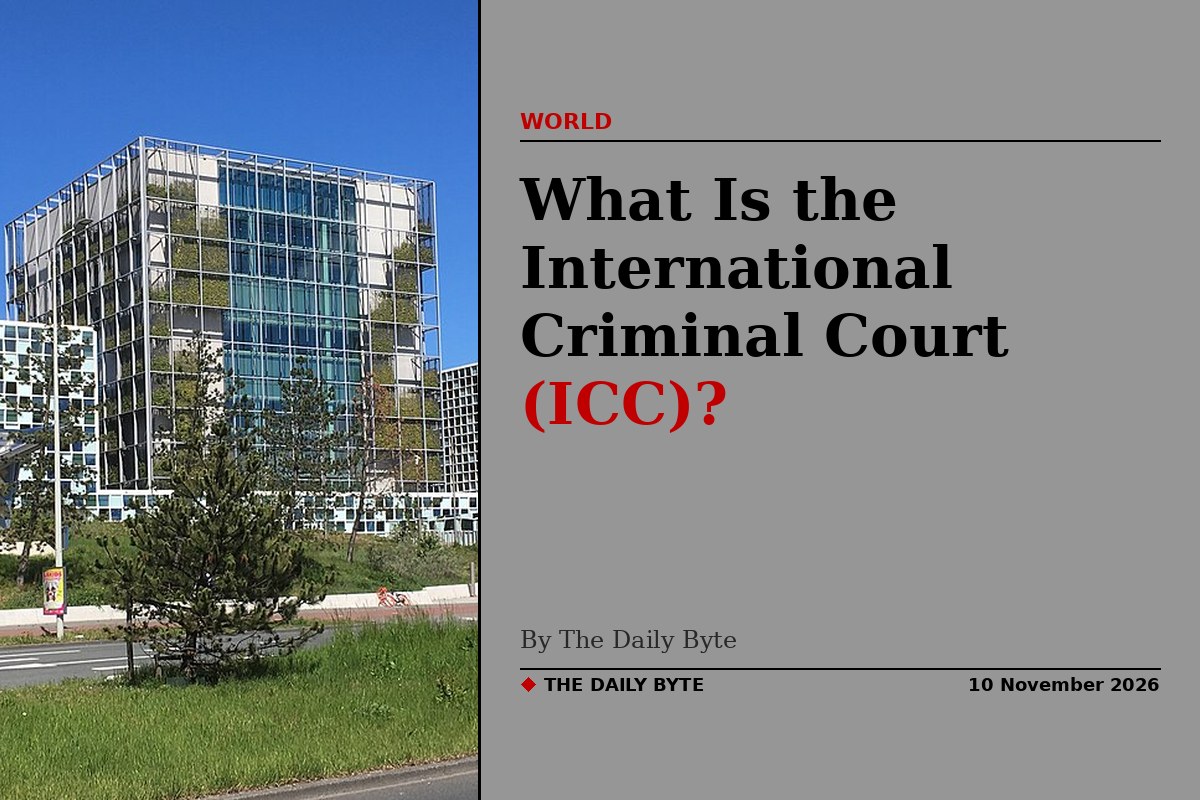
The International Criminal Court, known as the ICC, is a permanent international court based in The Hague, in the Netherlands, that tries individuals accused of the most serious crimes under international law: genocide, crimes against humanity, war crimes and the crime of aggression. It was created by a treaty called the Rome Statute, adopted in 1998, and it began operating in 2002. A total of 124 countries are parties to the treaty, although several major powers, including the United States, China, Russia and India, are not members.
Unlike a national court, the ICC does not replace domestic justice systems. It steps in only when a country is unwilling or unable to prosecute these crimes itself, a principle known as complementarity. The Court tries people, not countries, and it has no police force of its own, so it depends on governments to arrest suspects and hand them over.
What crimes does the ICC prosecute?
The Rome Statute gives the Court jurisdiction over four crimes, often described as the most serious crimes of concern to the international community as a whole. Genocide means acts committed with the intent to destroy, in whole or in part, a national, ethnic, racial or religious group, including killing members of the group and causing serious bodily or mental harm. Crimes against humanity cover acts such as murder, enslavement, torture, sexual violence, persecution and enforced disappearance when they are committed as part of a widespread or systematic attack against a civilian population.
War crimes cover grave breaches of the Geneva Conventions and other serious violations of the laws of war, including the deliberate targeting of civilians, the use of child soldiers and attacks on hospitals and schools. The fourth crime, the crime of aggression, concerns the planning, preparation, initiation or waging of a war of aggression by a person in a position to control or direct the political or military action of a state. The Court's jurisdiction over aggression took effect in 2018. The ICC can only deal with crimes committed after 1 July 2002, the date the Rome Statute entered into force.
Key facts about the ICC
- Founded: the Rome Statute was adopted on 17 July 1998 and entered into force on 1 July 2002.
- Headquarters: The Hague, in the Netherlands.
- States parties: 124 countries have joined the Rome Statute.
- Judges: 18 judges, elected by the member states for nine-year terms.
- President: Judge Tomoko Akane.
- Languages: six official languages, with English and French as the working languages.
- Staff: more than 900 people from around 100 states.
- Budget: about 196.9 million euros for 2026.
- Record so far: 34 cases, 68 arrest warrants issued, 15 convictions and four acquittals, according to the Court's own figures.
How was the ICC created?
The idea of a permanent international criminal court was discussed for decades before it became reality. After the Second World War, the Nuremberg and Tokyo tribunals tried senior leaders for war crimes and crimes against humanity, but there was no permanent court to do the same work. In the 1990s the United Nations set up temporary tribunals for the former Yugoslavia and for Rwanda, which showed that international trials were possible but also that a new tribunal had to be built from scratch each time.
In June and July 1998, delegates from around the world met in Rome to agree a founding treaty. The Rome Statute was adopted on 17 July 1998 by 120 votes to seven, with 21 countries abstaining. It needed 60 ratifications to take effect, a threshold reached in April 2002, and it entered into force on 1 July 2002. The first judges took office in 2003, and the Court's first trial opened in 2009. Supporters describe the ICC as a major step towards ending impunity for the worst crimes, because before it existed there was often nobody with the authority to try them when national courts would not or could not act.
Who can the ICC prosecute, and how does a case start?
The ICC prosecutes individuals, including political and military leaders. Being a head of state or government does not give a person immunity before the Court, which is why arrest warrants have been issued for sitting leaders. The Court cannot try a country, a company or an organisation, and it cannot try anyone for a crime committed before July 2002.
A case can reach the Court in three ways. A state party can refer a situation to the Prosecutor, as many African states did in the Court's early years. The United Nations Security Council can refer a situation even where the country concerned is not a party to the Rome Statute, as it did for Darfur in Sudan in 2005 and for Libya in 2011. Or the Prosecutor can open an investigation on their own initiative, but only with the authorisation of a Pre-Trial Chamber of judges.
Even then, a case must pass the complementarity test. If a national court is genuinely investigating and prosecuting the same person for the same conduct, the ICC must step back. An arrest warrant also needs the approval of a Pre-Trial Chamber, and a trial can only begin when the suspect is in the Court's custody, because the ICC does not hold trials in the absence of the accused. This is one reason cases can take years: 34 people with outstanding arrest warrants remained at large, according to the Court's figures, while 23 people have been detained and brought before the Court.
How is the ICC different from the ICJ?
The ICC is often confused with the International Court of Justice, known as the ICJ, and both sit in The Hague, but they are different institutions with different jobs. The ICJ is the principal judicial organ of the United Nations. It settles legal disputes between states, for example over borders or treaties, and gives advisory opinions to UN bodies. It does not try individuals and it cannot send anyone to prison.
The ICC, by contrast, is an independent judicial institution created by its own treaty. It is not part of the United Nations, although the two organisations cooperate under an agreement. The ICC tries individual people for genocide, crimes against humanity, war crimes and aggression, and it can impose prison sentences of up to 30 years, or life imprisonment in the most serious cases. In short, the ICJ deals with disputes between countries, while the ICC deals with criminal responsibility of individuals.
What cases has the ICC handled?
The Court's first verdict came in March 2012, when Thomas Lubanga, a militia leader from the Democratic Republic of Congo, was convicted of recruiting and using child soldiers. It was the ICC's first completed trial and its first conviction. Since then the Court has handed down 15 convictions and four acquittals, and several cases are still at the investigation or trial stage. Situations before the Court include the Democratic Republic of Congo, Uganda, the Central African Republic, Mali, Sudan, Libya, Kenya, Afghanistan, Palestine, Ukraine and the Philippines.
Some of the most high-profile arrest warrants have been issued in recent years. In March 2023 the Court issued a warrant for Russian President Vladimir Putin over the alleged unlawful deportation and transfer of children from Ukraine. In November 2024 it issued warrants for Israeli Prime Minister Benjamin Netanyahu and former defence minister Yoav Gallant in connection with the war in Gaza. In March 2025 the former president of the Philippines, Rodrigo Duterte, was surrendered to the Court to face charges of crimes against humanity relating to his government's anti-drugs campaign. Whether any of these cases reaches trial depends on the suspects coming into the Court's custody, and on states carrying out the arrests.
Why do some countries oppose the ICC?
The Court has always been controversial. The United States, China, Russia, India and Israel are among the countries that have not joined the Rome Statute, and their reasons differ. Some argue that the Court infringes national sovereignty, while others say it is open to political influence. The United States has gone further than criticism: in February 2025 President Donald Trump signed an executive order imposing sanctions on the Court, starting with its Prosecutor, and the measures were later extended to judges and deputy prosecutors during 2025. The United Nations human rights chief and the International Bar Association condemned the sanctions as an attack on judicial independence.
The Court also faces criticism from supporters of international justice. Its early cases were almost all in Africa, which led to accusations of bias, although the Court points out that most of those situations were referred by African governments themselves or by the Security Council. Trials are slow and expensive, and the Court's dependence on states for arrests means that powerful suspects can remain free for years. Supporters reply that the ICC is the only permanent court for the gravest crimes, that it gives victims a voice through a dedicated trust fund and victim participation, and that its existence deters some crimes even when arrests do not follow.
Frequently asked questions
Is the ICC part of the United Nations? No. The ICC is an independent court created by the Rome Statute. It cooperates with the United Nations, and the Security Council can refer cases to it, but it is not a UN body.
Can the ICC try a sitting president or prime minister? Yes, in principle. The Rome Statute says official capacity does not exempt a person from criminal responsibility, and warrants have been issued for sitting heads of state. In practice, a trial can only start if the person is arrested and brought to The Hague.
Does the ICC have its own police? No. The Court relies on national police and governments to execute arrest warrants. If a state refuses to cooperate, the Court can refer the matter to the Assembly of States Parties or, where the case came from the Security Council, to the Council itself.
What happens to people convicted by the ICC? The Court can impose prison sentences of up to 30 years, or life imprisonment for the gravest crimes. Convicted people serve their sentences in countries that have agreed to take them. The Court can also order reparations to victims.
Is the UK a member of the ICC? Yes. The UK ratified the Rome Statute in 2001 and is a state party. British nationals and crimes committed on UK territory fall within the Court's jurisdiction, and the UK has incorporated the Rome Statute crimes into its own law.


