What Is Interpol? How the Global Police Body Works
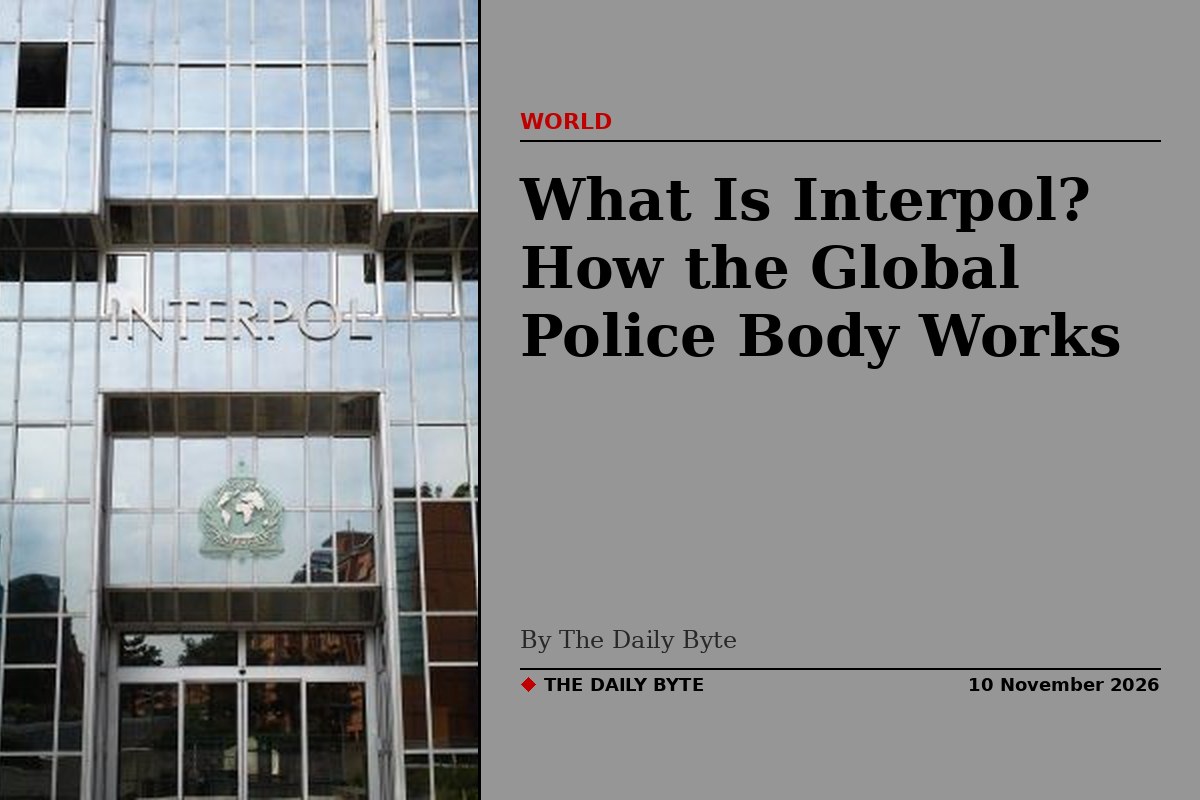
Interpol is the world's largest international police organisation, but it is not a police force in the way most people imagine it. It has no officers patrolling streets, no agents who can arrest suspects in another country, and no power to investigate crimes on its own. What it does is connect the police forces of 196 member countries, so that information about wanted people, stolen documents, fingerprints and criminal networks can be shared quickly and securely across borders. This guide explains what Interpol is, how it works, what a Red Notice really means, and what the organisation can and cannot do.
What does Interpol stand for?
Interpol is the common name for the International Criminal Police Organization, whose full official name is the International Criminal Police Organization - INTERPOL. The name began as a telegraphic address, a shortened form of "international police", and it was formally adopted as the organisation's common name in 1956. The organisation was founded in 1923 in Vienna, Austria, as the International Criminal Police Commission, after police officials from different countries agreed that criminals who crossed borders could only be caught if police forces worked together. After the Second World War its headquarters moved to France, settling first in Saint-Cloud and then, in 1989, in Lyon, where the General Secretariat still operates today.
Interpol describes its aim as enabling police around the world to work together to make the world a safer place. Its constitution says it must ensure and promote the widest possible mutual assistance between criminal police authorities, within the limits of the laws of different countries and in the spirit of the Universal Declaration of Human Rights. That is a deliberately practical mission. A fugitive who flees from one country to another, a passport stolen in one country and used in another, or a criminal gang operating across several continents all create problems that no single national police force can solve alone. Interpol exists to close those gaps.
How many countries are members of Interpol?
Interpol has 196 member countries, which makes it the world's largest international police organisation and one of the largest international organisations of any kind. Almost every country in the world is a member. Palau became the 196th member in November 2023. Each member country has a National Central Bureau, known as an NCB, which is the single point of contact between that country's police and the rest of the Interpol network. When British police want to ask colleagues abroad for help, or when a foreign force wants to alert the United Kingdom about a suspect, the request goes through the National Central Bureau.
The organisation is governed by a General Assembly, where all 196 member countries meet to take the major decisions, including electing the leadership and approving the budget and work programme. An Executive Committee oversees the work between assemblies, and the General Secretariat in Lyon runs the organisation day to day. Interpol also has regional bureaus around the world and a Global Complex for Innovation in Singapore, which focuses on research, training and new technology, including work on cybercrime. The General Secretariat operates around the clock, every day of the year, because crime does not keep office hours.
What does Interpol actually do?
Interpol's work falls into three main areas. First, it runs secure systems that let police forces share information. Its I-24/7 global police communications system gives authorised officers in member countries direct access to Interpol's databases, so that a passport presented at a border, a fingerprint taken at a crime scene or a vehicle stopped by police can be checked against international records in seconds. Interpol maintains 19 specialised databases holding records on wanted persons, missing persons, stolen and lost travel documents, stolen motor vehicles, fingerprints, DNA profiles, stolen works of art and firearms, among other things. Every day, police around the world run millions of searches against those databases.
Second, Interpol issues international alerts known as Notices. These are requests or alerts sent to all member countries, asking them to share information or to take action where their own laws allow it. Third, Interpol coordinates operations and provides training and expertise, bringing police from different countries together for joint operations against a particular crime, such as a crackdown on human trafficking routes, a sweep against online child abuse, or an operation targeting the trade in counterfeit medicines. It also helps countries build their own policing capacity, for example by training officers to use its databases or to investigate cybercrime.
Interpol focuses its operational work on three crime programmes: terrorism, cybercrime and organised and emerging crime. That last category covers a wide range of activity, including drug trafficking, human trafficking, people smuggling, environmental crime such as illegal logging and wildlife trafficking, financial crime and corruption, and crimes against children. The choice reflects the crimes that most often cross borders and that most often need international cooperation to investigate. A cybercrime gang, for example, may have its members in one country, its servers in another and its victims in a dozen more, and only a coordinated international response stands much chance of stopping it.
What is a Red Notice?
A Red Notice is Interpol's best-known tool, and also its most misunderstood. A Red Notice is a request to law enforcement worldwide to locate and provisionally arrest a person pending extradition, surrender or similar legal action. It is issued by the General Secretariat at the request of a member country, or of an international tribunal, and it must be based on a valid national arrest warrant. Red Notices are often described in news reports as international arrest warrants, but that is not accurate. A Red Notice is not an arrest warrant. It is an alert that asks other countries to act, and each country decides for itself, under its own law, whether to arrest the person, and whether to extradite them.
That distinction matters. Interpol does not order any country to arrest anyone, and it cannot force a country to hand a suspect over. The decision to arrest and the decision to extradite are made by national authorities and courts, applying their own laws and, in many cases, the terms of an extradition treaty. A person named in a Red Notice may be free to travel in one country and liable to arrest in another, depending on how each country treats the notice. In the United Kingdom, for example, a Red Notice does not by itself give police the power to arrest; an arrest normally requires a domestic warrant or another legal basis.
Red Notices are only one of several types of notice. A Blue Notice asks for additional information about a person, or help in locating or identifying them in connection with a criminal investigation. A Green Notice warns other countries about a person considered a threat to public safety, for example a convicted offender who may travel. A Yellow Notice is used to help locate missing persons, often children. A Black Notice seeks information about an unidentified body. An Orange Notice warns of an event, person, object or process that poses a serious and imminent threat to public safety. A Purple Notice shares information about the methods, devices and hiding places used by criminals. There is also a special notice issued at the request of the United Nations Security Council, aimed at people and groups subject to UN sanctions, and a newer Silver Notice, which helps countries trace criminal assets such as property and bank accounts so that they can be seized or confiscated.
What Interpol cannot do
The most important limit on Interpol is that it is not a law enforcement agency itself. It has no police officers with powers of arrest, it does not send agents into other countries to investigate crimes, and it does not prosecute anyone. That surprises many people, because films and television dramas often show Interpol agents chasing suspects around the world. In reality, all arrests, investigations and prosecutions are carried out by national police forces, applying national law. Interpol's role is to make it easier for those forces to work together, not to replace them.
A second limit comes from Article 3 of Interpol's constitution, which strictly forbids the organisation from undertaking any intervention or activities of a political, military, religious or racial character. That rule is meant to keep Interpol neutral, so that it is used for ordinary criminal law and not as a weapon against political opponents, journalists or refugees. In practice, the line is not always easy to draw. Requests for Red Notices are checked by the General Secretariat against Interpol's rules before they are published, and a request that appears to be politically motivated should be refused. There is also an independent watchdog, the Commission for the Control of Interpol's Files, which anyone can ask to check whether Interpol holds data about them, and to ask for that data to be corrected or deleted.
Even so, the misuse of Red Notices has been a persistent criticism. Human rights groups, lawyers and journalists have documented cases in which governments have sought Red Notices against dissidents, business rivals and people who have been granted refugee status in another country. Interpol has tightened its checks in response, including stronger review of requests involving refugees and people with asylum, and a policy of deleting notices where the underlying case is found to be political. Critics say the safeguards still do not go far enough, and that a Red Notice can cause serious harm even before it is withdrawn, for example by blocking travel or freezing bank accounts. Supporters of the system argue that the vast majority of Red Notices concern serious ordinary crime, and that without them many fugitives would simply move to a country that did not know they were wanted.
How does Interpol work with the UK?
The United Kingdom has been a member of Interpol since its early years, and the National Central Bureau is the bridge between British policing and the global network. When UK police investigate a crime with an international element, they can use the bureau to check Interpol databases, to ask other countries for information, or to request a notice. When a foreign force wants help from the UK, the request comes the other way. The system is used every day for routine checks as well as for major investigations, for example when a passport is checked at the border against the database of stolen and lost travel documents, or when a fingerprint from a crime scene is compared with records held abroad.
Interpol's databases are also used in areas the public rarely sees. Border officers can check whether a travel document has been reported stolen. Police investigating vehicle crime can check whether a car has been reported stolen in another country. Officers working on missing persons cases can circulate a Yellow Notice to ask police worldwide to look out for a child. None of this involves Interpol officers taking action themselves. It involves national officers using a shared system to find information that would otherwise take weeks of formal requests to obtain, if it could be obtained at all.
Why does Interpol matter?
Interpol matters because crime has become more international while policing remains national. A fraudster can run a scam from a laptop in one country against victims in twenty others. A terrorist network can recruit, fund and plan attacks across continents. A trafficking gang can move people through half a dozen countries before they reach their destination. No single police force can follow that trail alone, and formal diplomatic requests for help are often too slow for an investigation that needs answers in hours. Interpol's databases, its secure communications network and its notices give police a faster, standardised way to ask for help and to share what they know.
That does not make Interpol a world police force, and it does not mean its alerts are always right. It is a network, not an authority, and its strength depends on the quality of the information its members put into it and on the care with which requests are checked. Used properly, it helps police catch fugitives, find missing children, stop stolen documents being used at borders and dismantle criminal networks that operate across continents. Used badly, it can be turned against the very people it is meant to protect. Understanding that balance, between cooperation and control, is the key to understanding what Interpol is.
Frequently asked questions
Is Interpol a police force? No. Interpol is an intergovernmental organisation that helps national police forces cooperate. It has no officers with powers of arrest, and it does not investigate crimes or prosecute suspects itself.
What is a Red Notice? A Red Notice is a request to police worldwide to locate and provisionally arrest a person pending extradition, based on a valid national arrest warrant. It is not an international arrest warrant, and each country decides under its own law whether to act on it.
How many countries are in Interpol? Interpol has 196 member countries. Each one has a National Central Bureau that links its police to the network, and the General Secretariat is based in Lyon, France.
Can Interpol arrest someone in the UK? No. Interpol cannot arrest anyone anywhere. Arrests in the UK are made by UK police under UK law, and a Red Notice alone does not give them the power to arrest.
When was Interpol founded? Interpol was founded in 1923 in Vienna, Austria, as the International Criminal Police Commission. The name Interpol was adopted as its common name in 1956, and its headquarters moved to Lyon in 1989.
Sources: Royal Canadian Mounted Police, INTERPOL and Wikipedia, Interpol.


