What Is the JEF? Joint Expeditionary Force Explained
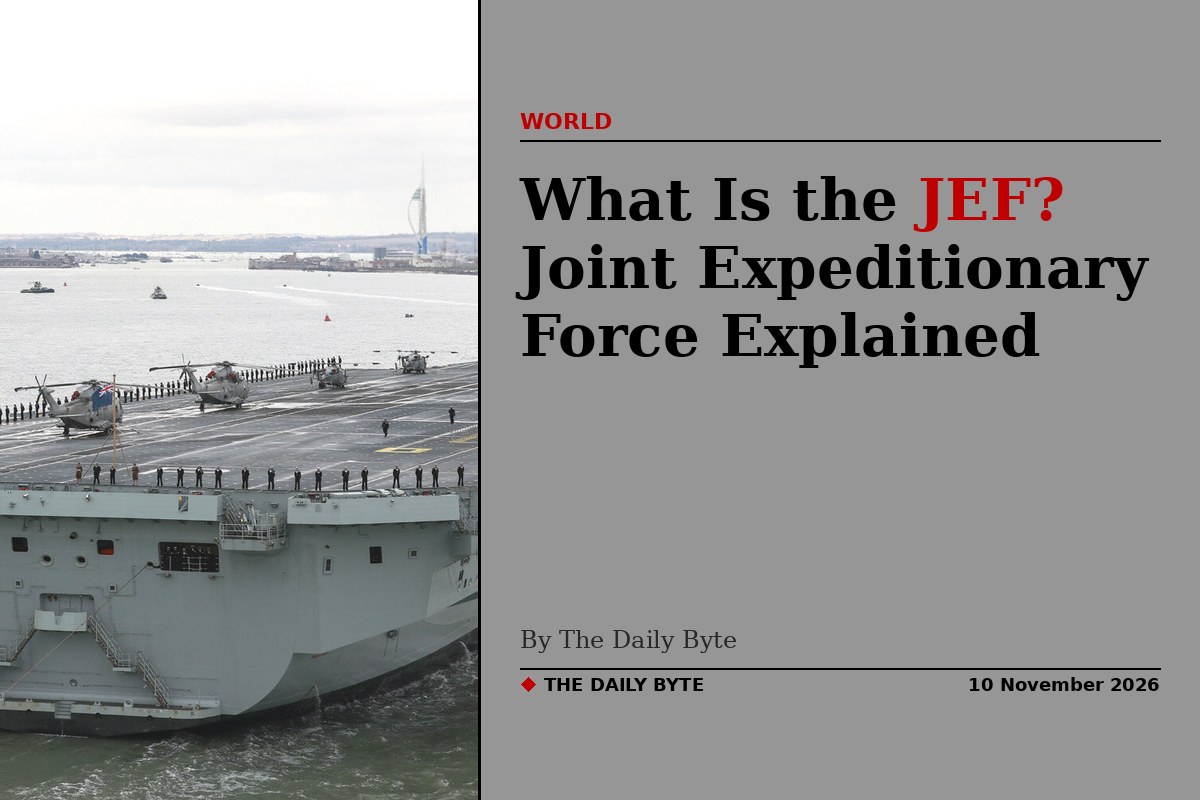
The Joint Expeditionary Force, or JEF, is a UK-led military partnership of ten northern European nations built to respond quickly to crises in the High North, the North Atlantic and the Baltic Sea. It is not part of NATO, although all ten of its members are now NATO members, and it is designed to act fast, with whatever forces its members choose to contribute, in situations that may fall below the threshold of a full NATO response. On Tuesday 10 November 2026, the ten JEF nations signed a naval partnership agreement in Oslo, aboard the Royal Navy aircraft carrier HMS Prince of Wales, committing themselves to joint action against Russian submarines and to the protection of shipping and undersea cables and pipelines.
This guide explains what the JEF is, who belongs to it, how it works, how it differs from NATO, and why it is suddenly at the centre of European defence news.
Which countries are in the JEF?
The JEF has ten members: the United Kingdom, Denmark, Estonia, Finland, Iceland, Latvia, Lithuania, the Netherlands, Norway and Sweden. The United Kingdom is the framework nation, which means it provides the command structure, the headquarters and much of the planning, and it leads the force in operations.
- United Kingdom — framework nation and lead, providing the command headquarters.
- Denmark, Norway, Sweden, Finland and Iceland — the Nordic members, covering the High North, the Arctic approaches and the Baltic exits.
- Estonia, Latvia and Lithuania — the Baltic states, on NATO's eastern flank.
- Netherlands — the North Sea and Atlantic partner, with a significant navy and amphibious capability.
All ten are now members of NATO. That was not the case when the force was created: Finland and Sweden were then neutral, and joined NATO only in 2023 and 2024 respectively. The JEF's membership gives it a geographic logic: together, its members surround the Baltic Sea, guard the Greenland-Iceland-UK gap through which Russian ships and submarines must pass to reach the Atlantic, and cover the approaches to the Arctic.
When was the JEF created?
The JEF was established in 2014, at the NATO summit in Wales, in the months after Russia seized Crimea. Seven countries signed up at the start: the UK, Denmark, Estonia, Latvia, Lithuania, the Netherlands and Norway. Their governments signed the founding agreement at Lancaster House in London on 30 November 2015.
Finland and Sweden joined in 2017, bringing the total to nine, and Iceland became the tenth member in April 2021, when its ambassador signed a note of joining with the then UK Defence Secretary. A comprehensive memorandum of understanding signed on 28 June 2018 declared the force fully operational, with the ability to deploy more than 10,000 personnel.
The idea behind it was a gap in the existing arrangements. NATO is a powerful alliance, but its decisions require consensus among all its members, and its most serious commitment, the collective defence clause known as Article 5, is reserved for an armed attack on a member. The JEF was designed for the space below that threshold: fast, flexible action by a smaller group of like-minded countries that share a region and a threat, without waiting for the whole alliance to agree.
What does the JEF do?
The JEF is a high-readiness force configured to respond rapidly to crises in support of NATO security, in the words of the UK government. Its geographic focus is the Arctic and High North, the North Atlantic and the Baltic Sea region.
Crucially, it has no standing force. There is no permanent JEF army, navy or air force waiting in barracks. Instead, each member decides, case by case, which forces to contribute to a particular activity, and the UK can conduct a JEF activity with one or more of the participating countries. That flexibility is the point: the force can be assembled in different shapes for different tasks, from a naval patrol to an exercise, a show of presence or a humanitarian response.
In practice, JEF activity has included joint exercises, maritime patrols, the monitoring of undersea infrastructure, and rapid deployments to the Baltic region. Its forces have trained together across the North Atlantic, the High North and the Baltic Sea, practising joint command and control, amphibious landings, maritime interdiction and the protection of critical national infrastructure. In August to October 2026, the force conducted Exercise Lion Protector 26, a wide-ranging operation across the region, and JEF defence ministers met in Iceland on 2 October 2026 to review it.
Operational command is led by the UK's Standing Joint Force Headquarters in London, which plans and directs JEF activities and provides information about them through the force's own website.
What happened in Oslo on 10 November 2026?
On Tuesday 10 November 2026, the ten JEF nations signed a naval partnership agreement in Oslo, aboard the British aircraft carrier HMS Prince of Wales, the Royal Navy's largest warship. The agreement commits the members to coordinated naval operations to deter Russian submarines and to safeguard shipping lanes and the undersea cables and pipelines that carry Europe's data and energy across the North Atlantic, the Arctic and the Baltic Sea.
The plan had been announced two days earlier, on 8 November, by General Sir Richard Knighton, the UK's Chief of the Defence Staff, who said the group would move from "memorandums of understanding, information exchange and consultations" to practical joint action. The signing took place during a week in which HMS Prince of Wales, which had arrived in Oslo escorted by the destroyer HMS Dauntless, the Norwegian frigate KNM Fridtjof Nansen and the coast guard vessel KV Nornen, was hosting the Atlantic Future Forum and the International Sea Power Conference.
The focus on submarines reflects a specific worry. Russian submarines have been active near the undersea cables and pipelines that link Europe, North America and Africa, and in April 2026 British forces tracked Russian submarines operating near critical undersea infrastructure in the North Atlantic. The Oslo agreement is intended to turn that kind of monitoring into a standing, joint naval effort, with shared planning, patrols and surveillance, rather than a series of one-off national operations.
The agreement also builds on a step taken earlier in 2026. In July, all ten JEF nations formally agreed a Maritime Proposition, a partnership under the wider Northern Navies initiative, committing themselves to a more persistent and integrated maritime presence, with more joint exercises, shared training, logistics and capability development.
Is the JEF part of NATO?
No. The JEF is not part of NATO, although it is intended to complement the alliance. The distinction matters in three ways.
First, the JEF has no equivalent of NATO's Article 5, the commitment that an attack on one member is an attack on all. JEF members cooperate because they choose to, not because a treaty obliges them to defend one another.
Second, the JEF can act with a subset of its members. NATO acts by consensus of all its members; the JEF can move when only some of its members are willing, which makes it faster to deploy.
Third, the JEF can operate in the grey area below armed conflict: monitoring a submarine, protecting a cable, patrolling a sea lane, or responding to sabotage or hybrid threats that would not trigger a NATO response. That is increasingly where the contest in northern Europe is fought, in the waters and on the seabed rather than on a battlefield.
None of this makes the JEF a rival to NATO. Its members describe it as a complement: a regional grouping that can act quickly and then, if a crisis escalates, hand over to or operate alongside the wider alliance. All ten JEF members are NATO members, and the force's stated purpose is to secure the Baltic Sea, the North Atlantic, the Arctic and the High North for NATO.
Could Canada join the JEF?
Canada has applied to join. Prime Minister Mark Carney announced on 16 September 2026 that Canada had formally applied for membership, and the UK government has said it supports Canada's participation. No announcement has been made that Canada has been admitted, and the application was on the agenda for discussion by JEF defence ministers.
Canada's interest is geographic as well as political. As an Arctic nation with a long northern coastline, it shares the JEF's focus on the High North, and it already works closely with the UK and other JEF members through NATO and the NORAD air defence arrangement with the United States. Membership would extend the JEF across the Atlantic, although it would also raise questions about how a North American member fits into a force built around northern Europe.
What is HMS Prince of Wales?
HMS Prince of Wales is one of the Royal Navy's two Queen Elizabeth-class aircraft carriers, and the largest warship ever built for the UK. She is 284 metres long, carries F-35B Lightning jets and Merlin helicopters, and serves as a floating headquarters for major operations and international conferences, as she did in Oslo this week.
Her presence in the Norwegian capital was itself part of the message. By signing the agreement aboard a British carrier, in a Norwegian port, in front of the assembled defence leaders of ten nations, the JEF's members were demonstrating the naval capability the pact is about, rather than simply announcing it on paper.
Frequently asked questions about the JEF
What does JEF stand for? Joint Expeditionary Force. It is a UK-led partnership of ten northern European nations, not a single standing army.
Is the JEF a new alliance? No. It was established in 2014 and has been fully operational since 2018. The Oslo agreement of November 2026 deepens its naval cooperation; it does not create a new organisation.
How many troops does the JEF have? There is no fixed number, because the force has no standing troops. When the memorandum of understanding was signed in 2018, the partners said the force could deploy more than 10,000 personnel. The actual size of any operation depends on what members contribute.
Who is in charge? The UK is the framework nation, and operational command is led by the UK's Standing Joint Force Headquarters in London. Each country decides for itself whether to contribute forces to a particular activity.
Does the JEF have nuclear weapons? No. The JEF itself has no nuclear weapons. In September 2026, Finnish media reported that Britain had offered to extend its national nuclear deterrent to the other nine JEF members, as an additional layer of protection alongside NATO's arrangements. Any decision to use UK nuclear weapons would remain with the British prime minister, and the details of that proposal have not been formally confirmed by the UK government.
What are undersea cables, and why do they matter? Undersea cables carry almost all international internet traffic and data between continents, while undersea pipelines carry gas and oil. Damaging them can disrupt communications, energy supplies and financial systems, which is why their protection has become a central task for navies in the North Atlantic and the Baltic.
The bottom line
The Joint Expeditionary Force is a practical answer to a practical problem: ten countries that share the same seas and the same security worries, organised so that they can act together quickly without waiting for a 32-nation alliance to agree. For a decade it worked mostly through exercises, meetings and memorandums. The Oslo naval pact of 10 November 2026, signed aboard HMS Prince of Wales, is the moment its members committed to turning that cooperation into standing joint naval operations, with Russian submarines and the undersea cables and pipelines of the North Atlantic, the Arctic and the Baltic at the top of the list.
Sources: Joint Expeditionary Force, jefnations.org; House of Commons Library, "What is the Joint Expeditionary Force?"; UK government and Royal Navy announcements on the JEF Maritime Proposition and Exercise Lion Protector 26; reporting of the Oslo signing of 10 November 2026.


