What Is King's Counsel? UK Silk Explained
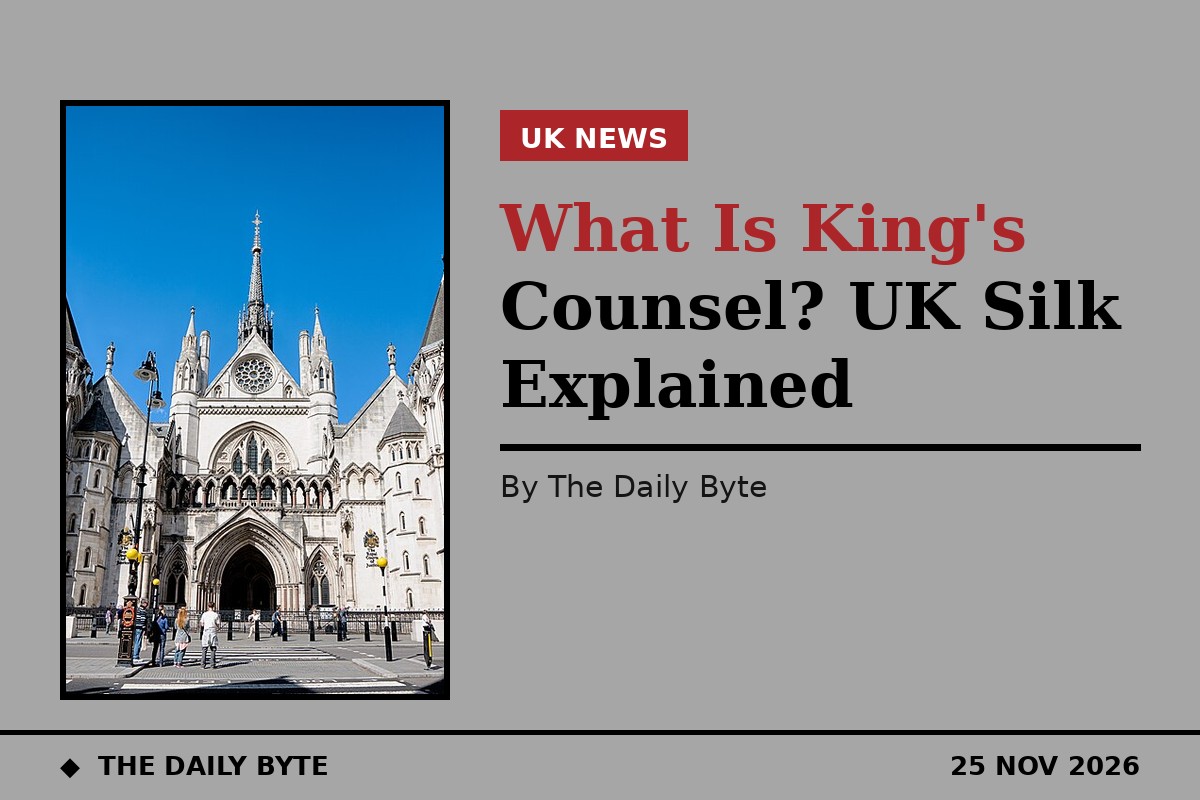
King's Counsel, usually shortened to KC, is a senior advocate in England and Wales who has been recognised for excellence in advocacy in the higher courts. The King appoints KCs on the recommendation of the Lord Chancellor, who is advised by an independent selection panel. It is not a separate profession and it is not a job in itself: a KC is still a barrister or a solicitor advocate, doing the same kind of work as before, but carrying a rank that signals to clients, judges and other lawyers that their advocacy has been tested and judged outstanding.
The rank is also known as "taking silk", because a newly appointed KC exchanges the plain black gown worn by junior barristers for a gown made of silk. In court the letters KC appear after the advocate's name, and the appointment is generally treated as the highest mark of distinction available to an advocate in England and Wales. Around one in ten practising barristers holds the rank.
Why is it King's Counsel and not Queen's Counsel?
The title follows the monarch. While Queen Elizabeth II was on the throne, senior advocates were Queen's Counsel, or QC. When she died on 8 September 2022, every QC in England and Wales became a KC overnight, with no paperwork, no ceremony and no need to reapply. The change is automatic under the Demise of the Crown Act 1901, which provides that Crown-appointed offices transfer to the new monarch when the Crown passes.
The rank itself is much older than that. The first Queen's Counsel was appointed by Queen Elizabeth I in 1597, when Sir Francis Bacon was named as counsel to the Crown. For centuries after that, silks were appointed by the monarch and acted as representatives of the Crown, which is where the "Counsel" part of the title comes from. The modern system keeps the name and the ceremony but has replaced the old method of choosing silks with an open, competitive application process.
What does a KC actually do?
A KC does the same work as any other advocate: advising clients, drafting legal arguments and presenting cases in court. The difference is the level at which they usually work. KCs are most often instructed in cases of real substance, complexity or difficulty — serious criminal trials, major commercial disputes, complex public law challenges and appeals in the Court of Appeal and the Supreme Court. They frequently appear as the leading advocate in a team, with junior barristers supporting them.
Being appointed does not give a KC any extra legal power. A KC cannot overrule a judge, cannot take a case that a junior could not take, and has no special right to be heard. What changes is professional standing and, in practice, fees: KCs usually command significantly higher fees than juniors, reflecting the scarcity of the rank and the demand for the most experienced advocates. Every barrister who is not a KC is known as a "junior", whatever their age or experience, which is why a barrister of thirty years' standing can still be described as a junior if they have never taken silk.
Who can become a KC?
Any barrister or solicitor advocate with rights of audience in the higher courts of England and Wales can apply. Historically the rank was limited to barristers, but solicitor advocates have been eligible since the mid-1990s. In practice, most successful applicants have spent years appearing regularly in complex cases before senior courts or tribunals, and the selection panel looks for excellence in advocacy in cases of real substance and difficulty, not simply a long career.
Solicitors have found the rank harder to win than barristers. Since solicitors became eligible, only 66 have been appointed out of about 231 applicants, according to the Law Society. In the most recent round, announced in January 2026, nine solicitors applied and none was appointed, while all 96 new KCs were barristers. The Law Society said it was extremely disappointed by that result. Applicants are normally expected to have substantial experience — usually at least ten years in practice — before they apply.
How does the application work?
Appointments are run as an annual competition by King's Counsel Appointments, an independent body set up in 2006 to replace the old system in which the Lord Chancellor chose silks after taking informal, private soundings from senior judges and lawyers. That old system was widely criticised as secretive and elitist, and the new body was designed to make selection fairer and more transparent. The selection panel is chaired by a lay member, someone without legal qualifications, and includes retired senior judges, senior barristers, senior solicitors and other lay members. It is independent of the Bar Council, the Law Society and the Government.
Applicants are assessed against five competencies, each judged to a standard of excellence: understanding and using the law; written and oral advocacy; working with others; diversity, action and understanding; and integrity. The application itself is demanding. Candidates list the twelve most important cases they contributed to over the previous three years, and name judges, fellow lawyers and clients who can assess their work across those competencies. The panel contacts those assessors directly. Candidates who pass the paper stage are interviewed by the panel, and those who succeed are recommended to the Lord Chancellor, who in turn recommends them to the King.
Applying is also expensive. The application fee is £2,730, which is £2,275 plus VAT, and a successful applicant pays a further appointment fee of £4,800, or £4,000 plus VAT. Reduced fees are available for lower earners. Those who are appointed are sworn in at a ceremony at Westminster Hall before the Lord Chancellor, an event known as Silk Day. The 2026 ceremony took place in March 2026.
How many new KCs were appointed in 2026?
In January 2026 the King approved the appointment of 96 new King's Counsel in England and Wales, the result of the 2025–26 selection round. The overall success rate was 29.5 per cent, with 96 appointments from 325 applicants, and it was the seventh year in a row that the success rate had fallen, down from 32 per cent the year before and 45 per cent in 2018. Of the 96 new silks, 67 were men and 29 were women. Eleven successful applicants declared an ethnic origin other than white, and four declared a disability.
| 2025–26 KC round | Figure |
|---|---|
| Applications received | 325 |
| New KCs appointed | 96 (all barristers) |
| Success rate | 29.5% |
| Men / women appointed | 67 / 29 |
| Solicitor applicants appointed | 0 of 9 |
| Honorary KCs awarded | 8 |
Eight Honorary King's Counsel were also awarded in the same round. Honorary KC, formally KC Honoris Causa, is a separate distinction for people who have made a significant, positive impact on the law of England and Wales, or on the legal profession, outside the courtroom. The 2026 honorary silks included consumer law solicitor Dean Dunham, disability and mental capacity academic Professor Rosie Harding, domestic abuse law scholar Professor Susan Edwards, public international lawyer Professor Eirik Bjorge, refugee law authority Professor James Hathaway, Judge Emma Nott, City solicitor Colin Passmore and Peter Kandler, who co-founded the UK's first law centre in North Kensington in 1970.
Is KC the same in Scotland and Northern Ireland?
No. The United Kingdom has three separate legal systems, and each runs its own silk appointments. The process described here covers England and Wales only. Scotland and Northern Ireland appoint King's Counsel under their own arrangements, with their own timetables and criteria, so a KC in England and Wales does not automatically hold the rank in the other jurisdictions. The title also exists in some Commonwealth countries, where senior advocates may still be appointed KC, but the rules differ from place to place.
Frequently asked questions
What is the difference between a KC and a barrister? A KC is a barrister, or a solicitor advocate, who has been awarded the senior rank of King's Counsel. All KCs are barristers or solicitor advocates, but most barristers are not KCs.
Does a KC outrank a judge? No. A KC is an advocate, not a judicial office. Judges are appointed separately, and a KC appearing before a court is subject to the judge's authority like any other advocate.
Can a KC lose the title? The rank is held for life in normal circumstances, but the title follows the monarch, so it changes between KC and QC when the Crown passes. A KC who is disbarred or struck off would lose the right to practise, and with it the practical use of the rank.
How much does it cost to apply for silk? For the current competition the application fee is £2,730 including VAT, with a further £4,800 including VAT payable on appointment. Reduced fees apply for lower earners.
Sources: GOV.UK — "New King's Counsel and Honorary King's Counsel welcomed by Lord Chancellor"; Law Gazette — "KC appointments: Out ranked"; Counsel Magazine — "96 new King's Counsel announced".