What Is LNG? Liquefied Natural Gas Explained
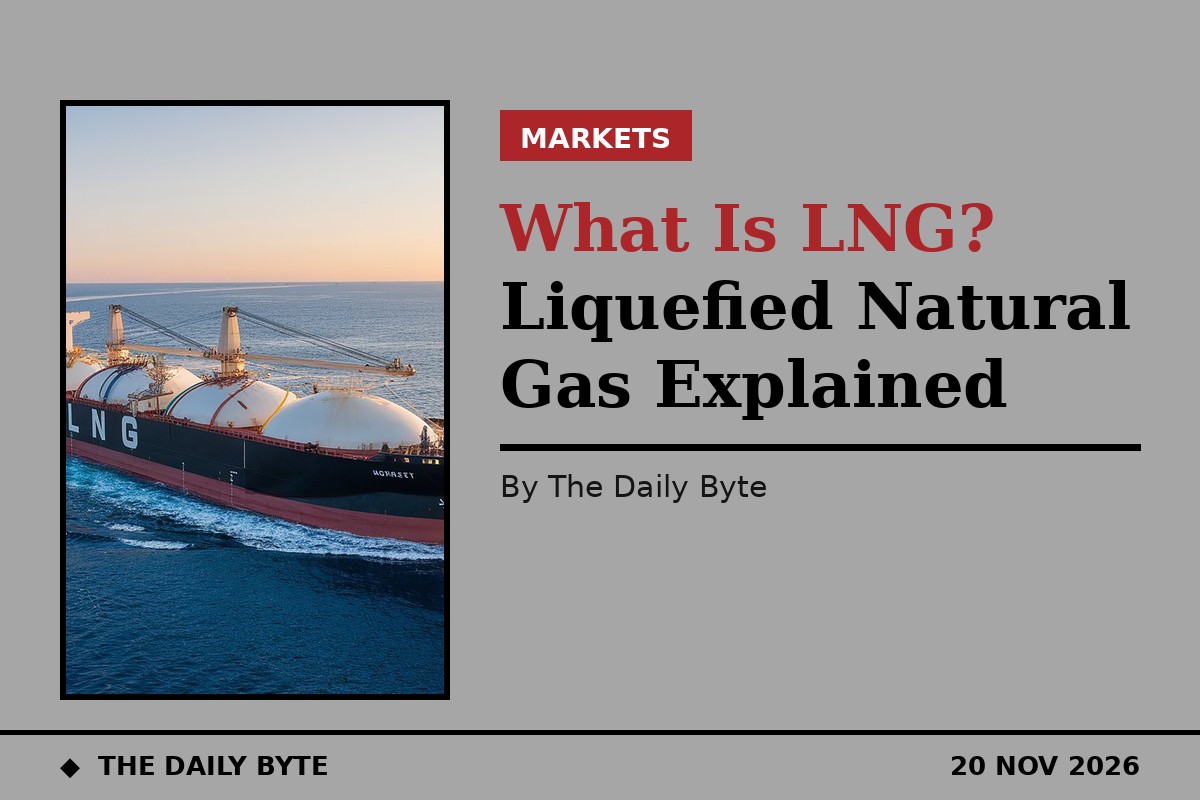
LNG stands for liquefied natural gas: natural gas, mostly methane, that has been chilled to about minus 162 degrees Celsius until it turns into a liquid. In that form it takes up roughly 1/600th of the space of the gas, which means it can be loaded onto a ship and carried across oceans to places no pipeline reaches. It is the reason gas produced in the United States, Qatar or Australia can heat homes and power stations in Europe and Asia.
LNG is back in the headlines in November 2026. Pakistan has turned to the spot market to buy LNG cargoes to cover a winter gas shortfall, and Europe has spent the last few years replacing Russian pipeline gas with seaborne LNG. Understanding what LNG is, and how its market works, explains why a cold winter in one part of the world can move gas prices everywhere else.
How is LNG made?
Making LNG starts with ordinary natural gas from a gas field. Before it can be chilled, the gas is cleaned: water, carbon dioxide, mercury and heavy hydrocarbons are removed, because each of them would freeze and damage the equipment at very low temperatures. The treated gas is then cooled in stages inside a liquefaction plant, in units called trains, until it condenses into a clear, colourless liquid at about minus 162 degrees Celsius. A large modern liquefaction train produces roughly five to eight million tonnes of LNG a year.
The liquid is stored in heavily insulated tanks at the plant and kept cold rather than under high pressure. LNG itself is odourless, colourless, non-toxic and non-corrosive. It does not burn as a liquid: it only becomes flammable once it warms back into a vapour and mixes with air, which is why spills are treated as a gas-release hazard rather than a liquid fire.
How does LNG travel and get used again?
LNG travels in specially built carriers with insulated cargo tanks. The best-known designs use either large white spherical tanks, called Moss tanks, that sit visibly on deck, or membrane tanks built into the hull. A small amount of the cargo inevitably warms and evaporates during the voyage, a process called boil-off, and on most ships that vapour is burned as fuel for the voyage itself.
At the destination, the ship unloads at a regasification terminal, where seawater or other heat sources warm the liquid back into gas. The gas then flows into pipelines and storage for power stations, industry and home heating. Some terminals are floating units, ships permanently moored offshore, which can be installed far faster than an onshore plant. LNG can also be used directly as a fuel for ships and heavy trucks, though that remains a small part of the market.
How is LNG bought and priced?
Most LNG is sold under long-term contracts, typically lasting 20 to 25 years, between producers and buyers. These sale and purchase agreements guarantee a steady volume and give producers the certainty they need to finance liquefaction plants that cost billions of dollars to build. The price in these contracts is usually set by a formula: in Asia it is often linked to the price of crude oil, while US export contracts are typically priced at a multiple of the Henry Hub gas benchmark plus a fixed fee for liquefaction.
Alongside those contracts there is a growing spot market, where single cargoes are bought for delivery within weeks or months. The benchmark for Asian spot LNG is the Japan Korea Marker, known as JKM, assessed daily and quoted in US dollars per million British thermal units. When a buyer such as Pakistan needs gas urgently for winter, it buys on the spot market and pays whatever the JKM price is that day, which can be far higher than the price in a long-term contract. That is why winter demand, plant outages and shipping disruptions can send spot prices soaring.
Who produces and buys LNG?
The three biggest LNG exporters are the United States, Australia and Qatar. The biggest importers are China, Japan and South Korea, which rely on LNG because they produce little gas of their own and cannot be reached by pipeline. Europe has become a much larger buyer since 2022, after Russian pipeline supplies were cut, and the United States is now its largest single supplier.
| Rank | Top exporters | Top importers |
|---|---|---|
| 1 | United States | China |
| 2 | Australia | Japan |
| 3 | Qatar | South Korea |
World LNG trade reached a record 437 million tonnes in 2025, according to the International Gas Union, and more liquefaction capacity is under construction, which means the seaborne gas market is still growing. That growth also concentrates risk: a handful of exporters and a few shipping chokepoints, such as the Strait of Hormuz, carry a large share of the world's supply, so an outage or a conflict in one place can tighten the market everywhere.
Is LNG clean energy?
LNG is often described as a cleaner fossil fuel, and in one sense that is true: burning natural gas produces less carbon dioxide than burning coal or oil for the same amount of energy, and it produces almost no sulphur or soot. That is why many countries have used gas to replace coal in power generation and cut air pollution quickly.
But LNG is still a fossil fuel, and its climate record is debated. Methane, its main component, is a far more powerful greenhouse gas than carbon dioxide over the short term, so leaks anywhere along the chain, from the gas field to the ship to the terminal, matter. Liquefying the gas also consumes energy, roughly 8 to 12 per cent of the gas itself. Supporters argue LNG is a bridge that lets economies cut coal use while renewables scale up; critics argue the new terminals and 20-year contracts lock in fossil fuel use for decades. Both points are part of the argument whenever a new LNG project is approved.
Frequently asked questions
Is LNG the same as LPG? No. LPG, liquefied petroleum gas, is mainly propane and butane, stored under pressure at ordinary temperatures, and is what fills gas bottles and some car tanks. LNG is mainly methane, stored at minus 162 degrees Celsius, and is used in bulk for power and heating.
Can LNG explode? Liquid LNG does not burn or explode on its own. The risk comes if it escapes and warms into a vapour that mixes with air in the right proportions, when it can ignite. That is why terminals and ships are built with strict safety zones and detection systems.
Why is LNG in the news? Because it has become the flexible part of the world's gas supply. When pipelines are cut or winter demand rises, countries turn to spot LNG cargoes, and the price of those cargoes sets the cost of heating and electricity for millions of people.


