What Is Martial Law? Meaning, Rules and History
Martial law is the temporary replacement of civilian government by military authority during an emergency. When it is declared, soldiers rather than civilian officials take charge of keeping order, and ordinary rights such as freedom of assembly, freedom of the press and the right to a civilian trial can be restricted or suspended.
It is one of the most drastic powers a government can use, and also one of the most misunderstood. It does not always mean a military takeover of the whole country, it does not always suspend the constitution, and in some countries it cannot be declared at all. This guide explains what martial law means, what it can and cannot do, and how it has worked in practice, including in South Korea in December 2024, when a declaration lasted only about six hours before parliament voted it down.
What does martial law mean?
Martial law is the law administered by military forces that is invoked by a government in an emergency when civilian law enforcement agencies are unable to maintain public order and safety. That is the definition given by Merriam-Webster and quoted by the Law Library of Congress in its explanation of South Korea's 2024 declaration.
There is no single global definition. Each country's constitution and laws set their own conditions, and some do not define the term at all. South Korea's constitution, for example, does not define martial law, but Article 77 allows the president to proclaim it when it is required to cope with a military necessity or to maintain public safety and order by mobilising the military in time of war, armed conflict or a similar national emergency.
The idea behind it is simple, and it is captured in an old legal maxim: the safety of the people is the supreme law. When the civil power in an area becomes incapable of maintaining law and order, the argument runs, it is lawful for the military to use the force necessary to restore order. The United States Supreme Court described it in the nineteenth century as the law of military necessity in the actual presence of war, administered by the commanding general.
Martial law is meant to be temporary and a last resort. It is declared for a specific crisis, such as war, invasion, rebellion or a breakdown of public order, and it is meant to end when civilian government can function again. In practice, however, declarations have sometimes lasted for years, and some leaders have used them to hold on to power rather than to restore order.
What happens when martial law is declared?
What changes depends on the country and on the wording of the declaration itself, but the usual measures follow a recognisable pattern. The military takes over responsibility for policing and public order. Curfews can be imposed. Political activity, public meetings, protests and strikes can be banned. The press and broadcasters can be placed under military control or censorship. In some systems, civilians can be arrested and searched without a warrant and tried by military courts rather than civilian ones.
South Korea's law draws a distinction that shows how much the details matter. Its constitution and Martial Law Act provide for two kinds: emergency martial law and precautionary martial law. Emergency martial law applies when there are belligerents or serious disturbances of social order that considerably impede the administrative and judicial functions of the state in time of war, incident or an equivalent national emergency. Under it, arrest and search without a warrant and restrictions on freedom of speech, the press, assembly and association may be allowed. Precautionary martial law is the lesser form, used to maintain public security and order when the social order is so disturbed that civil administrative authorities cannot preserve public peace.
When President Yoon Suk Yeol declared emergency martial law in South Korea on 3 December 2024, his decree banned all political activities, including the work of the National Assembly, local councils and political parties, and placed the media under the control of the Martial Law Command. It was the sweeping, emergency form of the power, not the precautionary one.
Martial law vs a state of emergency
People often use martial law and state of emergency as if they meant the same thing. They do not. A state of emergency is the broader idea: a government declares that a crisis exists and takes extra powers for a limited time. Martial law is one specific, military form of emergency rule, and it is the most severe version.
Martial law: the military runs things. Soldiers take over policing and public order, civilian courts can be replaced by military tribunals, and rights such as assembly and press freedom can be suspended.
State of emergency: civilian government stays in charge. The government gains extra powers, such as restricting movement or banning gatherings, but the police remain in charge of order and the ordinary courts keep working.
The distinction matters in practice. Pakistan's 2007 emergency, for example, was declared by General Pervez Musharraf as an emergency under which the constitution was held in abeyance, rather than as a formal martial law proclamation. France has used a state of emergency, or etat d'urgence, several times, including after the 2015 Paris attacks, while keeping civilian rule. In Britain there is no martial law statute at all; emergencies are handled under civilian law, principally the Civil Contingencies Act 2004, which lets the government make emergency regulations while parliament and the courts continue to function.
Who can declare martial law?
The answer depends entirely on the country's constitution. In South Korea, the president may proclaim martial law, but must first deliberate the matter with the State Council, the cabinet, and must notify the National Assembly. The Assembly can demand that it be lifted, and the president must comply. That check is what ended the December 2024 declaration within hours.
In the United States there is no explicit constitutional provision for martial law. It has been used by presidents and by Congress in wartime and rebellion, and by state governors within their states, but its legal basis has always been contested. During the American Civil War, President Abraham Lincoln declared it in some areas. In the Second World War it was imposed in Hawaii after the attack on Pearl Harbor and remained in force for almost three years.
In Britain, martial law has no modern statutory basis. The government can use emergency powers under the Civil Contingencies Act 2004, but those powers are exercised by civilian ministers, are time-limited, and can be challenged in parliament and the courts. The idea of soldiers replacing civilian government has no place in current British law.
South Korea, December 2024: six hours that shook a democracy
The most recent high-profile declaration of martial law came on the night of 3 December 2024, and it is now the clearest modern example of how the power works and how it can be stopped.
At 22:27 local time, President Yoon Suk Yeol appeared on television and declared emergency martial law, the first in South Korea for more than 40 years. He accused the opposition of paralysing the government with anti-state activities and plotting rebellion. Within the hour, a decree banned all political activity, including sessions of the National Assembly, and placed the media under military control.
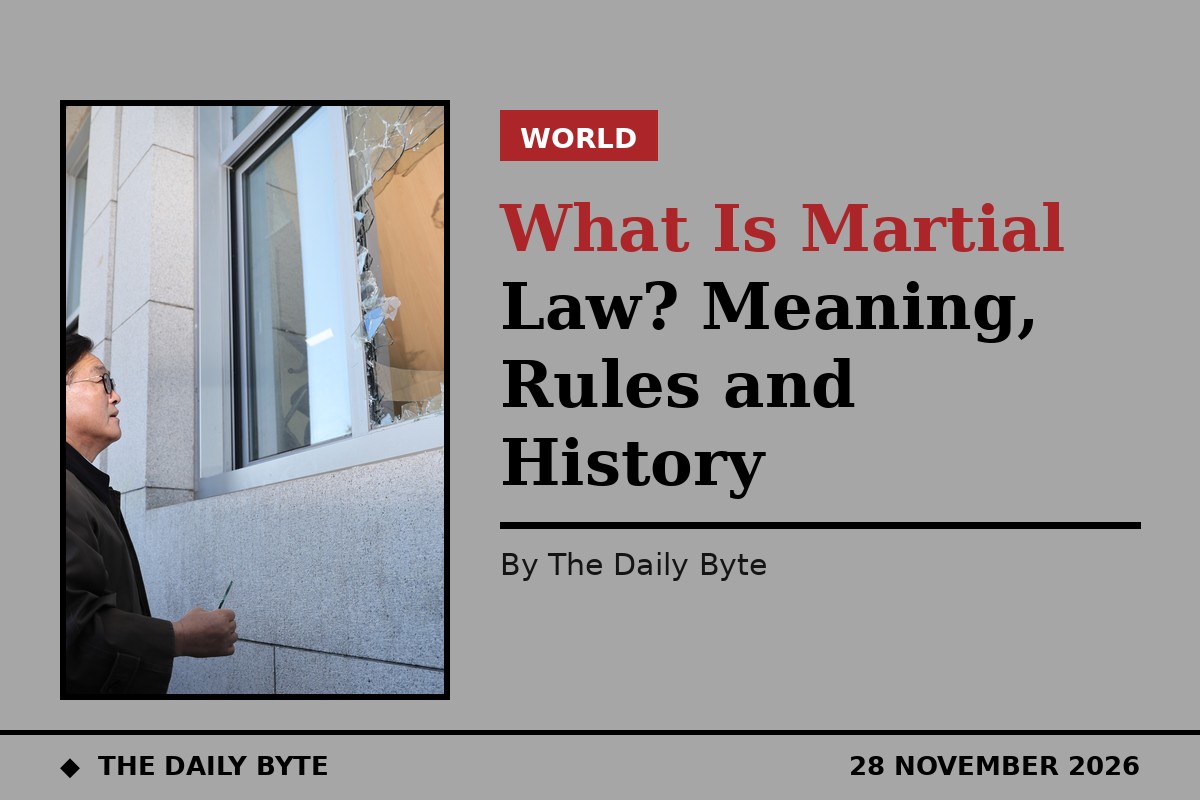
More than 1,800 police officers were mobilised to blockade the parliamentary complex, and around 400 armed troops were deployed to the National Assembly, including about 190 special forces soldiers flown in by helicopter. Troops broke windows to enter the building as staff barricaded doors with furniture and lawmakers climbed fences to get inside.
At 01:02 on 4 December, 190 lawmakers who had reached the chamber voted unanimously to demand that martial law be lifted. Under South Korea's constitution, the president had to comply. Yoon lifted the decree a few hours later, at about 04:30, and the Martial Law Command was disbanded. The whole episode lasted roughly six hours.
The political consequences lasted far longer. Yoon was impeached by the National Assembly on 14 December 2024, with 204 of the 300 members voting in favour. The Constitutional Court unanimously upheld his removal from office on 4 April 2025. A snap presidential election followed on 3 June 2025, which Lee Jae Myung won. In February 2026 a court found Yoon guilty on insurrection charges and sentenced him to life in prison, and prosecutors have since sought the death penalty on appeal.
The episode is studied around the world because it showed both sides of martial law at once: how quickly a president could invoke it, and how quickly a legislature determined to resist could end it.
Martial law in Pakistan
Pakistan's history makes martial law a familiar term to its readers. Britannica's chronology of the country's military governments lists four periods of military rule, and three of them were formally proclaimed as martial law.
The first nationwide martial law was proclaimed on 7 October 1958, when President Iskander Mirza abrogated the 1956 Constitution and appointed General Ayub Khan as chief martial law administrator. Ayub soon took power himself, and martial law ended on 8 June 1962.
The second was declared on 25 March 1969, when Ayub handed power to General Yahya Khan, who became chief martial law administrator. That period ended with the transfer of power in December 1971, and martial law was formally withdrawn on 21 April 1972.
The third began on 5 July 1977, when General Zia-ul-Haq overthrew the government of Prime Minister Zulfikar Ali Bhutto. Zia's martial law was withdrawn on 30 December 1985, although military influence over politics continued long after.
The takeover of 12 October 1999, when General Pervez Musharraf removed the government of Prime Minister Nawaz Sharif, is commonly called the fourth martial law. Legally, it was imposed through a proclamation of emergency and a Provisional Constitution Order rather than a formal martial law proclamation, and Musharraf remained in power until his resignation on 18 August 2008. The distinction is a reminder that the label matters less than the substance: in each case the armed forces took control, elected government was removed and the constitution was set aside or held in abeyance.
Can martial law be challenged?
Yes, in systems where the rule of law survives the declaration. The strongest check is usually the legislature. South Korea's National Assembly used its constitutional right to demand the lifting of martial law, and that vote ended the crisis. Courts are the second check. In 1866, in the case of Ex parte Milligan, the United States Supreme Court ruled that martial law could not be applied to civilians where the civilian courts were open and functioning, and that a citizen could not be tried by a military court while the ordinary courts were available.
International law adds a further limit. The International Covenant on Civil and Political Rights allows governments to derogate from some rights in a public emergency, but only to the extent strictly required by the situation, and some rights, such as the right to life and freedom from torture, can never be suspended. A declaration that is used to crush dissent rather than to restore order can also be challenged politically, through protest, through elections once civilian rule returns, and through later prosecutions, as the South Korean cases after 2024 have shown.
None of these checks works automatically. They depend on institutions that are willing to act and on a public that expects them to. Where the courts and the legislature have already been weakened, martial law can become the cover for a permanent military government rather than a temporary emergency measure.
Does martial law suspend the constitution?
Not necessarily, and the answer varies by country. In South Korea the constitution itself authorises martial law and sets its limits, so the declaration operated within a constitutional framework, even though the Constitutional Court later found Yoon's declaration unconstitutional on the facts. In Pakistan in 1958 the constitution was abrogated outright, and in 1977 and 1999 it was held in abeyance. In the United States the constitution does not mention martial law, so every use of it has been argued about in the courts ever since.
The safest way to think about it is this: martial law suspends the normal operation of civilian government and some ordinary rights, but whether it suspends the constitution itself depends on what the declaration says and on what the country's law allows. A declaration that claims to set the constitution aside entirely is a much more radical act than one made under a constitution that provides for it.
Frequently asked questions
Is martial law the same as a military coup? Not quite. A coup is the seizure of power, usually by force and outside the law. Martial law is a legal power that a government can invoke in an emergency. But the two can overlap: a coup leader often declares martial law to give military rule a legal appearance, and a lawful declaration can be used as the first step towards a coup.
Can martial law be declared in the UK? There is no martial law power in modern British law. Emergencies are dealt with under civilian legislation, principally the Civil Contingencies Act 2004, under which ministers can make emergency regulations that are time-limited and subject to parliamentary oversight.
How long can martial law last? It depends on the law that authorises it. South Korea's lasted about six hours. Hawaii's lasted almost three years during the Second World War. Pakistan's 1977 martial law lasted more than eight years. The length is often a sign of the intent: a short declaration suggests a genuine emergency, while a long one suggests a government that has stopped trying to return power to civilians.
What rights do people lose under martial law? It varies, but the rights most commonly restricted are freedom of speech, freedom of the press, freedom of assembly and association, freedom of movement, and the right to be tried in a civilian court. Under South Korea's emergency martial law, arrest and search without a warrant are permitted. Some rights, such as freedom from torture, cannot lawfully be suspended even in an emergency.
Has martial law ever been declared in the United States? Yes, in limited areas and mostly in wartime. It was declared in parts of the country during the Civil War and in Hawaii after Pearl Harbor. The Supreme Court's 1866 Milligan ruling limited its use against civilians where the ordinary courts were open.
Sources: Law Library of Congress, FAQs on South Korean martial law; Wikipedia, 2024 South Korean martial law crisis; Britannica and Pakistani press chronologies for Pakistan's martial law periods.


