What Is Mercosur? South America's Trade Bloc
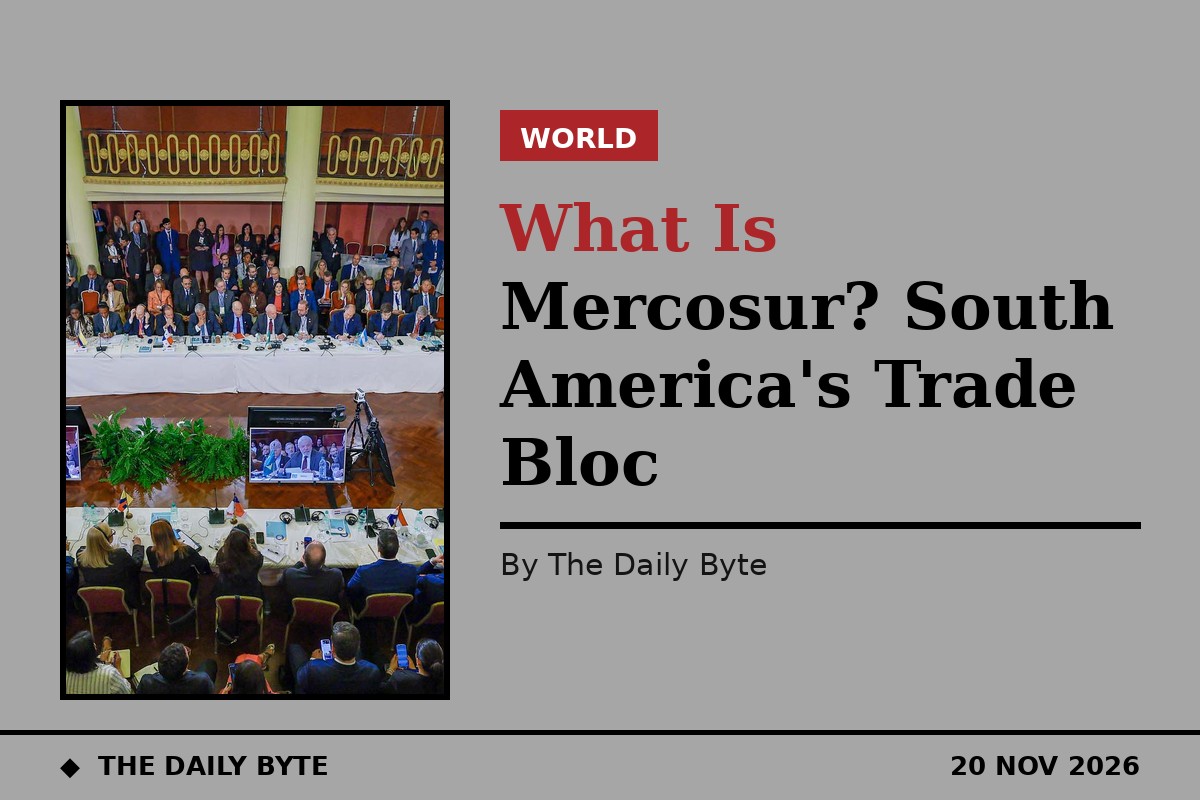
Mercosur is South America's main trade bloc, a customs union of five countries that has spent more than three decades trying to turn itself into a common market. It is in the news again after South Korea asked Uruguay on 20 November 2026 to help restart stalled free trade talks with the bloc, and after the European Union signed a landmark trade deal with Mercosur earlier this year. This guide explains what Mercosur is, who belongs to it, how it works and why it matters.
The short answer is that Mercosur, short for Mercado Comun del Sur, or the Southern Common Market, is an intergovernmental organisation and customs union established by the Treaty of Asuncion in 1991. Its full members are Argentina, Bolivia, Brazil, Paraguay and Uruguay. Venezuela is also a full member but has been suspended since 1 December 2016. The bloc covers a market of about 270 million people with a combined economy of about 2.9 trillion dollars, and its purpose is to promote free trade inside the zone and the free movement of goods, people and currency.
What is Mercosur?
Mercosur's full name in Spanish is Mercado Comun del Sur, and in Portuguese it is Mercado Comum do Sul, usually shortened to Mercosul. The name is a portmanteau of the words for common market of the south. It was established by the Treaty of Asuncion, signed on 26 March 1991 by Argentina, Brazil, Paraguay and Uruguay, and it entered into force on 29 November the same year. The Protocol of Ouro Preto, signed on 16 December 1994, gave the bloc its institutional structure. On 1 January 1995 the free trade area became a customs union, in which all members charge the same tariffs on imports from outside the bloc, known as a common external tariff.
The idea behind Mercosur was to boost the regional economy by letting goods, services, workers and capital move more freely between its members. It grew out of an older idea: discussions about a regional economic market for Latin America go back to the treaty that established the Latin American Free Trade Association in 1960, which was succeeded by the Latin American Integration Association in the 1980s. Argentina and Brazil made the first practical progress, signing the Iguacu Declaration in 1985, which set up a bilateral commission, followed by a series of trade agreements the next year. An integration, cooperation and development treaty signed between the two countries in 1988 set the goal of a common market that other Latin American countries could join. Paraguay and Uruguay joined the process, and the four countries signed the Treaty of Asuncion in 1991.
Who belongs to Mercosur?
Mercosur has five full members: Argentina, Bolivia, Brazil, Paraguay and Uruguay. Bolivia is the fifth full member, completing an accession process that began with a protocol signed in 2012. Venezuela joined as a full member but has been suspended since 1 December 2016. Seven countries are associate members: Chile, Colombia, Ecuador, Guyana, Panama, Peru and Suriname. Associate members have trade agreements with the bloc but are not part of the customs union and do not apply its common external tariff.
The bloc's headquarters are in Montevideo, the capital of Uruguay, where its administrative secretariat is based. The presidency of its main decision-making body, the Common Market Council, rotates between the member states every six months, with foreign ministers and economy ministers taking turns. Uruguay holds the rotating chair in the second half of 2026, which is one reason South Korea approached Montevideo about restarting trade talks. The bloc is due to hold its 69th summit in Uruguay in December 2026.
In economic terms, Mercosur is significant. In 2023 the bloc generated a nominal gross domestic product of around 5.7 trillion dollars on a purchasing power parity basis, placing it as the fifth largest economy in the world on that measure. South Korea's trade ministry puts the bloc's population at about 270 million and its combined nominal GDP at 2.9 trillion dollars, and describes it as South America's largest economic bloc, with abundant mineral resources such as lithium and nickel.
How does Mercosur work?
Mercosur is an intergovernmental organisation, which means its decisions are taken by the member governments rather than by a supranational body with powers of its own. Its supreme decision-making organ is the Common Market Council, made up of the foreign affairs and economy ministers of the member states. Below it sits the Common Market Group, an executive body that carries out the council's decisions, puts forward proposals on opening trade, coordinates macroeconomic policy and discusses and signs trade agreements with other countries. The group includes four formal and four alternate representatives from each member state, drawn from the foreign ministry, the economy ministry and the central bank. Under it sit ten working groups dealing with trade, customs, technical standards, taxation and financial policy, transport by land and sea, industrial and technological policy, agricultural policy, energy policy and the harmonisation of macroeconomic policy.
The customs union is the heart of the project. Inside the bloc, tariffs on most goods traded between members have been removed. Outside it, members apply a common external tariff to imports from the rest of the world. In practice the union is incomplete: the common external tariff applies to about 85 percent of tariff lines, and there are long lists of exceptions for sensitive products. That incompleteness is one of the long-running criticisms of the bloc, and it is why arguments about Mercosur often come down to whether it is a real customs union or a free trade area with ambitions it has not yet met.
The European Union deal: 25 years in the making
Mercosur's biggest external achievement is its deal with the European Union. Negotiations began in 2000 and ran for more than 25 years, with a broad political agreement first reached in 2019 and then delayed by technical, environmental and regulatory concerns. On 6 December 2024 the European Union and the four founding Mercosur countries reached a political agreement in Montevideo for a partnership agreement. On 17 January 2026 the two sides signed the EU-Mercosur Partnership Agreement and a parallel Interim Trade Agreement, and the interim agreement has been provisionally applied since 1 May 2026.
The deal is large. It links two blocs covering a market of about 700 million people, and trade between the European Union and Mercosur reached 111 billion euros in 2024. Once fully implemented it will progressively remove tariffs on the vast majority of goods traded between the two blocs: duties are to be eliminated on 91 percent of European Union exports to Mercosur countries and on 92 percent of Mercosur exports to the European market. European cars, machinery and wine become cheaper in South America, and South American farm goods gain privileged access to European markets. The deal still needs ratification by the European Parliament and by the legislatures of the Mercosur members before it takes full effect, and it has faced opposition, particularly from European farmers who argue it exposes them to unfair competition from South American producers. It includes safeguard mechanisms allowing either side to intervene if imports cause serious market disruption.
Why is Mercosur in the news now?
South Korea is the latest country to come knocking. Seoul's First Vice Foreign Minister Park Yoon-joo asked Uruguay on Friday 20 November 2026 to play an active role in resuming negotiations on a free trade agreement between South Korea and Mercosur, in talks in Seoul with Uruguay's Deputy Foreign Minister Valeria Csukasi. Uruguay holds the rotating Mercosur chair for the second half of 2026 and also coordinates the bloc's trade negotiations with Korea, which is why Seoul approached Montevideo. South Korea and Mercosur launched negotiations over a trade deal in 2018, but formal talks have stalled since 2021, and the Seoul meeting announced no date for renewed negotiations.
South Korea's interest is about more than tariffs. Its trade minister has described Mercosur as an important partner for diversifying markets and strengthening supply chain stability, at a time of rising protectionism and the use of trade as a weapon. The bloc's lithium and nickel matter to South Korea's battery and electronics industries, and Korean companies already operate in the region, including the steelmaker POSCO's lithium project in Argentina. The two sides also discussed expanding cooperation in artificial intelligence and other advanced technologies. Mercosur is also in demand elsewhere: the EFTA states signed their own deal with the bloc in September 2025, and Uruguay has been pushing trade deals with the European Union, the United States, South Korea and Canada.
What are the arguments about Mercosur?
Mercosur has always divided opinion. Its supporters say it has given South America a collective voice in world trade, letting smaller countries negotiate as a bloc with the European Union, China and the United States rather than alone. They point to the European Union deal as proof that the bloc can still deliver after decades of effort, and to the free movement of goods and people inside the zone as a real achievement for a region with a history of closed borders and rivalries.
Its critics say the bloc has delivered less than it promised. The customs union is still incomplete after 30 years, internal trade disputes between members are frequent, and the bloc's rules have sometimes held back individual members that wanted to sign their own trade deals. Uruguay has repeatedly argued for more flexibility so that each member can advance at different speeds, and has hinted it would press ahead with trade deals with or without its Mercosur counterparts. Argentina under its current government has also questioned the bloc's restrictions. The question at the heart of the argument is the same one the bloc has faced since 1991: whether five countries with very different economies can agree on a single trade policy, or whether Mercosur works best as a looser arrangement. The queue of countries asking for deals, from the European Union to South Korea, suggests the bloc is not going away. The unfinished customs union suggests it is still a work in progress.


