What Is Mpox?
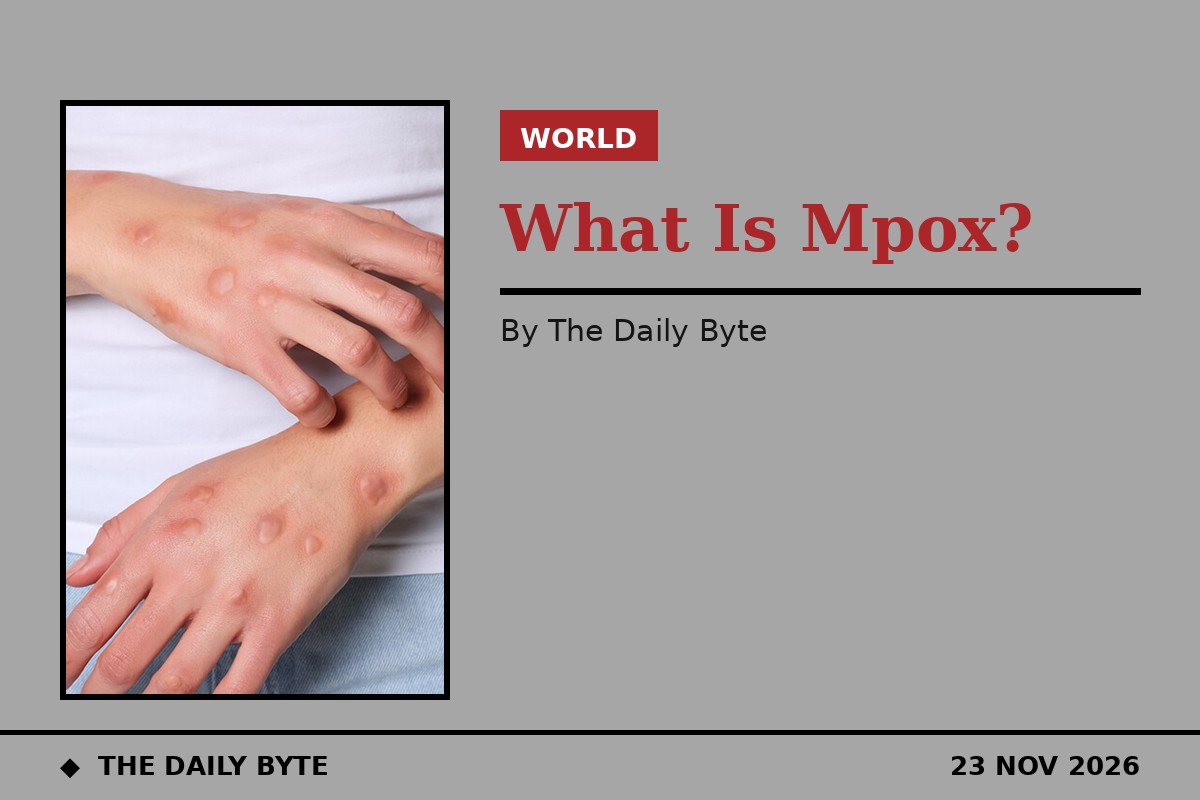
Mpox is a viral illness that causes a painful skin rash, fever, headache, muscle aches and swollen lymph nodes. It is caused by the monkeypox virus, a relative of the smallpox virus, and it spreads mainly through close physical contact with someone who has the disease. Most people recover within two to four weeks, but some become seriously ill, and the disease can be fatal.
The disease was in the news again in November 2026, when Cambodia confirmed its first case of mpox in more than 30 months. The patient tested positive on Friday 20 November and was receiving treatment in hospital after the health ministry announced the case on Sunday 22 November. It is Cambodia’s 21st case: the country previously recorded 20 cases between December 2023 and May 2024. This explainer sets out what mpox is, how it spreads, what the symptoms are, and what protection exists.
What causes mpox?
Mpox is caused by the monkeypox virus, known as MPXV. It is an enveloped, double-stranded DNA virus of the Orthopoxvirus genus in the Poxviridae family, which also includes the viruses that cause smallpox, cowpox and vaccinia. There are two distinct clades, or families, of the virus: clade I, with subclades Ia and Ib, and clade II, with subclades IIa and IIb.
| Clade | Where it is found | What is known |
|---|---|---|
| Clade I (Ia, Ib) | Central Africa | Generally more severe; clade Ib is spreading person-to-person in the Democratic Republic of the Congo and has been found outside Africa since August 2024 |
| Clade II (IIa, IIb) | West Africa | Clade IIb caused the global outbreak of 2022–2023 |
The virus was first discovered in 1958, in monkeys kept for research in Denmark — which is why the disease was originally called monkeypox. The first reported human case was a nine-month-old boy in the Democratic Republic of the Congo in 1970. After smallpox was eradicated in 1980 and routine smallpox vaccination ended worldwide, mpox steadily emerged in central, east and west Africa. Thousands of cases have been reported in the Democratic Republic of the Congo every year since 2005, and the disease re-emerged in Nigeria in 2017, spreading between people and in travellers to other countries. In 2003, an outbreak in the United States was linked to imported wild animals. The World Health Organization’s fact sheet sets out the virus, its clades and its history in full.
What are the symptoms of mpox?
Symptoms usually begin within a week of exposure, but they can start anywhere from 1 to 21 days afterwards. They typically last two to four weeks, though they can last longer in someone with a weakened immune system. The common symptoms are a skin rash or sores on the mucous membranes, fever, sore throat, headache, muscle aches, back pain, low energy and swollen lymph nodes.
For some people the first symptom is a rash; for others, fever, muscle aches or a sore throat come first. The rash often begins on the face and spreads over the body, reaching the palms of the hands and the soles of the feet, but it can also start where contact was made, such as the genitals. It starts as a flat sore, develops into a blister filled with liquid that may be itchy or painful, then dries up, crusts over and falls off. Some people have only one or a few skin lesions. Others have hundreds. Lesions can appear on the palms, soles, face, mouth and throat, groin and genital areas, and the anus. Some people also develop painful swelling of the rectum, pain when passing urine, or pain when swallowing.
Most people recover fully, but some become very sick. The skin can become infected with bacteria, leading to abscesses or serious skin damage. Other complications include pneumonia, infection of the cornea with loss of vision, vomiting and diarrhoea causing dehydration, and infections of the blood, brain, heart, rectum, genital organs or urinary passages. Mpox can be fatal in some cases. Children, pregnant people and people with weak immune systems, including people living with HIV that is not well controlled, are at higher risk of serious illness and death.
How does mpox spread?
Mpox spreads from person to person mainly through close contact with someone who has it, including members of the same household. Close contact includes skin-to-skin contact such as touching or sex, mouth-to-mouth or mouth-to-skin contact such as kissing, and being face to face with someone, for example talking or breathing close to one another, which can generate infectious respiratory particles. People with multiple sexual partners are at higher risk of acquiring mpox.
People can also catch mpox from contaminated objects such as clothing or linen, through needle injuries in health care, or in community settings such as tattoo parlours. During pregnancy or birth, the virus may be passed to the baby; contracting mpox during pregnancy can be dangerous for the fetus or newborn, and can lead to loss of the pregnancy, stillbirth, death of the newborn, or complications for the parent.
Animal-to-human transmission happens through bites or scratches, or during hunting, skinning, trapping, cooking, playing with carcasses or eating infected animals. The natural animal reservoir of the virus is still unknown, though various small mammals such as squirrels and monkeys are susceptible. People with mpox can pass the disease to others until all sores have healed and a new layer of skin has formed. Some people can be infected without developing any symptoms, although how often people catch it from someone without symptoms is still not well understood.
How is mpox diagnosed and treated?
Identifying mpox can be difficult because other infections and conditions can look similar, including chickenpox, measles, bacterial skin infections, scabies, herpes, syphilis and other sexually transmitted infections. Testing is therefore key, both to get care early and to prevent further spread. The preferred laboratory test is detection of viral DNA by polymerase chain reaction, or PCR. The best specimens are taken directly from the rash — skin, fluid or crusts, collected by vigorous swabbing. Testing blood is not recommended. The World Health Organization’s mpox fact sheet explains the testing, treatment and prevention in detail.
Treatment is supportive: the goal is to take care of the rash, manage pain and prevent complications. Early and supportive care matters, with close attention to nutrition, hydration, skin care and the prevention of secondary infections, and treatment of co-infections, including HIV where present. Some antivirals have received emergency use authorisation in some countries and are being evaluated in clinical trials, but to date there is no proven effective antiviral treatment for mpox. People with HIV and mpox should continue taking their antiretroviral therapy.
Is there a vaccine for mpox?
Yes. There are vaccines for mpox, and vaccination should be considered along with other public health measures. Vaccination is recommended for people at high risk of getting mpox, especially during an outbreak, including health and care workers at risk of exposure, people in the same household or close community as someone with mpox, people with multiple sex partners, including men who have sex with men, and sex workers of any gender and their clients.
The vaccine can also be given after a person has been in contact with someone who has mpox, as post-exposure prophylaxis. In those cases it should be given less than four days after contact, although it can be given for up to 14 days if the person has not developed symptoms. Vaccines and treatments developed for smallpox and approved for use in some countries can also be used for mpox in some circumstances. In August 2026, a global multi-partner initiative was launched in Addis Ababa, Ethiopia, to improve access to mpox vaccines through a long-term mechanism for countries to request doses for outbreak response.
Who is most at risk?
Anyone can get mpox, but the risk is not evenly spread. The highest risk comes from close physical contact with someone who is infectious, so household contacts, sexual partners and health workers caring for patients without protective equipment are the most exposed. Children, pregnant people and people with weak immune systems are the most likely to become seriously ill if they do catch it.
The global outbreak that began in May 2022 spread mainly, though not only, among gay, bisexual and other men who have sex with men, through sexual networks. The World Health Organization is explicit that stigma and discrimination linked to mpox are never acceptable, and that they undermine public health by making people less willing to come forward for care. The disease is defined by how it spreads — close contact — not by who catches it.
Where is mpox spreading in 2026?
Mpox remains a live public health problem. The World Health Organization declared the global outbreak a public health emergency of international concern twice, first in May 2022 and again in August 2024, when the clade I upsurge began in Africa. The second emergency was declared over on 5 September 2025, after an emergency committee concluded the upsurge no longer met the definition. The WHO Director-General extended the standing recommendations for mpox until August 2027, and the WHO still considers the multi-country outbreak a graded emergency. A global rapid risk assessment in August 2026 rated the overall public health risk as moderate, with more than a thousand confirmed cases reported every month.
In July 2026, 32 countries across four WHO regions reported 1,370 confirmed cases, including seven deaths — a case fatality ratio of 0.5%. The countries reporting the most cases that month were Madagascar, with 703, Angola with 138, China with 88, the Democratic Republic of the Congo with 85 and Kenya with 55. Over the longer sweep, more than 120 countries reported mpox between January 2022 and August 2024, with over 100,000 laboratory-confirmed cases and more than 220 deaths among confirmed cases. The WHO report of the September 2025 emergency committee meeting records the decision to end the emergency and the extension of the standing recommendations.
The Cambodia case reported on 22 November fits that picture: the virus has not gone away, and it keeps reappearing in places that have been free of it for years. Cambodia’s health ministry said the patient tested positive on 20 November and was in hospital, and it called for greater vigilance. The Xinhua report carried by NAMPA confirms the case, the 30-month gap and the country’s earlier total of 20 cases. Brazil, meanwhile, passed 1,000 cases in 2026 — 1,009 confirmed by 12 November, according to the Fiocruz public health institute — and recorded its first mpox death of the year, in Rio de Janeiro, as the clade Ib strain spread beyond Africa.
Why was monkeypox renamed mpox?
In November 2022, the World Health Organization adopted “mpox” as the new name for the disease, replacing “monkeypox”. The change followed concern that the old name was stigmatising and misleading: the virus was named after monkeys because it was first found in laboratory monkeys, but monkeys are not the main carriers, and the name had become a source of racist and stigmatising language online. Both names were used during a one-year transition period before “mpox” became the standard term. The disease itself did not change. Only the name did.
For most people, the practical advice has not changed either. Avoid close physical contact with someone who has mpox, do not share bedding or clothing with them, wash hands often, and contact a health care provider for advice if a new rash appears, especially after contact with a known case. People with mpox should stay at home and in their own well-ventilated room if possible, wear a mask and cover lesions around other people, avoid popping blisters or scratching sores, and use condoms during sex for 12 weeks after recovery. Contacts should monitor for signs and symptoms for 21 days.
Frequently asked questions
Is mpox the same as smallpox?
No. They are related viruses in the same Orthopoxvirus genus, but they are different diseases. Smallpox was eradicated in 1980. Mpox is generally less severe than smallpox was, although it can still cause serious illness and death, particularly in children, pregnant people and people with weakened immune systems.
Can you catch mpox from bedding or clothing?
Yes. The virus can spread through contact with contaminated materials such as clothing, bedding, towels or needles. The main route is direct close contact with an infected person, but contaminated objects are a real route of transmission, which is why washing hands and disinfecting shared spaces matter.
How long are you infectious with mpox?
You can pass the disease on until all sores have healed and a new layer of skin has formed. Symptoms usually last two to four weeks. People who have had contact with someone with mpox should monitor for symptoms for 21 days.
Is there a vaccine for mpox?
Yes. Vaccines exist and are recommended for people at high risk, especially during an outbreak. The vaccine can also be given after exposure, ideally within four days of contact and up to 14 days if no symptoms have developed.
Is mpox still a global emergency?
No. The World Health Organization ended the public health emergency of international concern for mpox on 5 September 2025. Standing recommendations remain in force until August 2027, and the WHO still rates the global risk as moderate, with more than a thousand confirmed cases a month.


