What Is NATO and How Does It Work?
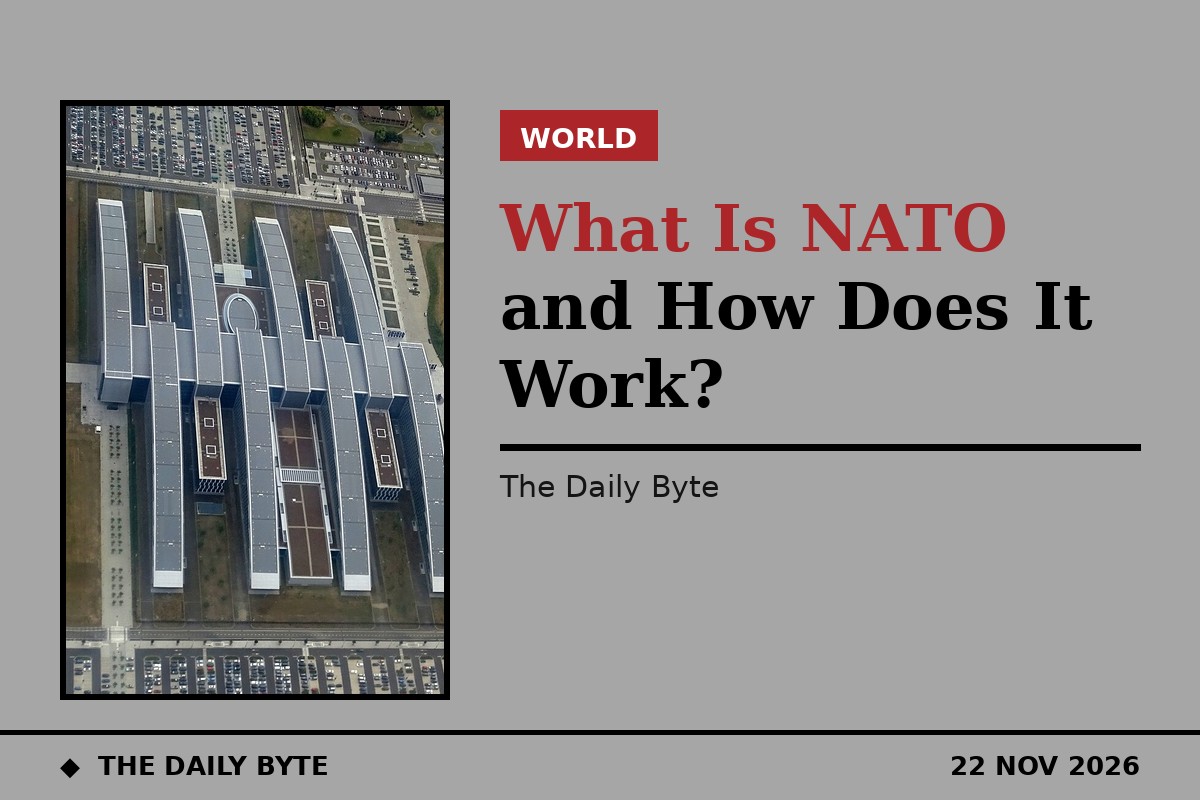
NATO, the North Atlantic Treaty Organization, is a political and military alliance of 32 countries in Europe and North America. It was founded in 1949, when 12 countries signed the North Atlantic Treaty, known as the Washington Treaty, promising to defend each other if one of them was attacked. Its central promise is Article 5 of the treaty: an armed attack against one member is treated as an attack against all of them. NATO is not a single army and it is not a world government. It is a forum where member governments consult, plan together, and, when they all agree, act together. This guide explains what NATO is, who belongs to it, how it makes decisions, and what it actually does.
How NATO began
NATO was created in the aftermath of the Second World War, during the early Cold War. On 4 April 1949, 12 countries signed the North Atlantic Treaty in Washington: Belgium, Canada, Denmark, France, Iceland, Italy, Luxembourg, the Netherlands, Norway, Portugal, the United Kingdom and the United States. The treaty entered into force on 24 August 1949. The founders wanted a durable security arrangement that would deter aggression in the North Atlantic area and bind North America and Western Europe together. The alliance was designed to counter the perceived threat from the Soviet Union, but its treaty was written in general terms, and it has adapted repeatedly since: to the end of the Cold War, to crises in the former Yugoslavia, to counter-terrorism operations after 2001, and to renewed territorial-defence planning after Russia's full-scale invasion of Ukraine in 2022.
The 32 members today
NATO now has 32 members: Albania, Belgium, Bulgaria, Canada, Croatia, Czechia, Denmark, Estonia, Finland, France, Germany, Greece, Hungary, Iceland, Italy, Latvia, Lithuania, Luxembourg, Montenegro, the Netherlands, North Macedonia, Norway, Poland, Portugal, Romania, Slovakia, Slovenia, Spain, Sweden, Türkiye, the United Kingdom and the United States. The alliance has grown in waves. Greece and Türkiye joined in 1952, West Germany in 1955, Spain in 1982, and a series of central and eastern European countries joined after the Cold War, including Poland, Czechia and Hungary in 1999, seven more countries in 2004, and Albania and Croatia in 2009. Montenegro joined in 2017 and North Macedonia in 2020. The most recent members are Finland, which became the 31st member on 4 April 2023, and Sweden, which became the 32nd member on 7 March 2024. Both applied in May 2022, after Russia's invasion of Ukraine prompted them to end decades of military non-alignment. Finland's accession was completed first, while Sweden's was delayed by objections from Türkiye and Hungary that were resolved in early 2024.
Article 5: an attack on one is an attack on all
Article 5 is the heart of the treaty. It says that an armed attack against one member, in Europe or North America, shall be considered an attack against them all, and that each member will assist the member attacked, including by armed force, with such action as it deems necessary. Two points about that wording matter. First, the commitment is collective and political as well as legal: every member is bound to respond, but each government decides for itself what action it considers necessary. Article 5 does not automatically commit every ally to the same military response. A member could contribute combat forces, or it could provide logistics, intelligence, medical support, or sanctions against the aggressor. Second, Article 5 has been invoked only once in NATO's history, after the terrorist attacks against the United States on 11 September 2001. Article 3 complements the pledge by requiring members to maintain and develop their individual and collective capacity to resist attack, so that the promise of mutual defence is backed by real forces rather than words alone.
How NATO makes decisions
NATO works by consensus, which means every member must agree before a decision is taken. There is no voting and no member can be outvoted. The main political decision-making body is the North Atlantic Council, where each member is represented, usually by its ambassador, and which meets regularly in Brussels. Defence ministers and foreign ministers meet in the same format, and heads of state and government meet at summits. The Secretary General chairs the Council and is NATO's chief official; the post is currently held by Mark Rutte, the former prime minister of the Netherlands. Below the Council sits a military structure, headed by the Military Committee and the Supreme Allied Commander Europe, which turns political decisions into military plans and operations. NATO's political headquarters is in Brussels, Belgium, where its international staff and the delegations of the member countries are based.
Consensus can be slow, and it gives every member a veto, but it also means that when NATO does act, it acts with the full backing of all its members. Decisions are usually reached after long negotiation, and disagreements are common. The accession of new members, for example, requires the unanimous agreement of all existing members, which is why Finland's and Sweden's applications took months of diplomacy to complete.
What does NATO actually do?
NATO's work falls into three broad tasks. The first is collective defence: deterring attack and defending member territory, through national forces, joint exercises, and the stationing of allied troops in exposed regions. The second is crisis management: operations beyond member territory, such as the missions in the Balkans in the 1990s, the operation in Afghanistan, and the air campaign over Libya in 2011. The third is cooperative security: working with partner countries that are not members, sharing expertise, and building the ability of other countries to defend themselves. Partners may cooperate closely with NATO, but they do not take part in its consensus decision-making as members, and they do not receive the Article 5 commitment. That distinction matters: partnership is not membership, and the guarantee applies only to members.
In recent years, NATO's focus has swung back to collective defence in Europe. After Russia's full-scale invasion of Ukraine in 2022, members increased defence spending, reinforced the alliance's eastern flank, and expanded exercises and planning for the defence of member territory. Ukraine itself is a partner, not a member, and its path to membership remains a subject of political debate among the allies.
Who can join NATO?
NATO has an open-door policy. Article 10 of the treaty allows any other European state that is in a position to further the principles of the treaty and to contribute to the security of the North Atlantic area to be invited to join, provided the existing members unanimously agree. Candidate countries must be democracies with market economies committed to the rule of law, and they must meet political, economic and military standards, including the ability of their armed forces to operate alongside those of other members. New members are also expected to meet the defence spending guideline agreed in 2014, under which members aim to spend 2 per cent of their gross domestic product on defence. Joining is a long process: a country applies, the allies assess it, an accession protocol is signed and ratified by every member's parliament, and only then does the country become a member. Finland and Sweden, established democracies with modern, interoperable militaries, still needed almost two years from application to membership.
NATO and the European Union are not the same thing
NATO is often confused with the European Union, but they are different organisations with different members and different purposes. The EU is a political and economic union of 27 European countries, with its own institutions, laws and budget. NATO is a defence alliance of 32 countries on both sides of the Atlantic, including the United States, Canada and Türkiye, which are not EU members, and excluding EU members such as Ireland, Austria, Cyprus and Malta, which are not in NATO. Most EU countries are also NATO members, and the two organisations cooperate closely, but neither controls the other.
Common misconceptions
A common misconception is that NATO can order a member's armed forces into action. It cannot. Member governments retain sovereignty over their armed forces and their foreign policy. NATO acts only when its members agree, and each member decides its own contribution. Another misconception is that Article 5 means automatic war. It does not: each member decides what action it deems necessary, and the response is a political decision taken by the North Atlantic Council. A third misconception is that NATO is an American organisation. The United States is its largest member and its largest military contributor, but decisions are taken by consensus, and every member, large or small, has the same formal say.
Frequently asked questions
What is NATO? NATO is a political and military alliance of 32 countries in Europe and North America, founded in 1949 by the North Atlantic Treaty. Its central promise is collective defence: an armed attack against one member is treated as an attack against all.
How many countries are in NATO? There are 32 members. Finland joined in April 2023 and Sweden in March 2024, bringing the total from 30 to 32.
What is Article 5? Article 5 of the North Atlantic Treaty says an armed attack against one member shall be considered an attack against them all, and each member will assist with such action as it deems necessary. It has been invoked once, after the 11 September 2001 attacks on the United States.
How does NATO make decisions? NATO works by consensus: every member must agree. The North Atlantic Council, chaired by the Secretary General, is the main decision-making body, and its headquarters is in Brussels.
Can any country join NATO? Under Article 10, any European state that can further the principles of the treaty and contribute to North Atlantic security can be invited to join, but only if all existing members unanimously agree. Candidates must meet democratic, economic and military standards, including the 2 per cent of GDP defence spending guideline.
NATO's story is one of adaptation: an alliance built for the Cold War that has repeatedly reinvented itself, most recently after 2022. Its rules are set out in the North Atlantic Treaty itself, and the House of Commons Library briefing on NATO enlargement explains how Finland and Sweden joined and how the accession process works. The US Congressional Research Service paper on NATO enlargement to Sweden and Finland sets out the same history from the American side, including the defence spending figures and the strategic reasons both countries gave for joining.


