What Is OPEC+? Oil Alliance Explained
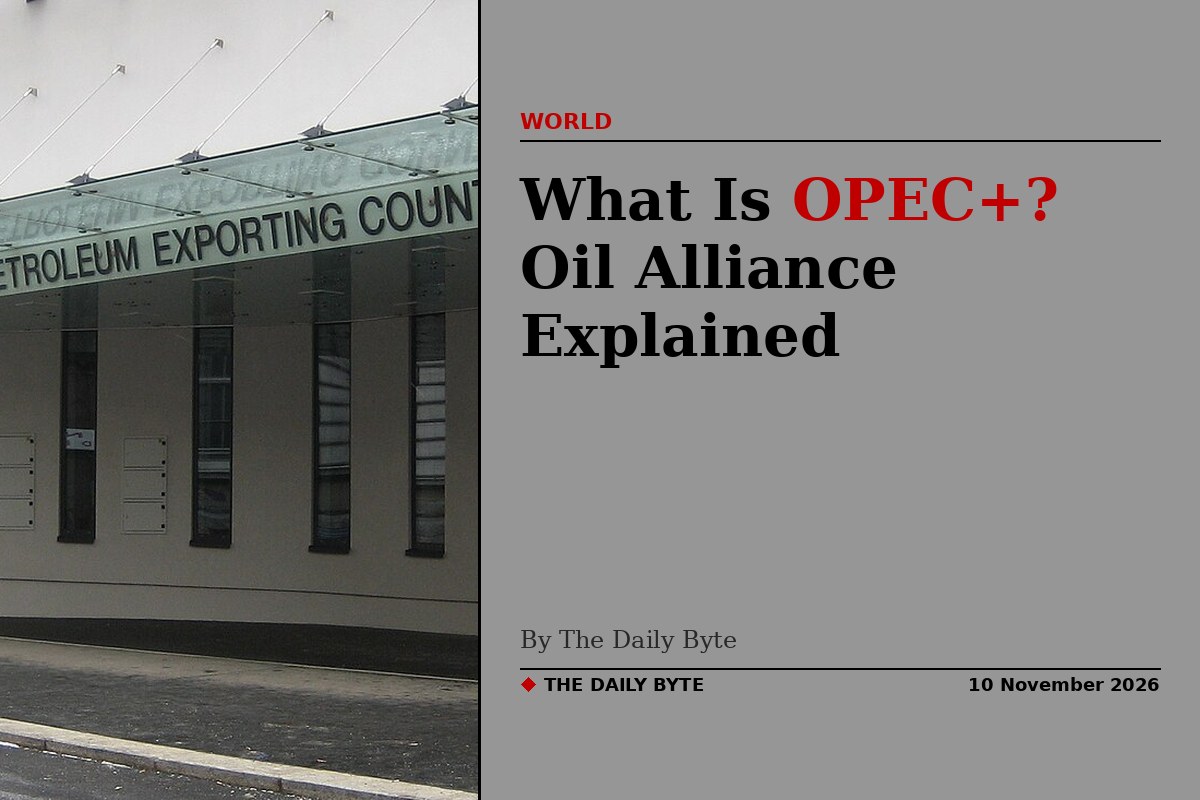
OPEC+ is an alliance of around 22 oil-producing countries that coordinate how much crude oil they pump in order to influence global oil prices. It brings together the members of OPEC, the Organization of the Petroleum Exporting Countries, and ten non-OPEC producers, including Russia, under a cooperation deal first agreed in late 2016. The group meets regularly in Vienna, Austria, to set production targets, and its decisions help determine the price of Brent crude, the benchmark that feeds through to petrol, diesel and heating costs around the world.
OPEC+ is not a single organisation with a headquarters and a treaty in the usual sense. It is a loose grouping built around OPEC itself, held together by a Declaration of Cooperation and a Charter of Cooperation. That matters, because the alliance can only act when its members agree, and individual countries have at times pumped more oil than their agreed share. Even so, the group controls a large share of world oil supply, so when it cuts or raises output, markets listen.
Key facts about OPEC+
- Formed: late 2016, when OPEC agreed to cooperate with ten non-OPEC producers; the Declaration of Cooperation followed in 2017.
- Members: around 22 countries, made up of OPEC members plus ten non-OPEC producers including Russia, Kazakhstan, Mexico and Oman.
- Headquarters: the group is coordinated through OPEC, which is based in Vienna, Austria.
- Secretary General of OPEC: Haitham Al Ghais.
- What it does: agrees production levels for member countries to manage supply and support oil prices.
- Share of supply: OPEC members alone accounted for about 38 percent of global oil production in 2022, and the wider OPEC+ group controls roughly half of world output.
- Key players: Saudi Arabia, the largest OPEC producer, and Russia, the largest non-OPEC partner, effectively lead the group.
- Market context: Brent crude, the international benchmark, has fallen below 92 dollars a barrel this week as traders weigh weaker demand and ample supply.
How is OPEC+ different from OPEC?
OPEC was founded in 1960 at the Baghdad Conference by five countries: Iran, Iraq, Kuwait, Saudi Arabia and Venezuela. Its aim was to give oil-exporting countries a collective voice against the large Western oil companies that then dominated the market, and to coordinate production so that prices did not collapse. OPEC moved its headquarters to Vienna in 1965, and its membership grew over the following decades to include producers in Africa, the Middle East and Latin America.
By 2016, however, OPEC alone could no longer steer the market. A surge in production from the United States, driven by shale oil, had pushed prices down sharply, and Russia, then the world's largest oil producer alongside Saudi Arabia, was outside the group. In December 2016 OPEC and ten non-OPEC producers agreed to cut output together, the first joint cut of its kind, and the grouping became known as OPEC+. The cooperation was formalised in the Declaration of Cooperation in 2017 and in a Charter of Cooperation signed in July 2019, which created a long-term framework for the partners to keep working together.
The distinction still matters. OPEC is a permanent intergovernmental organisation with its own secretariat, budget and rules. OPEC+ is the wider, informal alliance of OPEC members and their non-OPEC partners. Decisions on production are taken by the whole OPEC+ group, but only OPEC members are bound by OPEC's own constitution, and the non-OPEC partners take part voluntarily.
Who are the members of OPEC+?
When the alliance was formed, it combined 12 OPEC members with ten non-OPEC producers. The OPEC members were Algeria, the Republic of Congo, Equatorial Guinea, Gabon, Iran, Iraq, Kuwait, Libya, Nigeria, Saudi Arabia, the United Arab Emirates and Venezuela. The ten non-OPEC partners were Azerbaijan, Bahrain, Brunei, Kazakhstan, Malaysia, Mexico, Oman, Russia, South Sudan and Sudan. Together the group had 22 members.
Membership has changed since then. Angola left OPEC at the start of 2024, and the United Arab Emirates left OPEC in 2026. Brazil, meanwhile, has joined the Charter of Cooperation, the wider framework through which OPEC and its partners work together. Saudi Arabia and Russia are the dominant producers in the group, and their agreement is usually essential for any production decision. The current Secretary General of OPEC, Haitham Al Ghais, acts as a public voice for the organisation, but real power lies with the energy ministers who meet to set output policy.
How does OPEC+ decide how much oil to produce?
OPEC+ sets production through meetings of its member countries, usually held in Vienna or by video link. At these meetings, ministers review global demand, stock levels and prices, and then agree production targets for each member, known as quotas. If the group believes there is too much oil on the market, it cuts quotas to support prices. If it believes demand is strong, it can raise quotas to increase supply. Decisions are taken by consensus, which means any member can block a deal, and disagreements have at times delayed or weakened agreements.
Alongside the overall quotas, a smaller group of producers has also made additional voluntary cuts in recent years to support prices. In November 2026, seven producers, Saudi Arabia, Russia, Iraq, Kuwait, Kazakhstan, Algeria and Oman, reaffirmed their commitment to market stability, according to OPEC. The group has also been unwinding some of those voluntary cuts in stages, adding barrels back to the market when it judges that demand can absorb them. Traders watch every meeting closely, and even a hint that output will rise or fall can move the oil price within minutes.
Compliance is the weak point. Quotas are targets, not laws, and members have often produced more than their agreed share, sometimes because their economies depend on oil revenue. OPEC publishes monthly production figures, and analysts track tanker movements and exports to check whether countries are keeping to their promises. When cheating is widespread, the cuts lose their effect and prices fall anyway.
Why does OPEC+ matter for petrol prices?
Oil is a global commodity, so a decision taken in Vienna can affect what drivers pay in Britain, Pakistan and everywhere else. Crude oil is the main cost in a litre of petrol or diesel, so when Brent crude rises, pump prices usually follow within days or weeks, and when it falls, prices at the pump tend to fall more slowly. OPEC+ matters because it controls so much of the world's exportable oil: when it restricts supply, the global price rises, and when it opens the taps, the price falls.
That is why OPEC+ decisions are watched far beyond the energy industry. Higher oil prices push up transport and heating costs, feed into inflation and put pressure on central banks. Lower prices ease inflation but cut revenue for producer countries, many of which depend on oil to fund public spending. Brent crude has fallen below 92 dollars a barrel this week, easing some of the inflation pressure that built up when oil traded far higher, but the market remains sensitive to any change in OPEC+ output policy and to tensions in the Middle East, where much of the world's oil is produced and shipped.
What are the criticisms and limits of OPEC+?
Critics in oil-consuming countries describe OPEC+ as a cartel that keeps prices artificially high, and the United States has repeatedly pressed the group to pump more. The group's defenders reply that producers have the right to manage their own resources, and that stable prices benefit consumers too by encouraging the investment needed to keep oil flowing. The argument has run for decades and flares up whenever prices spike.
The group also faces limits that have nothing to do with politics. The United States, now the world's largest oil producer, is outside OPEC+, so the alliance cannot control a large part of global supply. Members sometimes ignore their quotas, as described above. And over the longer term, the shift towards electric vehicles and renewable energy is expected to slow the growth of oil demand, which could reduce the group's influence. For now, though, oil still powers most transport and much of industry, and OPEC+ remains one of the most powerful forces in the global energy market.
Frequently asked questions
What does OPEC stand for? OPEC stands for the Organization of the Petroleum Exporting Countries. It was founded in 1960 and is based in Vienna, Austria.
What does the plus mean in OPEC+? The plus refers to the ten non-OPEC oil producers, led by Russia, that cooperate with OPEC on production policy. Together they form the wider alliance known as OPEC+.
Is Russia a member of OPEC? No. Russia is not a member of OPEC itself, but it is the largest partner in OPEC+, and it takes part in the group's production decisions alongside Saudi Arabia.
How often does OPEC+ meet? The group's ministers meet several times a year, and a smaller monitoring committee meets more often to review production and compliance. Meetings can also be called at short notice if prices move sharply.
Can OPEC+ control the oil price? It can influence the price by changing supply, but it cannot control it. Demand, production outside the group, wars, sanctions, economic growth and the shift to other forms of energy all affect the price as well.
Does OPEC+ affect UK petrol prices? Yes, indirectly. UK pump prices follow the global price of crude oil, and OPEC+ decisions are one of the biggest influences on that price, along with the value of the pound against the dollar, fuel duty and tax.


