What Is Pax Silica? Economic Security Zone Explained
Pax Silica is a name that has appeared in headlines across Southeast Asia in recent weeks, as leaders gather in Manila for the ASEAN summit and President Donald Trump prepares to visit the Philippines. The United States ambassador has now said plainly that no Pax Silica announcement was ever planned for the summit. So what is it, why does it matter, and why is there no deal yet? This explainer sets out what is known, what is still proposed rather than agreed, and what happens next.
What is Pax Silica?
Pax Silica is a United States-led multilateral initiative to secure the supply chains for the technologies that modern economies depend on: critical minerals, semiconductors, artificial intelligence and advanced manufacturing. Its centrepiece in the Philippines is a proposed Economic Security Zone, a large industrial enclave where companies would make the chips, components and materials that feed global supply chains. The United States State Department describes the planned zone as a first-of-its-kind industrial hub designed to expand production of critical inputs essential to global supply chains.
The idea is economic security rather than trade in the usual sense. Pax Silica is not a free trade agreement and it is not a military alliance. It is a coalition of countries working together to make sure the raw materials and the factories that turn them into chips and AI hardware are not concentrated in one place, and not vulnerable to a single disruption. The Philippines joined Pax Silica in April 2026 as its 13th participant. The coalition now has more than 30 countries.
Why is it called Pax Silica?
The name is a deliberate piece of branding. Pax is the Latin word for peace, and silica is silicon dioxide, the compound at the heart of silicon chips. Every computer chip, every smartphone processor and every AI accelerator starts with silicon, and silica is its most common natural form. The name is meant to signal that secure, widely shared supplies of the materials behind the digital economy are a foundation for stability, in the same way that earlier American-led orders were named for peace. It is a big claim for a project that, so far, exists mainly on paper.
Where would the hub be built?
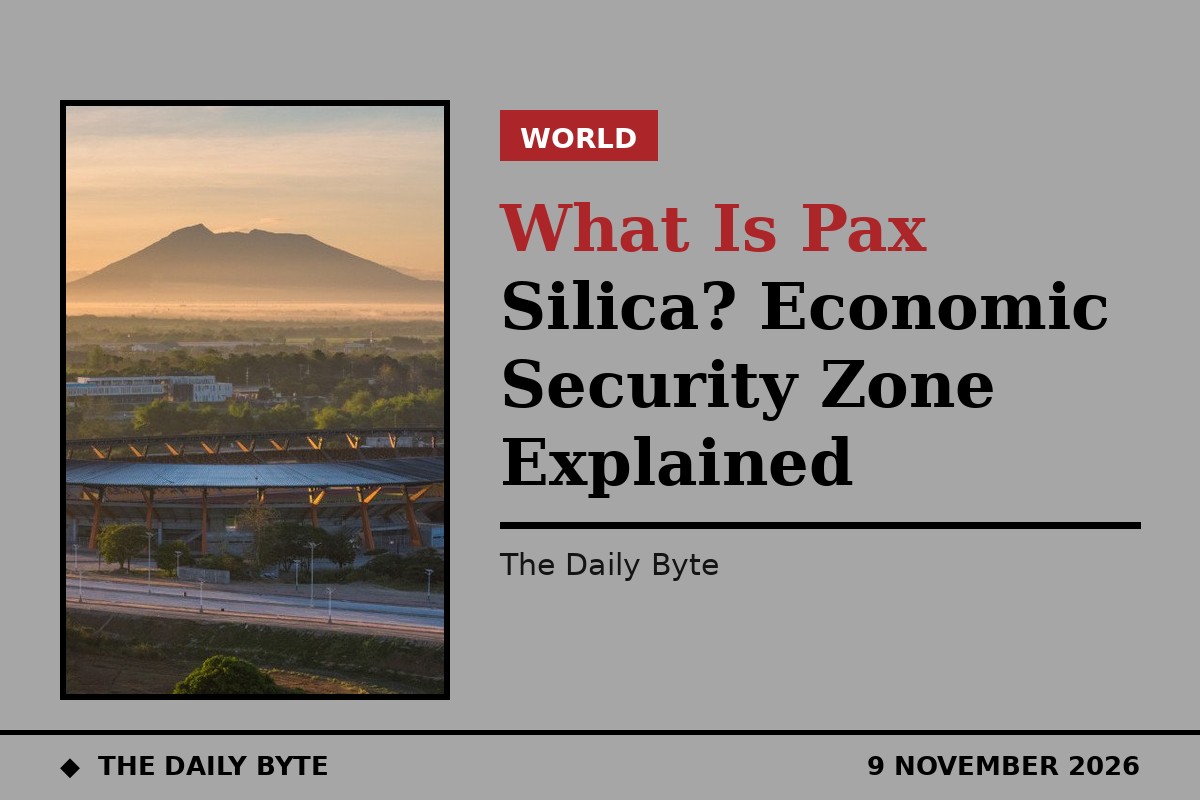
The proposed site is in New Clark City, a planned city in Capas, Tarlac, about 120 kilometres north of Manila. The Philippine government has identified a 1,619-hectare site there, roughly 4,000 acres, for the proposed hub. New Clark City is already home to a large athletics stadium and government buildings, and it sits inside the area once used by the former Clark Air Base. The Bases Conversion and Development Authority, the Philippine agency known as the BCDA, owns and develops the land, and it has been working with the United States State Department since June on a proposed agreement covering the legal, commercial and other issues involved in developing the enclave.
The hub would form part of the Luzon Economic Corridor, an infrastructure and investment initiative involving the Philippines, the United States and Japan. The corridor aims to link Subic Bay, Clark, Metro Manila and Batangas with rail, port and airport infrastructure, so that goods made in the new hub can move quickly to ports and airports. The corridor was launched as part of a wider effort to build alternatives to supply chains that run through a small number of countries.
Who is involved and how big could it be?
The project was unveiled in May 2026, when Jacob Helberg, the United States undersecretary of state for economic affairs, led the presentation of the proposed site at New Clark City. Since then, the BCDA and the State Department have been negotiating a framework agreement, the document that would set the terms for the zone before any building begins.
The BCDA has estimated that the hub could attract between 40 billion and 70 billion dollars in investment and generate between 130,000 and 190,000 direct jobs over several decades. It has named Apple, Nvidia, Qualcomm and Taiwan Semiconductor Manufacturing Co. as potential investors. Those figures need to be read carefully: they are projections from the Philippine development authority, not secured commitments, and no firm investment has been announced by any company. The jobs figure, if it were ever reached, would be spread over decades rather than delivered in a single wave.
Why is there no announcement at the ASEAN summit?
For weeks, there was speculation that a framework agreement for Pax Silica could be signed during the ASEAN summit in Manila, possibly during President Trump's visit. The BCDA's president, Joshua Bingcang, had said the signing could be among the major announcements at the summit, and that the authority was targeting a November signing, although no definite date had been set. That expectation was then knocked down from both sides.
Palace Press Officer Claire Castro said this week that the agreement had not yet been finalised, and that the government would see whether negotiations could be expedited. Malacanang said the BCDA was awaiting Washington's response to a draft framework agreement. The Philippine ambassador to the United States, Jose Manuel Romualdez, said a deal was unlikely to be finalised during Trump's visit because the two countries were still working out the details.
Then, on Saturday 7 November, the United States ambassador to the Philippines, Lee Lipton, issued a statement on social media. "No such announcement on the Pax Silica Economic Security Zone was ever planned," he said. "Decisions will be made in full consultation with the government of the Philippines at the appropriate time." He added that the process would include rigorous discussions on the initiative's potential impact on stakeholders. In short, the two governments are still negotiating, and neither side is ready to sign.
What are the concerns?
The project has drawn questions as well as enthusiasm in the Philippines. Farmers, indigenous communities and environmental groups have raised concerns about possible displacement from the 1,619-hectare site, and about the project's demand for water and electricity in an area where both are already stretched. Philippine officials have said facilities would be placed in a designated buildable zone and that affected communities would be consulted, but the details of how that would work have not been published.
There is also a debate about what the Philippines would actually gain. A discussion paper by the University of the Philippines Center for Integrative and Development Studies argued that attracting major technology companies would not necessarily lead to technological advancement for the country. It said the Philippines could remain largely a manufacturing base while research and design continued overseas, and it called for stronger domestic technological capabilities alongside any foreign investment. That argument matters because the history of export zones in the Philippines includes places where jobs arrived but higher-value work did not follow.
What happens next?
Negotiations continue. The BCDA is waiting for Washington's response to its draft framework agreement, and there is no new signing date. The framework agreement, when it comes, would be only the first step: it would set the legal and commercial terms, after which investors would need to commit, land would need to be prepared, and power and water supplies secured. None of that has happened yet.
For now, Pax Silica is best understood as a proposal with powerful backers and a chosen site, but no signed agreement, no confirmed tenants and no construction timetable. Its fate will be decided in the negotiations between Manila and Washington in the coming weeks, not at the ASEAN summit. The White House and the Philippine government have separately confirmed that Trump will attend the summit in Manila and then travel to the Asia-Pacific Economic Cooperation meetings in Shenzhen, China, on 18 and 19 November, so the project is likely to stay in the headlines even without a signing.


