What Is Pay-Per-Mile Tax for Electric Cars? Explained
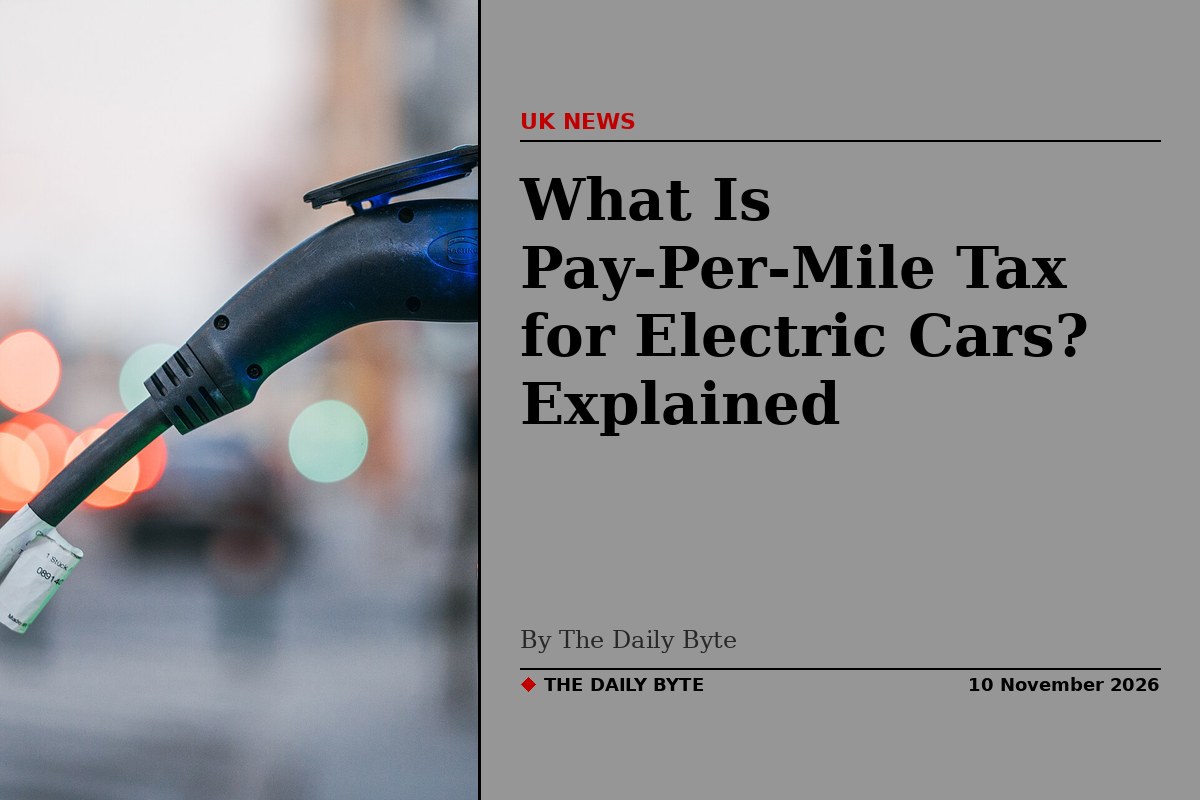
From April 2028, drivers of electric cars will pay for the miles they drive. The new charge, officially called Electric Vehicle Excise Duty, or eVED, will cost 3p a mile for fully electric cars and 1.5p a mile for plug-in hybrids, on top of the road tax they already pay. This guide explains what pay-per-mile tax is, how much it will cost, how the miles are counted and who is affected.
The charge was first announced at Budget 2025, consulted on in early 2026, and confirmed unchanged in the Autumn Budget on 28 October 2026, when Chancellor John Healey kept both the April 2028 start date and the rates. It is one of the biggest changes to motoring tax in decades, and it will eventually affect millions of drivers.
What is pay-per-mile tax?
Pay-per-mile tax is a mileage-based charge for electric and plug-in hybrid cars, introduced as an extension of the existing Vehicle Excise Duty (VED) system — the tax most people still call road tax. The official name is Electric Vehicle Excise Duty, or eVED.
It works like this: instead of paying a flat annual amount, electric car drivers will pay a set amount for every mile they drive. The more you drive, the more you pay. The government says the point is fairness. Petrol and diesel drivers already pay fuel duty at the pump, roughly 53p a litre, every time they fill up. Electric car drivers pay no equivalent, and as more people switch to electric cars, the Office for Budget Responsibility has forecast that fuel duty receipts will fall. eVED is intended to replace that lost revenue over the long term.
How much will pay-per-mile tax cost?
From 1 April 2028, the rates are 3p a mile for battery electric cars and hydrogen fuel-cell cars, and 1.5p a mile for plug-in hybrid cars. The rates will be uprated in 2029-30 and in future years in line with CPI inflation, so they keep their real-terms value.
- 5,000 miles a year — £150 a year for an electric car, £75 for a plug-in hybrid
- 8,500 miles a year — £255 a year for an electric car, about £128 for a plug-in hybrid
- 10,000 miles a year — £300 a year for an electric car, £150 for a plug-in hybrid
- 15,000 miles a year — £450 a year for an electric car, £225 for a plug-in hybrid
Those figures are on top of existing Vehicle Excise Duty. Electric cars have paid VED since April 2025: £10 in the first year, then £200 a year, with an additional expensive-car supplement for cars listed at more than £40,000. A typical electric car driver doing 10,000 miles a year would therefore pay £200 of VED plus £300 of eVED from 2028.
By comparison, the government notes that petrol and diesel drivers still pay roughly double per mile through fuel duty. The Treasury's own comparison is that eVED keeps electric motoring cheaper per mile than petrol or diesel, while making sure electric drivers contribute towards the roads they use.
When does pay-per-mile tax start?
eVED takes effect from 1 April 2028. Drivers will first pay it when they renew their Vehicle Excise Duty after that date, so the exact month you start paying depends on when your car's tax is due for renewal.
The timeline so far: the government announced eVED at Budget 2025, published a consultation on how it would work, which closed on 18 March 2026, and published its response on 13 July 2026. Budget 2026, delivered on 28 October 2026, confirmed the scheme would go ahead as planned, with no change to the rates or the start date, despite lobbying from the motor industry.
How will the miles be counted?
Drivers will give an odometer reading from their car and estimate the mileage for the year ahead when they renew their vehicle tax. They can pay an upfront charge based on that estimate, or spread the payment across the year. At the end of the year, a fresh mileage reading triggers a reconciliation, so you pay for the miles you actually drove.
The DVLA will administer eVED alongside VED, and the mileage reporting will be built into the existing vehicle-tax renewal process. The government says it will use mileage data already collected at annual MOT tests to check that the figures drivers supply are consistent, so for cars that already have an MOT there should typically be no extra steps.
Two new tools are planned for the launch. A mileage estimation tool will be available from April 2028 to help drivers work out what they will owe. An opt-in service called eVED Connect will let a car's own built-in connectivity report its mileage automatically, for drivers who choose to use it. The government has said participation will be voluntary, and that the scheme will not require motorists to report where or when they drive. Automatic refunds are planned by 2030 for drivers who overestimate their mileage or sell the car part-way through the year.
Who has to pay pay-per-mile tax?
The charge applies to registered keepers of cars that are battery electric, plug-in hybrid or hydrogen-powered. It applies to every electric car and plug-in hybrid, however you get it — including cars obtained through salary sacrifice schemes.
Self-charging hybrids that cannot be plugged in are not affected, because they already pay fuel duty on the petrol they use. Petrol and diesel cars are also unaffected; they continue to pay fuel duty instead. Fuel duty was frozen for six more months in Budget 2026, with the rise due on 1 January 2027 cancelled and duty held at 52.95p a litre until the end of June 2027.
The government expects the charge to affect around 5.6 million vehicles in the financial year 2028-29. The Treasury forecasts it will raise £1,115 million in 2028-29, rising to £2,285 million by 2031-32.
What about privacy and tracking?
One of the most asked questions about pay-per-mile tax is whether the government will track where drivers go. The published consultation response says the scheme will not require motorists to report where or when they drive — only how far. The standard method is an odometer reading, the same number already recorded at an MOT, not a location log.
eVED Connect, the opt-in connected-car service, has drawn the most attention. In a written parliamentary question submitted on 29 October 2026, Conservative MP Alison Griffiths asked the Treasury whether eVED Connect would give HM Revenue and Customs vehicle location information, journey routes and the times and dates of individual journeys. The government's published position is that participation is voluntary and that motorists will not be required to disclose where or when they drive. Drivers who do not want a connected service can simply report their mileage themselves.
Will pay-per-mile tax put people off electric cars?
That is the main criticism of the policy. The Office for Budget Responsibility assessed that eVED, together with related Budget measures, would reduce electric car sales by around 120,000 between the financial years 2025-26 and 2030-31 — about 2% of total anticipated electric car sales in that period. The OBR also noted significant uncertainty, because the effect depends on how drivers respond: some existing owners may keep petrol and diesel cars longer, and some buyers may choose slightly smaller electric cars to offset the cost.
The government argues the opposite case: that a per-mile charge is fairer than a flat tax, because it links what you pay to how much you use the roads, and that it protects the long-term funding of the road network as the country moves away from petrol and diesel. It also points to the wider package supporting the switch to electric cars, including £100 million announced in Budget 2026 to cut the cost of on-street charging, and company car tax rates for electric cars now set all the way to April 2031.
Frequently asked questions
What is pay-per-mile tax?
It is Electric Vehicle Excise Duty (eVED), a mileage-based charge for electric and plug-in hybrid cars starting on 1 April 2028: 3p a mile for electric cars, 1.5p for plug-in hybrids.
Do I pay it instead of road tax?
No. It is on top of existing Vehicle Excise Duty. Electric cars pay £200 a year in VED from their second year, plus the per-mile charge.
How do I report my mileage?
Through the DVLA when you renew your vehicle tax: an odometer reading and an estimate of the year's mileage, with a reconciliation at year end. An opt-in connected service, eVED Connect, is also planned.
Does it apply to petrol and diesel cars?
No. Petrol and diesel drivers pay fuel duty instead, and self-charging hybrids that cannot be plugged in are not affected.
Will the government track where I drive?
The government says no. The scheme is based on mileage, not location, and eVED Connect is voluntary.
This article is general information, not personal financial advice. Check the official GOV.UK pages linked below for the current position, because the detailed rules are still being finalised.