What Is Platinum Used For?
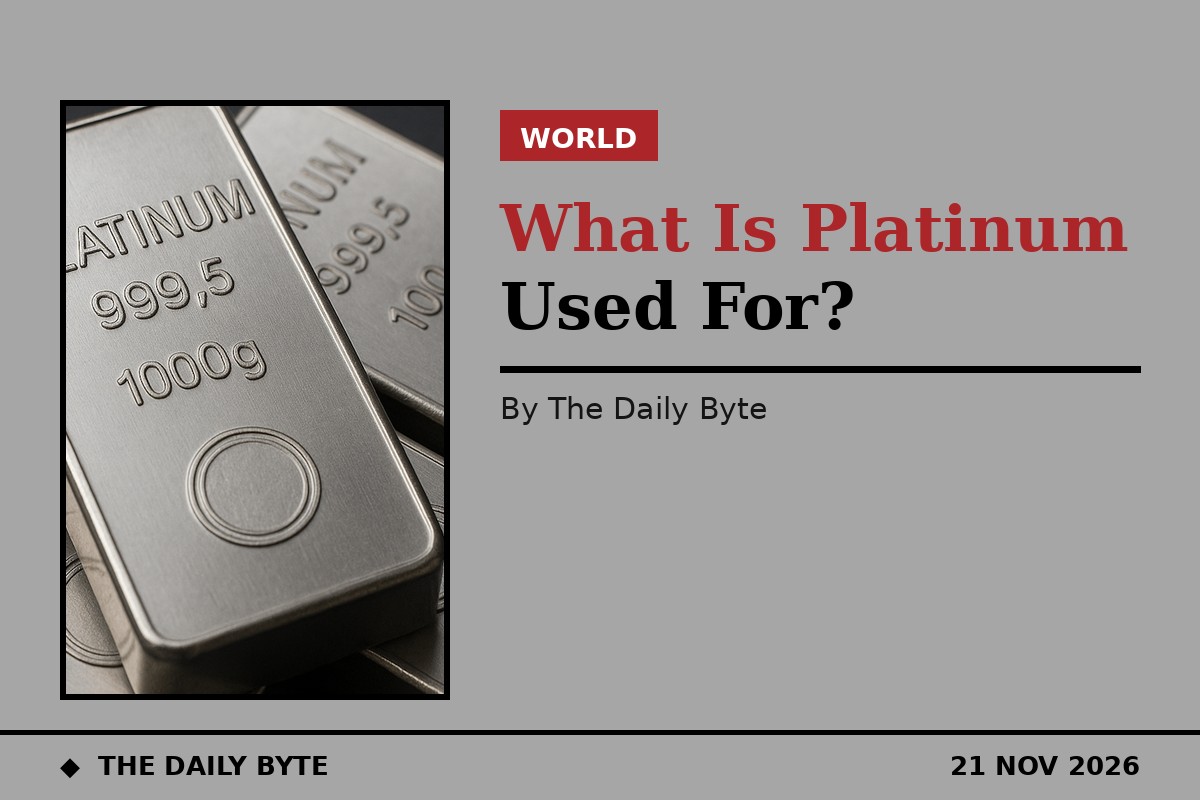
Platinum is used mainly in vehicle catalytic converters, jewellery, industrial processes and investment. It is one of the rarest metals in the world, prized for its ability to speed up chemical reactions without being used up itself, for its very high melting point, and for its resistance to corrosion.
That mix of precious-metal and industrial uses is what makes platinum different from gold: its price is driven as much by car factories and chemical plants as by investors. In November 2026 that balance came sharply into view, when platinum fell to a 17-month low of about $1,290 an ounce, having traded at a record $2,923.70 an ounce as recently as January 2026.
What is platinum used for in cars?
Vehicles are the single largest source of platinum demand. The World Platinum Investment Council (WPIC) puts automotive demand at between 30% and 44% of total demand over the five years to 2023, and forecasts it at 2.92 million ounces in 2026, down 3% on the year before.
Almost all of that automotive platinum goes into catalytic converters, the honeycomb devices fitted in exhaust systems that convert more than 90% of harmful hydrocarbons and carbon monoxide into carbon dioxide, nitrogen and water vapour. Autocatalysts have been fitted in the United States and Japan since 1974, and today more than 95% of new vehicles sold each year have one.
Platinum dominates the diesel autocatalyst market, and its use in petrol vehicles is growing as it substitutes for palladium, which has become more expensive. Platinum is also used in spark plugs and in sensors that monitor oxygen and temperature to help engines run more efficiently. Looking further ahead, hydrogen fuel-cell vehicles use platinum's catalytic properties to turn hydrogen and air into water, producing electricity to power the car with zero exhaust emissions.
What is platinum used for in jewellery?
Jewellery is the second-largest source of platinum demand. The WPIC expected jewellery demand to reach 2.16 million ounces in 2025, then fall 6% to 2.04 million ounces in 2026.
Platinum suits jewellery because it is dense, naturally white, durable and resistant to tarnish. It is usually alloyed with other platinum-group metals such as palladium, as well as copper and cobalt, so that it is easier to work with. Demand has traditionally been strongest in Japan and the West, with recent growth coming from the United States, China and India.
What are platinum's industrial uses?
Industrial demand is the second-largest demand segment overall, accounting for between 27% and 36% of total demand in recent years, according to the WPIC. Its uses are wide-ranging:
| Industry | How platinum is used |
|---|---|
| Chemicals and fertiliser | Catalyst to make nitric acid, a fertiliser ingredient, and to raise petrol yields |
| Glass | Equipment that withstands extreme heat without distortion or contamination |
| Electronics | Hard disks with high storage density, sensors and silicones |
| Medicine | Pacemakers, cochlear implants and instruments visible during keyhole surgery |
| Hydrogen energy | Catalyst in fuel cells and electrolysers that split water into hydrogen |
CME Group summarises the broad split of non-investment demand as roughly 40% automotive, 40% jewellery and 20% industrial. Hydrogen is the fastest-growing small segment: demand from hydrogen production was forecast to grow by more than a third in 2026, although from a very low base.
Is platinum an investment?
Yes. Platinum is bought as bars, coins and exchange-traded funds, and it is also held by investors as a store of value. Because the metal pays no income, it tends to become less attractive when interest rates rise and the US dollar strengthens, since holding it then carries a higher opportunity cost.
That is exactly what happened in 2026. The WPIC revised its forecast for the platinum market from a deficit of 297,000 ounces to a surplus of 265,000 ounces, and attributed the change almost entirely to weakening investment demand. Investment demand swung from buying of 1,152,000 ounces in 2025 to net selling of 83,000 ounces in 2026, a reversal of about 1,235,000 ounces.
Why has the platinum price fallen in November 2026?
Platinum dropped about 9.9% in a week to near $1,290 an ounce, a 17-month low and its lowest since mid-2025. The fall was part of a broader precious-metals sell-off: gold fell to a 14-month low and silver also dropped sharply in the same week.
The main drivers were expectations of further US interest-rate rises and a stronger dollar, which hit gold and silver as well. Higher financing costs also squeezed car production, adding pressure on a metal whose biggest use is in vehicles, and soft demand from carmakers weighed further. The WPIC's switch from a forecast deficit to a forecast surplus removed one of the arguments that had supported the price during its rally in 2025 and early 2026.
On the supply side, mined output is dominated by South Africa, with smaller contributions from Russia, Zimbabwe and North America, and recycling of old catalytic converters and jewellery is also important. Traders are now watching the Federal Reserve's December meeting, South African electricity supply and mine safety, global vehicle production, and platinum fund holdings for the next move.
Frequently asked questions
Is platinum rarer than gold? Yes. The World Platinum Investment Council describes platinum as one of the rarest metals in the world, and annual mined supply is only around 5.5 million ounces.
Is platinum more expensive than gold? Not now. Platinum traded at a record $2,923.70 an ounce in January 2026, but by November 2026 it had fallen to about $1,290, while gold was trading near $3,881 an ounce.
Do electric cars use platinum? Battery electric cars use little or no platinum, because they have no exhaust to clean. Hybrid cars still use catalytic converters, and hydrogen fuel-cell cars use more platinum per vehicle than a conventional car.
Why is platinum called a critical mineral? The World Platinum Investment Council describes it as a critical mineral for the energy transition, because of its role in hydrogen fuel cells, electrolysers and emissions control.


