What Is PMQs and How Does It Work?
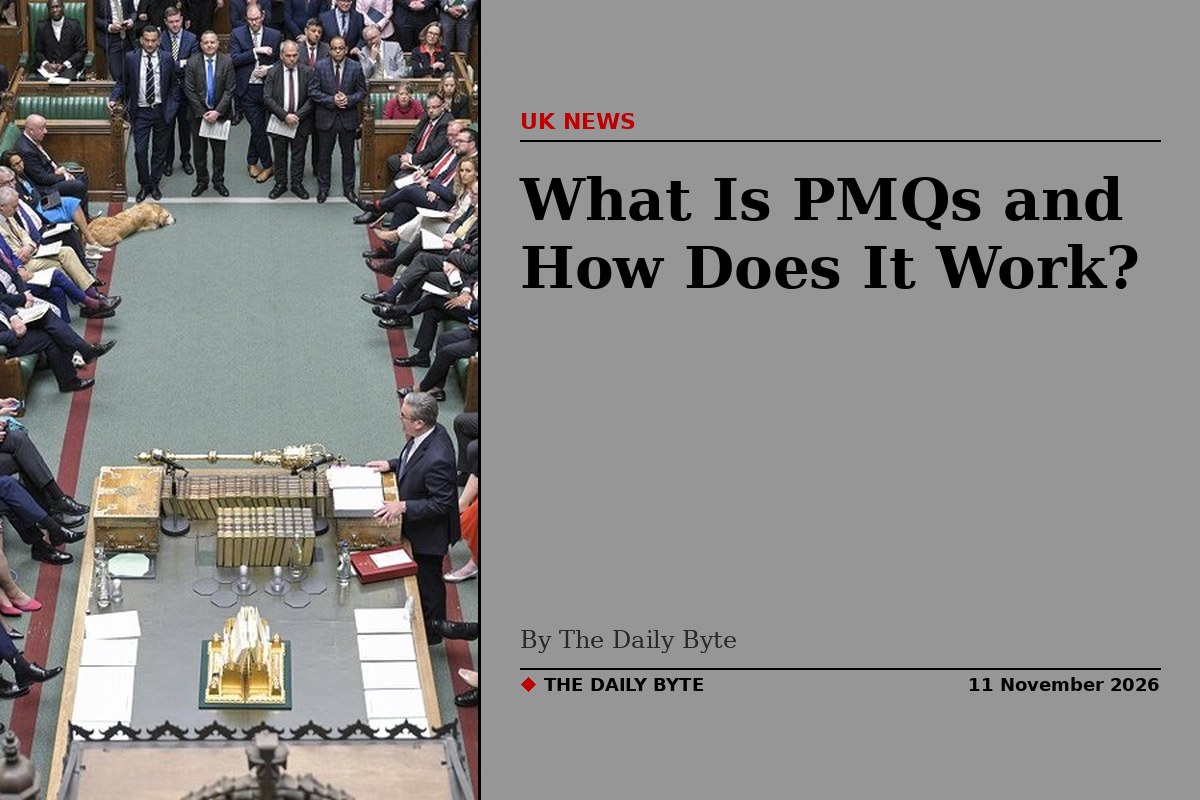
Prime Minister's Questions, known as PMQs, is the weekly 30-minute session in the House of Commons in which MPs question the Prime Minister about government policy. It takes place every Wednesday at noon when the Commons is sitting, including today, Wednesday 11 November 2026. It is the most watched half-hour in British politics and the Prime Minister's most regular public test in Parliament.
Any MP can question the Prime Minister on any aspect of government policy, from the economy and the NHS to foreign affairs. The Prime Minister does not know most of the questions in advance, which is why the session is both a test of preparation and a test of political skill.
When does PMQs take place?
PMQs is held every Wednesday at 12 noon when the House of Commons is sitting, and it is scheduled to last for 30 minutes. The Speaker of the House of Commons chairs the session and decides who is called to speak. In practice the session often runs a little beyond its half-hour slot so that more MPs can be heard.
The session is broadcast live and has been filmed since 1989, with live broadcasting since 1990. It is also one of the few parliamentary events that regularly makes the evening news bulletins, because the exchanges between the Prime Minister and the Leader of the Opposition often set the political agenda for the rest of the week.
How are questions chosen at PMQs?
Backbench MPs who want to ask a question enter their names in a ballot. The names are then drawn at random in a process known as the shuffle, and the order in which MPs will be called is published on the Order Paper for the Wednesday session. Unlike departmental question times, MPs do not submit the text of their question in advance.
The first question on the Order Paper is usually a formal one, in which an MP asks the Prime Minister to list their engagements for the day. The Prime Minister answers briefly, and the MP then asks a supplementary question, which is the one they really want answered. Other MPs who have not been drawn in the ballot may still be called by the Speaker to ask a supplementary question.
The Speaker calls MPs in turn, usually alternating between the government benches and the opposition benches, so that both sides of the House are heard during the session.
Who gets to ask the most questions?
The exchanges at PMQs are dominated by the Leader of the Opposition, who is entitled to ask six questions in each session. The six questions are usually asked in a single block, allowing the opposition leader to pursue one theme or to press the Prime Minister across several topics.
The leader of the third-largest party in the Commons is entitled to ask two questions. Other party leaders and backbenchers are called by the Speaker as time allows. Because the Prime Minister is questioned by MPs from every party, the session can range from detailed questions about local issues to the biggest questions of national policy.
What is PMQs for?
PMQs is one of the main ways the House of Commons holds the government to account. It forces the Prime Minister to defend government decisions in public, in front of MPs and the cameras, and to respond to events as they happen rather than in a prepared statement.
Supporters say it keeps the Prime Minister in touch with the concerns of ordinary MPs and their constituents, because backbenchers can raise anything from a local hospital to a national crisis. Critics argue that it has become more about political point-scoring than about scrutiny. Research by the Hansard Society has found that many members of the public view PMQs as excessively confrontational, and it is often described as Punch and Judy politics.
Whatever the criticism, PMQs remains a central part of British political life. For MPs it is a rare chance to put a question directly to the Prime Minister; for the Prime Minister it is a weekly examination with no notes on the questions in advance; and for the public it is the clearest weekly picture of how the government is being challenged in Parliament.
A short history of PMQs
Questions to the Prime Minister have a long history, but the modern form of PMQs dates from 1961, when two fixed 15-minute sessions on Tuesday and Thursday afternoons were made permanent. The first session in that format took place on 24 October 1961.
The format changed again in 1997, when Tony Blair merged the two 15-minute sessions into a single 30-minute session on Wednesdays, initially at 3pm. The start time moved to noon in 2003, and the Leader of the Opposition's allocation was doubled from three questions to six. The first PMQs in the new format took place on 21 May 1997, and the Wednesday-at-noon format has been in place ever since.
PMQs at a glance
| Detail | PMQs |
|---|---|
| When | Every Wednesday at 12 noon when the Commons is sitting |
| How long | 30 minutes, often running slightly over |
| Where | House of Commons chamber, chaired by the Speaker |
| Leader of the Opposition | Six questions per session |
| Third-largest party leader | Two questions per session |
| Backbench MPs | Chosen by random ballot, known as the shuffle |
| Modern format since | 1997, when two 15-minute sessions were merged |


