What Is Public Sector Borrowing and Why Does It Matter?
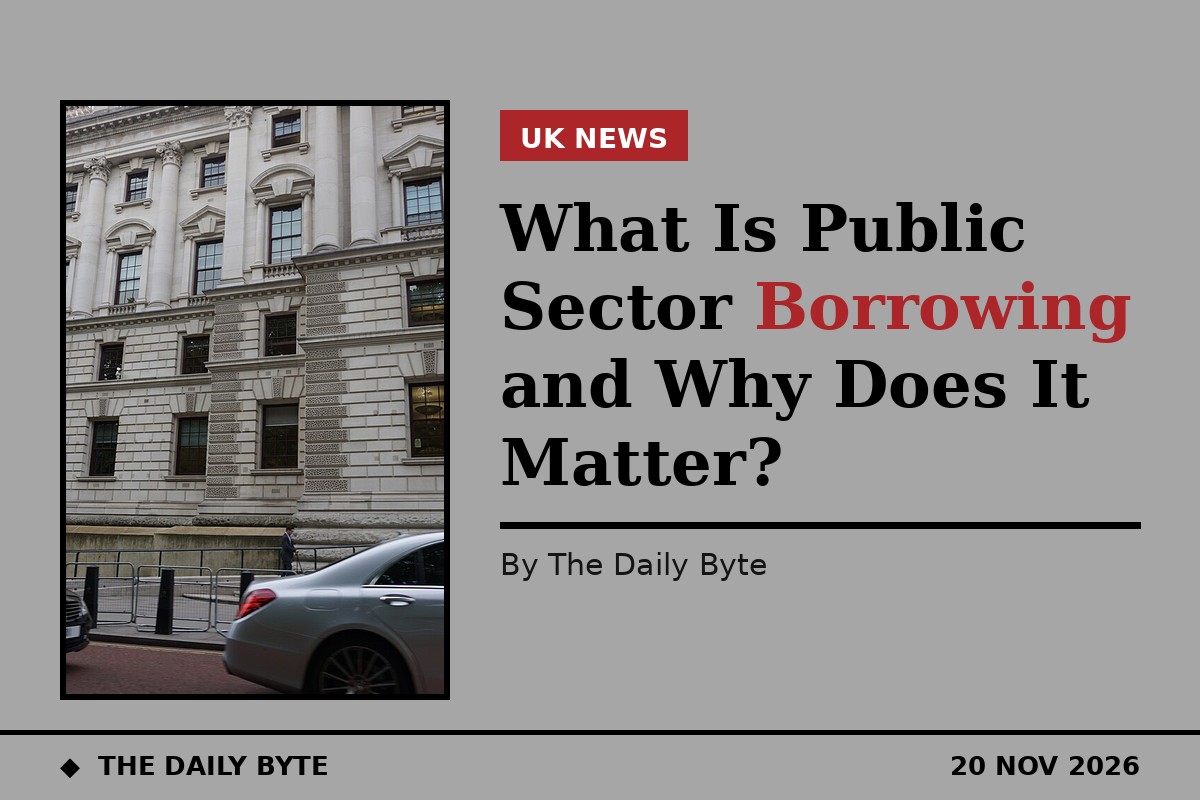
Public sector borrowing is the gap between what the government and other public bodies spend and what they receive in taxes and other income. When spending is higher than income, the difference is borrowed, and the total borrowed over time becomes the national debt. In October 2026 the UK borrowed 17 billion pounds, 800 million pounds more than in October 2025, and the third-highest October figure since monthly records began in 1993. The latest figures, published by the Office for National Statistics on 20 November 2026, show a government spending more than it planned on debt interest, even as tax receipts came in stronger than expected.
Borrowing figures are published every month and they matter because they show whether the Chancellor's plans are on track, how much the state is paying to service its debts, and how much room there is for tax cuts or spending increases. This explainer sets out what public sector borrowing is, what the October 2026 figures show, why borrowing rose, what the national debt now stands at, and why it matters for households.
What is public sector borrowing?
Public sector net borrowing, often shortened to PSNB, is the difference between total public sector spending and total public sector income in a given period. Spending includes the day-to-day costs of running the state, such as the NHS, schools, the police and the armed forces, plus welfare payments including pensions, plus investment in things like roads, railways and hospitals. Income is mainly taxes, including income tax, national insurance, VAT and corporation tax, plus smaller amounts from charges and other receipts. When spending exceeds income, the shortfall is borrowing. When income exceeds spending, the government runs a surplus and can pay down debt.
The public sector in this measure is wider than central government alone. It includes central government departments, local authorities, and public corporations such as the Bank of England. The figures are produced by the Office for National Statistics and are published about three weeks after the end of each month. The latest estimates are provisional and are often revised in later months as more complete data arrives, so a single month's figure should always be read alongside the trend for the financial year so far.
Borrowing is not the same as the national debt. Borrowing is a flow, the amount added in a particular month or year. The debt is a stock, the total amount owed after years of borrowing, minus the government's liquid assets such as cash. Economists usually talk about the debt as a share of the size of the economy, because a debt of 3 trillion pounds means something different in a growing economy than in a shrinking one.
What did the October 2026 figures show?
The Office for National Statistics bulletin for October 2026, published on 20 November 2026, showed borrowing of 17 billion pounds in the month, up 800 million pounds, or 5.2 per cent, on October 2025. It was the third-highest October borrowing figure since monthly records began in 1993, behind only October 2024 and October 2020, the height of the pandemic. It was, however, lower than the 18 billion pounds that economists polled by Reuters had expected, and lower than September's 22.9 billion pounds.
Key figures from the October 2026 public finances bulletin:
Borrowing in October 2026: 17.0 billion pounds, up 0.8 billion pounds (5.2 per cent) on October 2025.
Central government debt interest in October 2026: 11.2 billion pounds, up 2.8 billion pounds (33.4 per cent) on October 2025, the highest October figure on record.
Borrowing in the financial year to October 2026: 111.3 billion pounds, down 7.3 billion pounds (6.1 per cent) on the same period last year, but 3.3 billion pounds higher than the Office for Budget Responsibility forecast in March 2026.
Public sector net debt at the end of October 2026: 3,058.3 billion pounds (3.1 trillion pounds), 161.6 billion pounds more than a year earlier, and equivalent to 95.8 per cent of gross domestic product, up 1.9 percentage points on the year.
Public sector net financial liabilities at the end of October 2026: 2,696.2 billion pounds, a wider balance sheet measure that includes additional financial assets and liabilities.
The Office for National Statistics also revised down its estimate of borrowing for April to September 2026 by 3.6 billion pounds, thanks largely to stronger tax receipt data, and noted that receipts had grown faster than spending so far this financial year. Its chief economist, Grant Fitzner, said borrowing so far this financial year remained lower than in the same period last year, with income-related tax receipts growing particularly strongly, but that monthly borrowing was up on last October, partly due to higher debt interest.
Why did borrowing rise in October?
The main reason borrowing rose in October was the cost of servicing the national debt. Central government debt interest payable was 11.2 billion pounds in the month, 2.8 billion pounds more than in October 2025 and the highest October figure since records began. Of that 11.2 billion pounds, 4.2 billion pounds was the inflation-related uplift on index-linked gilts, the government bonds whose payments rise with the Retail Prices Index. When inflation is high, the amount the government owes on these bonds rises automatically, and October is a month when that uplift is particularly large.
Debt interest has become one of the biggest items in the public finances. Between April and October 2026 the government spent 71.9 billion pounds on debt interest, up 7.4 per cent on the same period last year. Britain now has the highest borrowing costs in the Group of Seven wealthy nations, a legacy of the surge in global interest rates since 2021, and the debt interest bill alone is larger than the budgets of many government departments.
The figures also show the government spending more than the Office for Budget Responsibility expected when it published its forecast in March 2026. Central government spending in the financial year to October was 11.4 billion pounds higher than forecast, mainly reflecting higher than expected debt interest of 5.7 billion pounds, higher net investment of 3.4 billion pounds, and higher net social benefit payments, including pensions, of 2.6 billion pounds. Tax receipts were also stronger than forecast, by 10.2 billion pounds, but spending overshot by more, leaving borrowing 3.3 billion pounds above the March forecast for the year to date. October's borrowing alone was 800 million pounds above the watchdog's forecast for the month.
What is public sector net debt?
Public sector net debt is the amount the public sector owes to the private sector and overseas, less its liquid assets such as cash. At the end of October 2026 it stood provisionally at 3,058.3 billion pounds, or 3.1 trillion pounds, which was 161.6 billion pounds more than a year earlier. Expressed as a share of the economy, it was equivalent to 95.8 per cent of gross domestic product, 1.9 percentage points higher than a year earlier. In other words, the state owes almost as much as the entire economy produces in a year.
The debt has risen sharply over the past two decades. It stood at less than 40 per cent of GDP before the financial crisis of 2008, climbed above 80 per cent after the crisis and the pandemic, and has kept edging up since. The fiscal rules set by the Chancellor require debt to be falling as a share of GDP in the medium term, and the current budget, day-to-day spending minus income, to be balanced by 2029-30. The current budget deficit stood at 72.9 billion pounds for the year to October, down more than 10 per cent on a year earlier and slightly smaller than the Office for Budget Responsibility's March forecast, but closing that gap entirely remains a demanding task while debt interest costs stay high.
A related measure, public sector net financial liabilities, stood at 2,696.2 billion pounds at the end of October 2026. This is a wider balance sheet measure that includes additional financial assets and liabilities, such as student loans and funded pension schemes, and the government has increasingly pointed to it as a better guide to the health of the public finances than net debt alone.
How does the government borrow the money?
Central government borrowing is mainly financed by selling gilts, which are bonds issued by the Debt Management Office on behalf of the Treasury. Investors, including pension funds, insurance companies, banks and overseas buyers, lend the government money by buying gilts, and the government pays them interest until the bond matures, when the original sum is repaid. Some gilts are index-linked, meaning their payments rise with inflation, which protects investors but leaves the government exposed when inflation jumps, as the October figures show.
The government also borrows through Treasury bills, which are short-term, and through National Savings and Investments products sold to the public, such as Premium Bonds. The Bank of England holds a large stock of gilts bought under its quantitative easing programme, and the interest the Bank pays on its own reserves is another channel through which higher interest rates feed into the public finances. When investors worry about a government's finances, they demand higher interest rates to lend to it, which is why Chancellors pay such close attention to the bond markets.
Why does borrowing matter?
Borrowing matters for three reasons. First, it determines how much the government can spend without raising taxes. Every pound borrowed is a pound that must eventually be repaid, with interest, out of future taxes or future spending cuts. When debt interest alone costs 11.2 billion pounds in a single month, that is money that cannot be spent on schools, hospitals or roads.
Second, the figures shape the Chancellor's room for manoeuvre. John Healey, the Chancellor, delivered his Budget on 28 October 2026, a cautious set of tax and spending plans that offered households and drivers some help with rising energy bills and fuel costs while raising taxes on banks, gambling and landlords. He has repeatedly stressed his commitment to fiscal discipline, and the October figures, published less than a month after that Budget, show why: borrowing is running above the official forecast, and the margin for error is thin. If borrowing continues to overshoot, the Chancellor may face pressure to raise taxes or cut spending in future statements.
Third, borrowing affects the whole economy. Higher government borrowing can push up interest rates for everyone, including mortgage holders and businesses, if investors demand higher returns to lend to the state. Britain already has the highest borrowing costs in the G7, and the debt interest bill is a direct cost to taxpayers. The October figures are a reminder that the public finances remain under strain even though the economy grew faster than expected in the third quarter of 2026 and tax receipts beat forecasts.
Frequently asked questions
What is the difference between the deficit and the debt? The deficit, or public sector net borrowing, is the amount the government borrows in a particular period, such as a month or a year. The debt is the total amount owed after years of borrowing, minus liquid assets. In October 2026 borrowing was 17 billion pounds, while the debt stood at 3,058.3 billion pounds.
Is 17 billion pounds of borrowing in a month a lot? It is the third-highest October figure since monthly records began in 1993, behind only 2024 and 2020, but it was lower than economists expected and lower than September's 22.9 billion pounds. Borrowing so far this financial year, at 111.3 billion pounds, is 7.3 billion pounds lower than the same period last year.
Why is the government paying so much debt interest? Because the national debt is very large, at 95.8 per cent of GDP, and because interest rates have risen sharply since 2021. A large share of the debt is index-linked, so inflation automatically increases the amount owed. In October 2026, 4.2 billion pounds of the 11.2 billion pound interest bill was the inflation uplift on index-linked gilts.
What are the fiscal rules? The Chancellor's rules require the current budget, day-to-day spending minus income, to be balanced by 2029-30, and public sector net debt to be falling as a share of GDP. The Office for Budget Responsibility judges whether the government is on course to meet them.
Where can I read the official figures? The Office for National Statistics publishes the public sector finances bulletin every month, and the Office for Budget Responsibility publishes forecasts and assessments of the fiscal rules. Both are free to read online.
Sources: Office for National Statistics, Public sector finances, UK: October 2026 (published 20 November 2026); Reuters, UK borrowing beats forecasts as Healey's deficit picture improves, 20 November 2026; The Times, UK borrowing rises as monthly debt interest payments hit 11.2 billion pounds, 20 November 2026.