What Is Quebec Bill 21? Supreme Court Ruling Explained
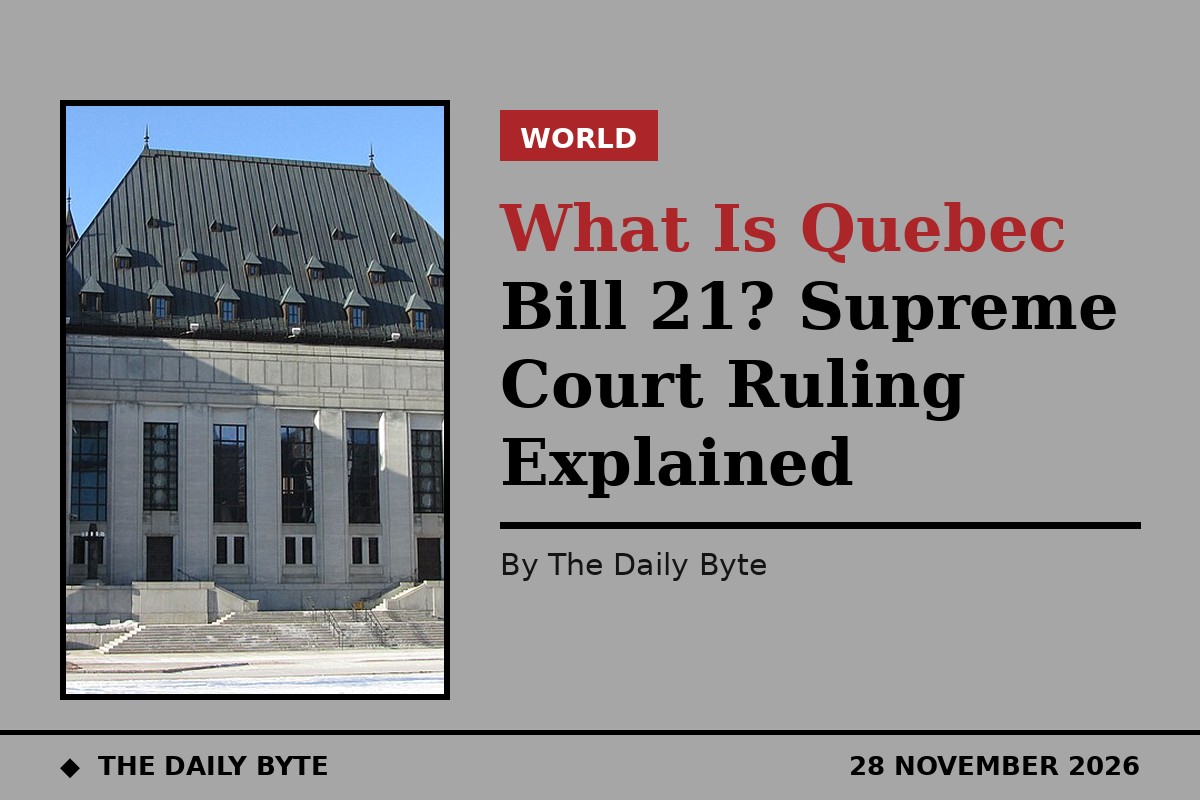
Quebec's Bill 21 is a 2019 Quebec law that bans public-sector workers in positions of authority, including public school teachers and police officers, from wearing religious symbols while they work. On 27 November 2026, the Supreme Court of Canada ruled that most of the law can stand, because Quebec validly used the Constitution's notwithstanding clause to shield it from challenges based on religious freedom, freedom of expression and equality. One part did not survive: the rule requiring people to uncover their faces does not apply to members of Quebec's National Assembly.
The decision, in English Montreal School Board v. Quebec (Attorney General), 2026 SCC 41, answers a question that has divided Canada since 2019: can a government use the notwithstanding clause to shield a law from a court challenge? The court's answer was largely yes, with one narrow exception.
What does Bill 21 ban?
Bill 21 is the common name for the Act respecting the laicity of the State, passed by Quebec's National Assembly in June 2019. It bans people in covered public-sector jobs from wearing religious symbols, such as a Muslim hijab, a Sikh turban, a Jewish kippah or a Christian cross, while performing their duties. It also requires people in some public roles to work with their face uncovered.
Supporters say the ban shows that the state is neutral towards religion. Opponents say it discriminates against religious minorities, in particular Muslim women who wear the hijab, by forcing them to choose between their faith and their job.
What did the Supreme Court decide?
Six of the seven judges found that Quebec had validly used the override clauses in section 33 of the Canadian Charter of Rights and Freedoms and section 52 of Quebec's own Charter of Human Rights and Freedoms. That use shields Bill 21 from challenges based on freedom of religion, freedom of expression and equality rights. Chief Justice Richard Wagner wrote that the law was rooted in Quebec's "legitimate and historical commitment" to keeping the state secular.
The court also said judges can still declare a law inconsistent with the Charter even when the override is used, but it made no such declaration here. It rejected challenges based on section 28, on equality between men and women, and on section 23, the minority-language education rights.
All seven judges agreed on the one part of the law that failed. Section 8 of Bill 21, which stops people from doing their jobs while wearing a face covering, infringes the democratic rights in section 3 of the Charter when it applies to members of the National Assembly. Section 3 protects the right to vote and to seek election, and the rule would stop an elected member whose beliefs require a face covering from sitting in the legislature.
What is the notwithstanding clause?
The notwithstanding clause, section 33 of the Charter, lets Parliament or a provincial legislature declare that a law will operate notwithstanding certain Charter rights, including freedom of religion, freedom of expression and equality. The override lasts for five years at a time and must be renewed to stay in effect. Quebec invoked it pre-emptively when it passed Bill 21 in 2019. The Supreme Court confirmed that the override power has no limit other than those written into the text of section 33 itself.
What has the reaction been?
Quebec Premier Paul St-Pierre Plamondon welcomed the ruling as "a victory for secularism". Prime Minister Mark Carney said he respected the ruling but pledged that his government would not use the constitutional override, stressing that constitutional rights matter most for minorities and vulnerable people. Critics were blunt: Manitoba Premier Wab Kinew called Bill 21 "legislated discrimination", and Mehramat Kaur of the World Sikh Organization of Canada said Quebec was "still telling qualified people that they must set aside their faith". Bill 21 stays in force, subject to the override being renewed every five years.
Frequently asked questions
Does Bill 21 ban all religious symbols in Quebec? No. It applies only to people in covered public-sector jobs, at work.
Does the ruling end the debate? No. The court upheld the law's validity, but political debate continues, and the override must be renewed every five years.


