What Is Quebec Bill 21? Secularism Law Explained
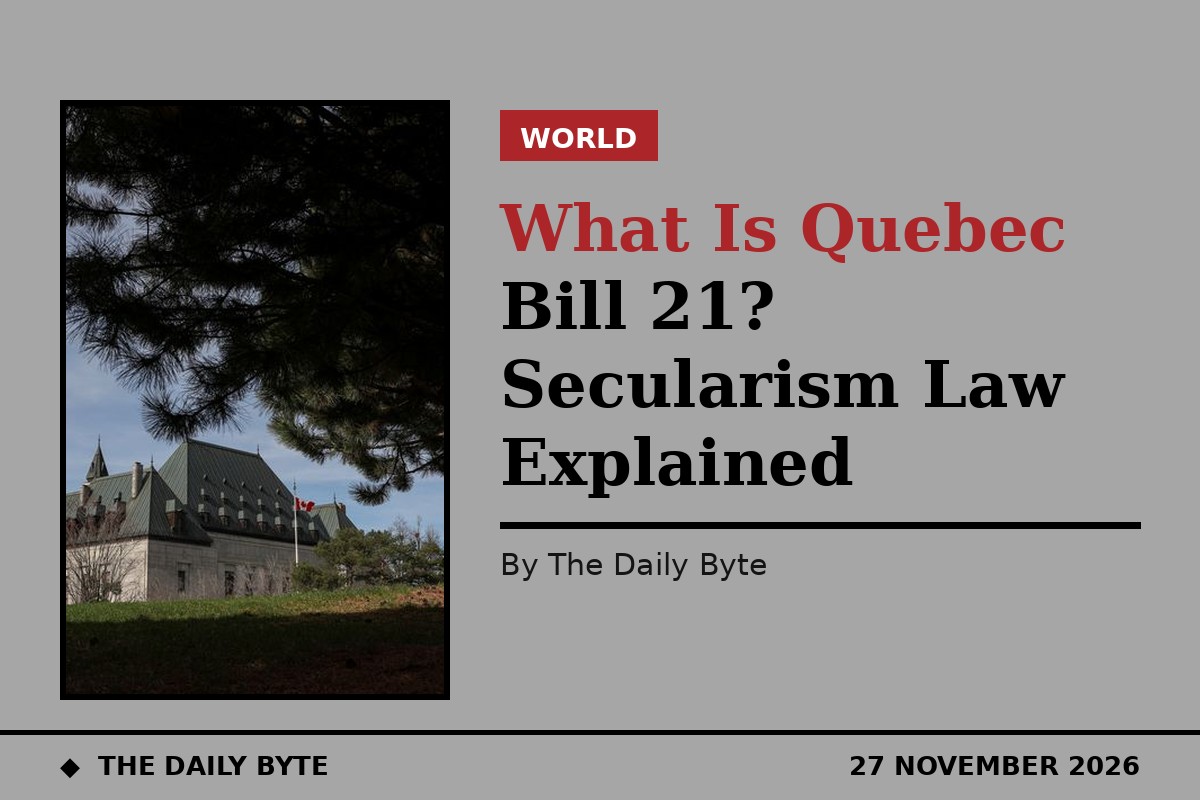
Quebec Bill 21 is the province's secularism law, formally the Act respecting the laicity of the State, which bans certain public servants from wearing religious symbols while they work. It was passed in June 2019 and has been one of the most contested laws in modern Canadian history. On 27 November 2026, the Supreme Court of Canada largely upheld it, ruling in English Montreal School Board v. Quebec (Attorney General), 2026 SCC 41, that Quebec had validly used the notwithstanding clause to shield the law from most Charter challenges — with one exception, a provision barring elected members of the National Assembly from wearing a face covering.
What is Quebec Bill 21?
Bill 21 was passed by Quebec's National Assembly in June 2019 under the government of then premier François Legault. The law says the state of Quebec is secular — laïque in French — and it prohibits public servants in positions of authority from wearing religious symbols, such as the hijab, the turban, the kippah or the cross, while performing their duties. It also includes rules about face coverings for people giving and receiving public services.
The government said the law was necessary to protect Quebec's secular society and argued that anyone receiving services from public servants has the right to do so without being exposed to overt religious symbols. Critics, including civil liberties groups and many of the people directly affected, say the law is discriminatory and disproportionately targets Muslim women, as well as Sikh and Jewish public servants.
Who does the Bill 21 ban apply to?
The ban applies to public servants in positions of authority. That includes public school teachers, police officers, judges, government lawyers and other public officials. A teacher wearing a hijab in a public school classroom, a police officer wearing a turban on duty, or a Crown prosecutor wearing a kippah in court would all fall within the ban.
The law does not apply to all public sector workers — it is aimed at those exercising state authority. It also does not ban religious symbols in private life, in private schools, or for members of the public. A separate provision, section 8 of the law, concerns face coverings: it prevents people whose religious beliefs require them to wear a face covering from sitting in the National Assembly and taking part in the legislative process if elected.
What is the notwithstanding clause?
The notwithstanding clause is the popular name for section 33 of the Canadian Charter of Rights and Freedoms. It allows a provincial legislature or the federal Parliament to declare that a law will operate notwithstanding — in spite of — certain Charter rights, including freedom of religion and equality rights. A declaration under section 33 lasts for up to five years and can be renewed. Quebec invoked the clause when it passed Bill 21, and renewed it in 2024. Quebec also relied on section 52 of its own Charter of human rights and freedoms, which contains a similar override.
The clause is controversial because it lets elected legislatures pass laws that would otherwise violate constitutional rights. Its defenders say it preserves democratic accountability and the balance between courts and legislatures. Its critics say it lets governments override fundamental rights. Until this case, the Supreme Court had never ruled directly on the limits of section 33.
What did the Supreme Court decide on 27 November 2026?
The Supreme Court confirmed the validity of the Act respecting the laicity of the State, with one exception. Chief Justice Wagner and Justices Karakatsanis, Côté, Rowe, Kasirer and O'Bonsawin held that the Quebec legislature had validly used the override clauses. The Court relied on the text of section 33, its context and its purpose and effects, and confirmed the interpretation adopted in its 1988 decision in Ford v. Quebec (Attorney General). As a result, the exercise of the override power is not subject to any limit other than those expressly set out in the provision's text.
The Court also decided three other questions. First, it held that Bill 21 cannot be invalidated because of section 28 of the Charter, which says Charter rights apply equally to men and women: section 28 guides how other rights are understood, but it does not create a distinct right that can be used to challenge a law. Second, it ruled that Bill 21 does not infringe the rights of Quebec's English-speaking minority in education under section 23, even though the Court recognised the law could limit English-language school boards' ability to recruit, retain, transfer or promote certain people.
Third, the Court found that section 8 of Bill 21 does infringe the democratic rights in section 3 of the Charter — the right to vote and to seek election — to the extent that it applies to members of the National Assembly. Section 3 is not covered by the notwithstanding clause, so the override cannot protect that provision. The Court also held that a court has the power to declare whether a law is consistent with the Charter even when the notwithstanding clause has been invoked, but it made no such declaration in this case. The Court dismissed the appeals of the English Montreal School Board and the other challengers, and dismissed the cross-appeal of Quebec's Attorney General.
Why was Bill 21 challenged in court?
The law was challenged by a range of groups, including the English Montreal School Board, female Muslim, Sikh and Catholic teachers, and civil liberties organisations, who argued it violated their fundamental rights, including freedom of religion and equality. The case reached the Supreme Court after Quebec's Court of Appeal upheld most of the legislation in February 2024. A record 51 interveners, including six attorneys general, took part in the Supreme Court proceedings, reflecting how far the ruling reaches beyond Quebec.
The case matters well beyond one province because it is the first time the Supreme Court has ruled on how the notwithstanding clause works. The decision confirms that provinces can invoke the clause without first waiting for a court to decide whether a law violates Charter rights, and that courts can still examine a law's consistency with the Charter even when the clause is in force.
What changes now after the ruling?
For most Quebec public servants, nothing changes: the ban on religious symbols at work remains in force. The one concrete change is that the face-covering rule cannot be enforced against elected members of the National Assembly — a person elected to the legislature whose faith requires a face covering cannot be prevented from sitting and voting.
Politically, the ruling is a win for Quebec's sovereigntist government under Premier Paul St-Pierre Plamondon, and it could complicate Prime Minister Mark Carney's efforts to hold Canada together as the country faces a trade dispute and annexation threats from United States President Donald Trump. Civil liberties groups have said they are disappointed, while supporters of the law say the Court has confirmed Quebec's right to defend its secular character. Because the Court did not make a declaration of inconsistency, and because the notwithstanding clause can be renewed every five years, the wider debate over Bill 21 is likely to continue in Quebec politics rather than in the courts.
Quebec Bill 21 at a glance
| Fact | Detail |
|---|---|
| Full name | Act respecting the laicity of the State |
| Passed | June 2019, under Premier François Legault |
| What it does | Bans certain public servants in authority from wearing religious symbols at work |
| Who is affected | Teachers, police, judges, government lawyers and other public officials |
| Override used | Section 33, Canadian Charter; section 52, Quebec Charter; renewed 2024 |
| Court of Appeal | Upheld most of the law, February 2024 |
| Supreme Court | 27 November 2026, 2026 SCC 41 |
| Outcome | Law largely upheld; section 8 unenforceable against National Assembly members |
| Interveners | A record 51, including six attorneys general |
Frequently asked questions
What is Quebec Bill 21? Bill 21 is Quebec's secularism law, passed in June 2019. It bans public servants in positions of authority, such as teachers and police officers, from wearing religious symbols including the hijab, turban, kippah and cross while at work.
Did the Supreme Court uphold Bill 21? Yes, largely. On 27 November 2026 the Supreme Court of Canada confirmed the law's validity, ruling that Quebec had validly used the notwithstanding clause. The only exception was section 8, which the Court said infringes democratic rights where it applies to elected members of the National Assembly.
What is the notwithstanding clause? It is section 33 of the Canadian Charter of Rights and Freedoms, which lets a legislature declare that a law operates notwithstanding certain Charter rights. A declaration lasts up to five years and can be renewed.
Does Bill 21 apply to all workers in Quebec? No. It applies to public servants in positions of authority, not to private sector workers or the general public, and not to religious symbols worn in private life.
Can the law still be challenged? The Supreme Court said courts can still declare whether a law is consistent with the Charter even when the notwithstanding clause is invoked, but it made no such declaration in this case, and the clause can be renewed every five years.
Sources: Supreme Court of Canada, Case in Brief, English Montreal School Board v. Quebec (Attorney General), 2026 SCC 41; Reuters, 'Canada's Supreme Court upholds Quebec ban on religious symbols for public servants'.


