What is RAF Mildenhall? US aircraft move explained
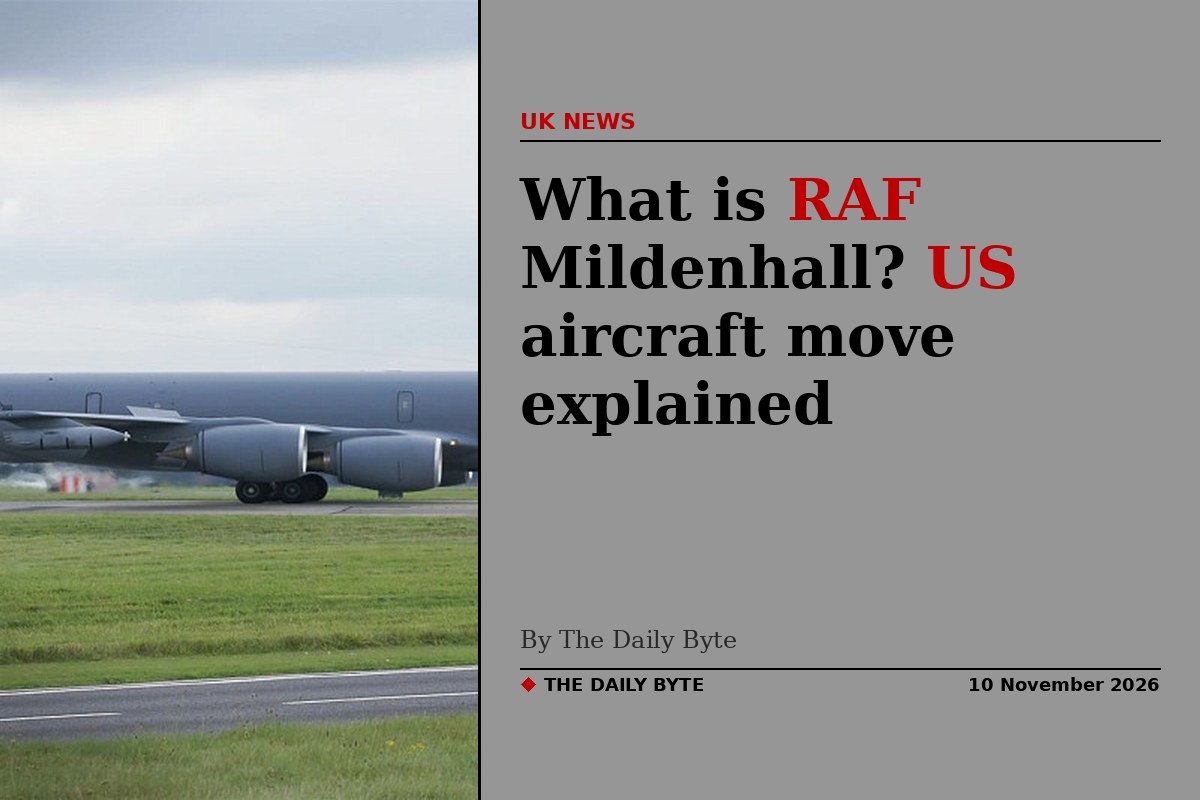
RAF Mildenhall is a Royal Air Force station in Suffolk, England, that mainly supports United States Air Force operations, and it is home to the 100th Air Refueling Wing, the US Air Force's only permanent air refuelling wing in Europe. It returned to the headlines on 10 November 2026 after reports that the US military had moved refuelling aircraft away from the base on Monday 9 November following a threat linked to Iran. The exact nature of that threat has not been made public, and US officials were still discussing it when the reports emerged, so this explainer separates what has been confirmed from what remains unclear.
The move matters because Mildenhall is not a remote outpost. Its tanker aircraft refuel US and allied jets in the air, which makes long-range missions possible without landing, and the base is one of the two largest US Air Force presences in the United Kingdom, alongside nearby RAF Lakenheath. When aircraft leave a base like this, even temporarily, it is a sign that commanders have judged the risk to the aircraft and their crews to be serious enough to act on, rather than a routine change of plan.
What is RAF Mildenhall?
RAF Mildenhall is a Royal Air Force station near the town of Mildenhall in Suffolk, about 80 miles north-east of London. Despite its RAF status, it primarily supports United States Air Force operations, and its host unit is the 100th Air Refueling Wing. The station was built in 1934 and has hosted US Air Force operations since 1959. The 100th Air Refueling Wing became the host unit on 1 February 1992, and it has been based there ever since.
The wing's job is air refuelling and combat support across Europe and Africa. According to the US Air Force's own fact sheet, it is the sole US tanker wing in US Air Forces in Europe and Air Forces Africa, it has 17 assigned KC-135 aircraft, and it supports more than 16,000 military and civilian personnel, dependants and retirees, including other units based at Mildenhall. The fact sheet also describes Mildenhall as the only 24-hour United States Air Force airfield in the United Kingdom. Other units at the station include the 352d Special Operations Wing and the 501st Combat Support Wing.
The aircraft most associated with the base is the Boeing KC-135 Stratotanker, a large four-engine jet that transfers fuel to other aircraft while both are flying. A KC-135 can refuel fighter jets, bombers and transport aircraft, which extends how far they can fly and how long they can stay in the air. That is why tanker bases are often described as the backbone of long-range air operations: without them, many missions over the Middle East or across the Atlantic would need extra landings or could not be flown at all.
Mildenhall's future was once in doubt. In January 2015 the US Department of Defense announced that operations at the base would end and move elsewhere, including to Spangdahlem Air Base in Germany. After years of uncertainty, that plan was reversed, and in July 2020 it was confirmed that the 100th Air Refueling Wing and the 352nd Special Operations Wing would remain at Mildenhall, keeping the base open for the foreseeable future.
What happened on 9 November 2026?
On Monday 9 November 2026, the US military moved aircraft away from RAF Mildenhall after a threat from Iran, according to a report in The Wall Street Journal, reported by Reuters. The Journal, citing people familiar with the matter, said two refuelling tankers that had been operating from Mildenhall were diverted to Germany on Monday morning, while several other tankers stationed at the base were moved to Germany and other locations later in the day.
Flight-tracking data analysed by CNN showed that 10 US refuelling aircraft were relocated away from RAF Mildenhall on Monday. Four of those KC-135 Stratotankers went to Spangdahlem Air Base in Germany, one went to Ramstein Air Base in Germany, four went to Moron Air Base in Spain, and one went to Glasgow Prestwick airport in Scotland. Flight-tracking reports also showed three CV-22B Osprey aircraft moving to nearby RAF Lakenheath. The precise figures vary slightly between reports because some counts include aircraft that were only passing through the base, but the broad picture is consistent: a substantial part of the tanker fleet left Mildenhall in a single day.
It is important to be clear about what has not been established. The precise nature of the threat to RAF Mildenhall remains under discussion among US officials, according to the Journal's reporting, and no public evidence has established that Iran directed or carried out a specific operation against the base. A US Air Force spokesperson declined to give details about the movement of aircraft, saying only that US aircraft rotate between installations and operating locations for a variety of reasons. That is a standard form of words, and it does not by itself confirm or deny that a threat prompted the move.
Where did the aircraft go?
The aircraft were dispersed to several locations in Europe rather than to a single replacement base. According to the flight-tracking analysis reported by CNN, the destinations were Spangdahlem and Ramstein in Germany, Moron in Spain, and Prestwick in Scotland, with Osprey aircraft going to RAF Lakenheath in Suffolk. Dispersal is a familiar military precaution: spreading valuable aircraft across several airfields makes them harder to target in one place, and it keeps them available for operations from different locations.
The relocation does not mean the base has closed or been abandoned. RAF Mildenhall remains an operational station, and moving aircraft away temporarily is different from withdrawing a unit permanently. What it does show is that US commanders were willing to disrupt normal operations at short notice, which suggests the warning they received was treated as credible enough to act on, even while its exact details were still being assessed.
What is FPCON Charlie?
Alongside the aircraft movement, the security alert level at RAF Mildenhall and RAF Lakenheath was raised to Force Protection Condition Charlie, known as FPCON Charlie, according to the Journal and the defence publication The War Zone. FPCON Charlie is the second-highest level in the Pentagon's force protection system, which sets the security posture of US military installations in response to terrorist threats.
The US Defense Logistics Agency, which publishes guidance on the system, explains that FPCON Charlie applies when an incident has occurred or intelligence has been received indicating that some form of terrorist action or targeting of personnel or facilities is likely. At that level, 100 per cent identity card checks are required, access is more tightly restricted, and additional security measures are put in place. The system has five levels, from Normal at the lowest end to Delta at the highest, and Delta applies when an attack has occurred in the immediate area or is believed to be imminent. Charlie sits one step below that, and it is described as a demanding posture that is not intended to last for a long period.
Since the attacks of 11 September 2001, the baseline level for US installations has been FPCON Bravo, so a move to Charlie is a clear step up. It does not mean an attack is certain or that one has happened. It means commanders have information, or an incident has occurred, that makes an attack seem likely enough to justify the disruption that tighter security causes to daily life on a base, including longer waits at gates, restricted movement and cancelled non-essential activity.
Why does Mildenhall matter for US operations?
Mildenhall matters because of geography and capability. It sits in eastern England, within reach of Europe, the Atlantic and the Middle East, and its tankers can support aircraft flying to and from those regions. The 100th Air Refueling Wing manages the European Tanker Task Force, a rotational force that provides air refuelling to US and NATO aircraft in the European theatre. In practice, that means fighters and bombers operating far from their home bases depend on Mildenhall's tankers to stay in the air long enough to complete their missions.
The base has also served as a staging point for tanker support to US missions in the Middle East, which is why it is relevant to the current tensions with Iran. The United States and Israel began their war against Iran in February 2026, and the conflict has repeatedly affected shipping in the Strait of Hormuz, oil prices and the security of US bases in the region and in Europe. Against that background, a threat to a tanker base in England is treated as part of a wider security picture, not as an isolated incident.
What happened at RAF Fairford?
The Mildenhall movement is the second time in about five weeks that US aircraft have been withdrawn from a British base over an Iran-linked security concern. In early October 2026, the US withdrew 12 B-1B Lancer bombers from RAF Fairford in Gloucestershire after a security incident near the base and arrests linked to a suspected drone attack plot. Reports at the time linked the suspected plot to Iran's Islamic Revolutionary Guard Corps, although the full details have not been made public in the same way as a court case would present them.
RAF Fairford is the US Air Force's only European airfield for heavy bombers, so the withdrawal of its B-1 fleet was significant in its own right. As of late October, none of those bombers had returned to Fairford. The pattern of the two episodes is similar: a warning or incident, a rapid decision to move high-value aircraft, and a rise in security measures, with officials declining to give a full public account while investigations continue.
What happens next?
Three questions will decide what happens next. The first is whether the threat is resolved or downgraded, which would allow the security level at Mildenhall and Lakenheath to return to its baseline and the tankers to return to Suffolk. The second is whether any further details are made public about the nature of the warning, which would help explain whether it was a specific plot, a general warning or a precaution based on intelligence that could not be shared. The third is the wider diplomatic picture: on 10 November, President Donald Trump said the war with Iran was effectively over and pointed to positive momentum in negotiations, although talks have stalled before and fighting has resumed after earlier pauses, so that claim will be tested by events rather than by words alone.
For people living near the base, the practical effects are likely to be visible before any official announcement: fewer tanker movements at Mildenhall, tighter security at the gates, and aircraft operating from other bases in Europe. For the wider public, the episode is a reminder that the war with Iran has consequences well beyond the Middle East, including for military bases in Britain and for the security posture of US forces in Europe.
Frequently asked questions
Is RAF Mildenhall a British or an American base? It is a Royal Air Force station owned by the Ministry of Defence, but it primarily supports United States Air Force operations under arrangements for US visiting forces in the UK.
Has RAF Mildenhall closed? No. Aircraft were moved away temporarily on 9 November 2026, but the station remains operational and no closure has been announced.
Was there an attack on RAF Mildenhall? No attack has been reported. The aircraft were moved after a reported threat, and the exact nature of that threat has not been made public.
What does FPCON Charlie mean? It is the second-highest US military force protection level. It applies when intelligence or an incident indicates that terrorist action against personnel or facilities is likely, and it brings stricter checks and restricted access.
Where did the aircraft go? Flight-tracking data showed KC-135 tankers going to Germany, Spain and Scotland, and Osprey aircraft moving to RAF Lakenheath.


