What Is Ranked-Choice Voting and How Does It Work?
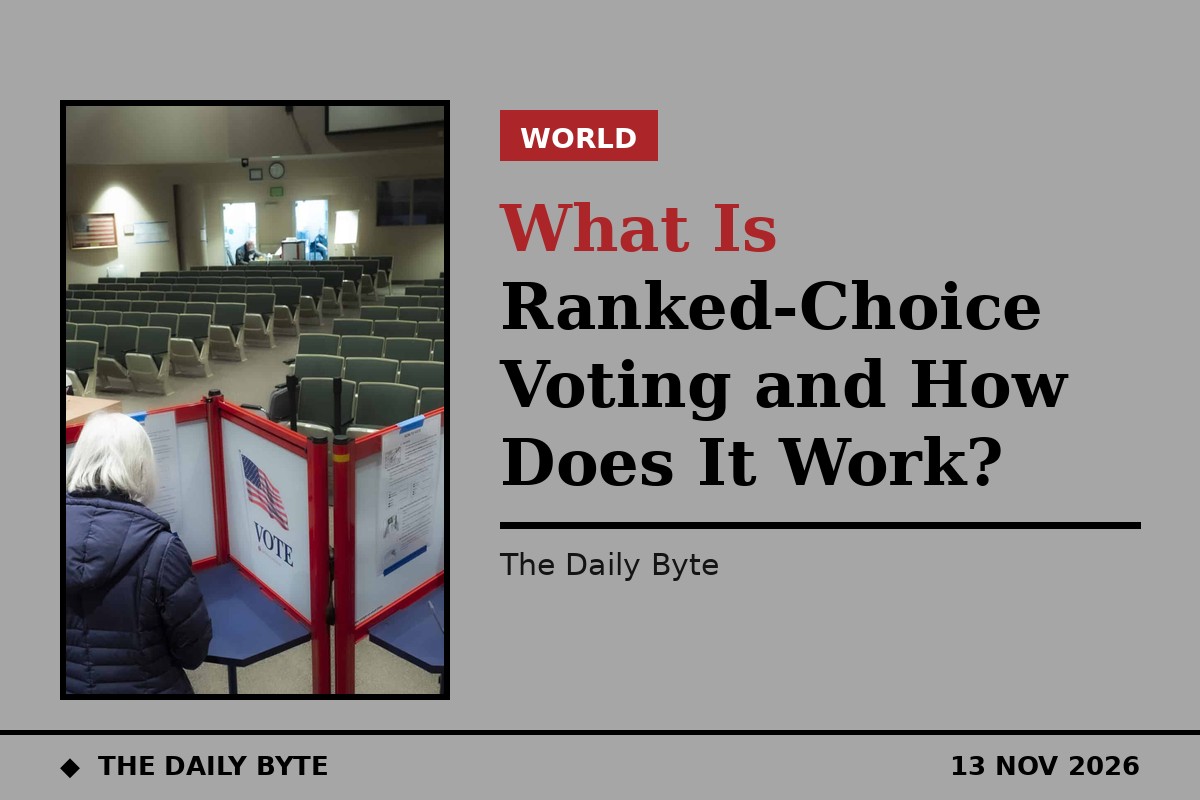
Ranked-choice voting lets voters rank candidates in order of preference — first choice, second choice, third choice — instead of picking just one. If no candidate wins more than half of the first-choice votes, the candidate in last place is eliminated and their ballots move to each voter's next choice, round by round, until someone holds a majority. The system is deciding Alaska's 2026 US Senate race, where the winner will be settled by a ranked-choice tabulation on 18 November.
How does ranked-choice voting work, step by step?
First, election officials count everyone's first-choice votes. If a candidate has more than 50%, they win outright and the count stops there. If nobody reaches a majority, the "instant runoff" begins: the candidate with the fewest votes is eliminated, and the ballots that ranked that candidate first are redistributed to the next candidate ranked on each ballot. Ballots with no further usable choice are set aside — election reports call them exhausted or inactive — so the 50% threshold applies to the ballots still in play in each round.
The process repeats, eliminating the new last-place candidate each time, until one candidate holds more than half of the continuing ballots. With two candidates left, the one with more votes wins. A single ballot can move more than once — for example, from a voter's third choice to their second — but it never counts for two candidates at once. Voters do not have to rank every candidate; they can rank as many or as few as they like, and a second choice only counts if the first choice is eliminated.
Why does Alaska use ranked-choice voting?
Alaskan voters approved the system in 2020, when Ballot Measure 2 passed with 50.55% of the vote, and it has been used in every general election since 2022. Alaska pairs ranked-choice voting with an open, nonpartisan primary: all candidates for an office appear on one ballot, voters pick one, and the top four finishers advance to the general election, where voters rank them.
Alaska is the only US state that elects its governor, legislature and members of Congress with ranked ballots. Maine also uses ranked-choice voting, but for primaries and federal elections; its constitution requires plain plurality winners for governor and the state legislature. Australia has used a similar preferential system for more than a century, and around four dozen US cities use ranked-choice voting for local races. Supporters say it guarantees majority winners and rewards candidates who appeal beyond their own base; critics say it is confusing and slows results.
What is happening in Alaska's 2026 Senate race?
The race between Democrat Mary Peltola and Republican Senator Dan Sullivan is the last uncalled US Senate contest of the 2026 midterms, and it is a textbook case of ranked-choice voting in action. In the count released by the Alaska Division of Elections on 12 November, Peltola had 125,157 first-choice votes (49.08%) and Sullivan had 119,357 (46.8%), a lead of 5,800 votes for Peltola. Republican Gerald Heikes had 5,490 votes, Daniel J. Sullivan Jr. had 4,199, and write-ins had 807. Because neither leading candidate is above 50%, the ranked-choice tabulation will run on 18 November, and certification is set for 25 November.
Preliminary analyses of the ballot data, which are based on partial counts and are not final results, put the final round extremely close. An analysis by Alaska News put Peltola at about 50.7% in the final round, while a preliminary tabulation by the campaign finance group FairVote had her winning 50.1% to 49.9%. Late-arriving ballots, which have tended to favour Peltola, could still move the picture.
Who is the second Dan Sullivan — and does he matter?
Daniel J. Sullivan Jr., a retired schoolteacher from Petersburg, is a Republican who shares the incumbent senator's name and is not related to him. He finished fourth with 4,199 first-choice votes, and his presence has become the most talked-about quirk of the race: some voters may have marked his name by mistake, and his ballots will be among the first redistributed in the ranked-choice count.
An analysis by FairVote of the state's ballot-level data found that, of 3,940 ballots ranking Daniel J. Sullivan Jr. first, 1,345 would count for Peltola in the final round and 910 for Senator Sullivan, while 1,685 ranked neither finalist. In other words, his voters' second choices lean towards Peltola — which is why the "Decoy Dan" question has loomed so large over the final count.
Why is the count taking so long?
Alaska's geography and election law make for a slow count. Absentee ballots postmarked by Election Day can still arrive — through 13 November from inside the United States and through 18 November from overseas — and many ballots come from remote communities off the road system. The Division of Elections posts updated counts on a fixed schedule, on the 7th, 10th and 15th days after the election, rather than continuously. The Associated Press has not called the race, and neither candidate has claimed victory.
Frequently asked questions
Does ranking a second choice hurt my first choice? No. Your second choice is only counted if your first choice is eliminated, so ranking cannot damage your favourite candidate.
Do I have to rank every candidate? No. You can rank as many or as few as you like. But if all the candidates you ranked are eliminated, your ballot stops counting in later rounds.
Is ranked-choice voting the same as a runoff election? It works like one, but without a second trip to the polls. The rankings voters already marked do the work of the runoff, which is why it is often called instant runoff voting.
Alaska News's analysis of the ballot data put Peltola narrowly ahead in a final ranked-choice round, while Alaskans for Better Elections explains that a candidate must earn majority support to win and that ranking cannot hurt a voter's first choice.


