What Is Remembrance Day? Poppies and Silence Explained
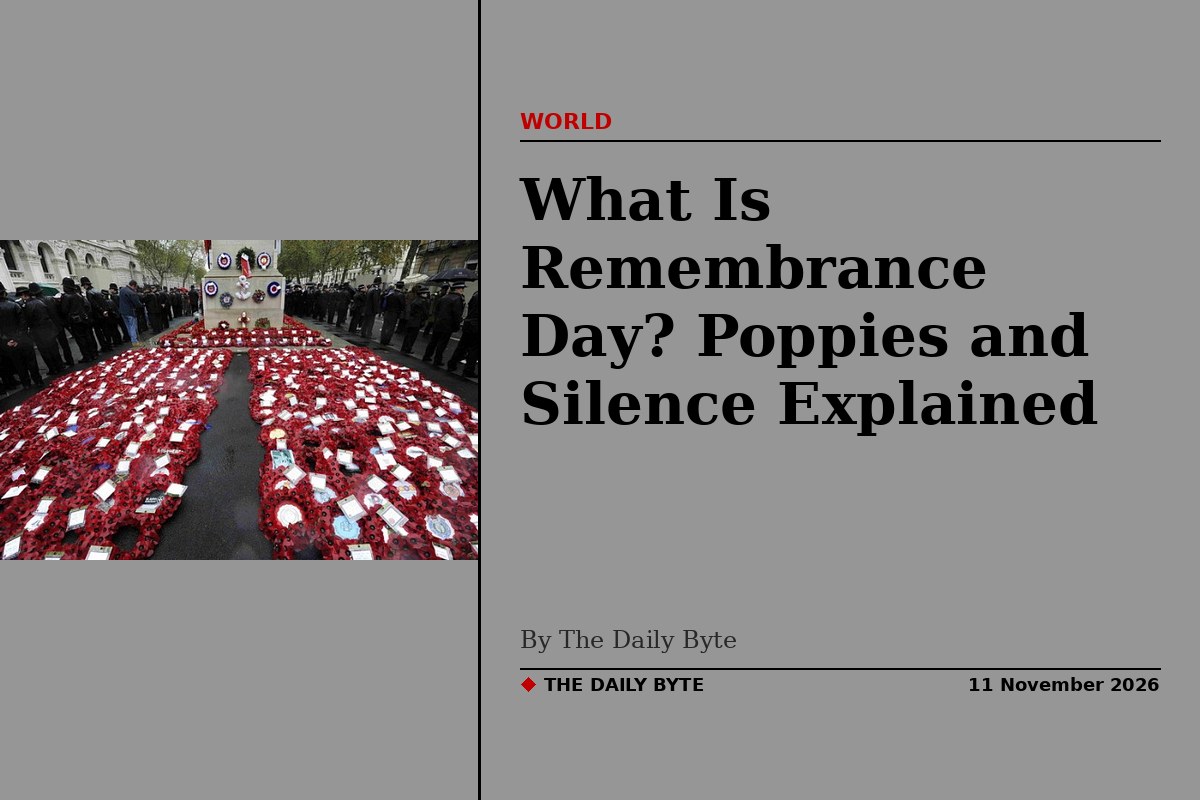
Remembrance Day is a memorial day observed on 11 November each year to honour the service and sacrifice of British and Commonwealth armed forces members who have died in the line of duty. It marks the anniversary of the Armistice that ended fighting in the First World War at 11am on 11 November 1918.
Across the UK, people observe a two-minute silence at 11am, wear red poppies, and lay wreaths at war memorials. The National Service of Remembrance is held at the Cenotaph in Whitehall, London, with members of the Royal Family, political leaders and representatives of the Armed Forces in attendance.
Why is it on 11 November?
Remembrance Day is also known as Armistice Day. It recalls the end of First World War hostilities, which ended "at the 11th hour of the 11th day of the 11th month" of 1918, under the armistice signed by representatives of Germany and the Entente that morning.
When the day was first introduced in 1919 it was called Armistice Day. Since the end of the Second World War it has more commonly been called Remembrance Day, so that it commemorates servicemen and women who died in all conflicts, not only the First World War.
Why is there a two-minute silence?
The tradition of observing two minutes of silence began on the first Armistice Day in 1919 and is observed from 11am, to coincide with the time in 1918 at which the First World War largely came to an end.
The origins of the silence lie in the "three minutes' pause" practised in South Africa during the final months of the First World War. The proposal for a two-minute silence in the UK was discussed by the War Cabinet in November 1919 and considered by King George V, who on 7 November 1919 issued a letter calling for the proposal to be introduced. The silence is observed at war memorials and in public spaces across the UK as an act of remembrance for those who died in conflict.
Why do people wear poppies?
The red poppy became a symbol of remembrance after the First World War. Poppies grew on the former battlefields of Belgium and northern France, and the red of the flowers was viewed as symbolic of bloodshed. The symbolism was popularised by the poem "In Flanders Fields", written in 1915 by Canadian military doctor John McCrae.
The poppy was adopted by the Royal British Legion after the organisation was formed in 1921. The first remembrance poppies were made and sold to help wounded First World War veterans in 1921, and millions of people now donate to the Royal British Legion's Poppy Appeal each year.
The Royal British Legion describes the red poppy as having "no political or religious meaning and the decision to wear it is a matter of personal choice". It also states there is no "correct" time to start or stop wearing a poppy. Other colours carry different meanings: white poppies stand for pacifism, purple poppies commemorate fallen animals, and black poppies commemorate black servicemen and women.
What is the difference between Remembrance Day and Remembrance Sunday?
Remembrance Day is always on 11 November. Remembrance Sunday is the Sunday nearest to 11 November, when the main public ceremonies take place, including the National Service of Remembrance at the Cenotaph. In 2026, Remembrance Sunday falls on 8 November, three days before Remembrance Day itself.
On both days, wreath-laying ceremonies organised by local branches of the Royal British Legion are held at war memorials across the UK, with a two-minute silence at 11am.
Frequently asked questions
When is Remembrance Day? Remembrance Day is always on 11 November. In 2026 it falls on a Wednesday.
What time is the two-minute silence? The silence is observed from 11am on 11 November and on Remembrance Sunday.
Do I have to wear a poppy? No. The Royal British Legion says wearing a poppy is a matter of personal choice, and there is no correct time to start or stop wearing one.
Who is remembered on Remembrance Day? The day honours the service and sacrifice of the Armed Forces, veterans and their families, and commemorates those who died in the First and Second World Wars and in conflicts since.


