What Is the San Francisco Declaration on AI Supply Chains?
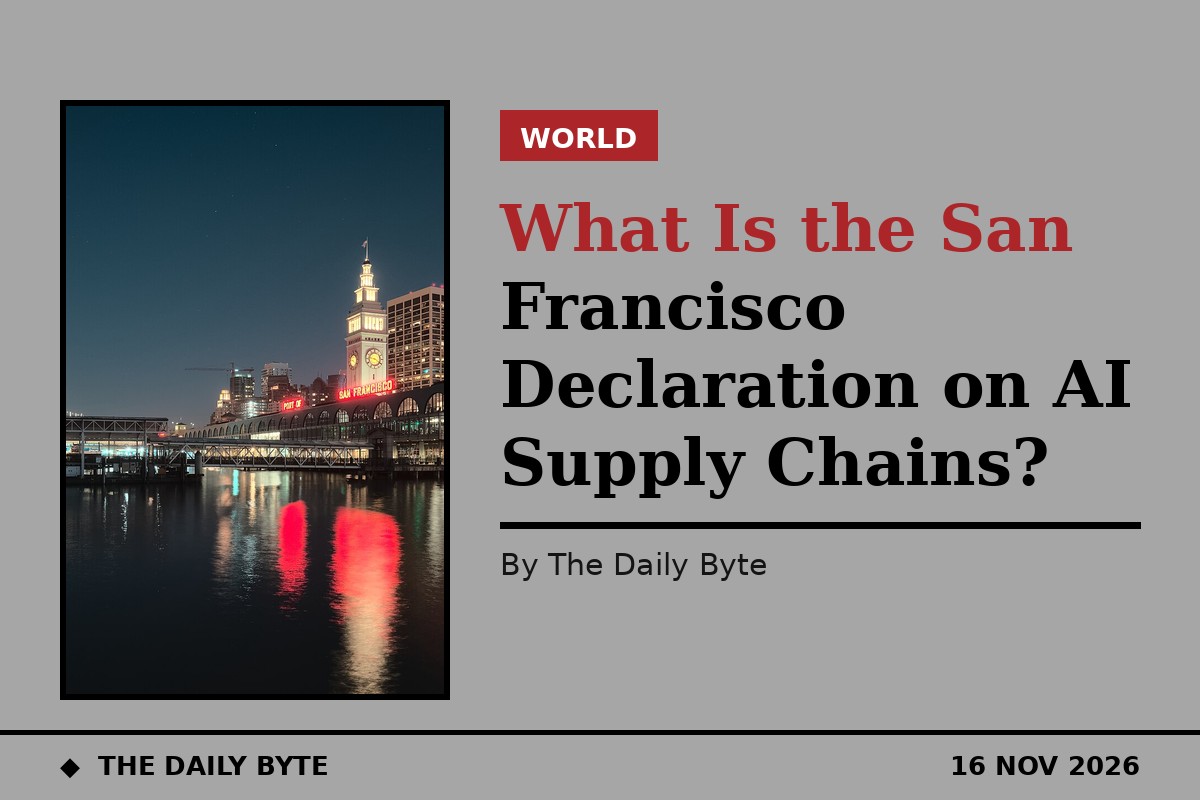
On 15 November 2026, the United States and nine partner governments signed the San Francisco Declaration on the Secure Foundations of Enduring Prosperity, a joint commitment to identify and protect the sensitive technologies and critical infrastructure behind advanced artificial intelligence supply chains. The signing took place at the Pax Silica Founders Retreat in San Francisco, convened by Jacob Helberg, the US Under Secretary of State for Economic Affairs. It is a political declaration, not a treaty: it sets out shared principles and creates working groups, but it announces no new export controls, names no banned companies and publishes no list of protected technologies yet.
The declaration matters because it turns a loose coalition into a working partnership with an agreed definition of what must be protected. For the first time, the ten governments have put in writing a common understanding of the technologies and infrastructure they consider essential to the artificial intelligence era, and have committed to defend them together. The Financial Times, which first reported the signing, described it as an accord to protect AI supply chains from China, and it was signed just days before President Donald Trump was due to meet Chinese President Xi Jinping in Shenzhen on 19 November, on the sidelines of the APEC summit.
What does the declaration actually say?
Its central claim is that economic security is fundamental to national security, and that no nation can be secure without securing its critical systems and technologies from those that would do it harm. The text, published in full by the US State Department, then defines the two things the signatories agree must be protected.
First, sensitive technologies: the goods, software, materials, knowledge, components and inputs used to produce them, and their means of production, where these are essential to what the declaration calls super intelligence supply chains. The test is whether their theft, illicit transfer or acquisition by hostile actors would hand those actors a meaningful military or intelligence advantage, or undue economic leverage over the participants.
Second, critical infrastructure: the physical and digital systems and assets underpinning those supply chains, on which the security, economic function and essential services of the participants depend. The declaration names ports, terminals, transport, communications and logistics networks, the ICT and energy infrastructure their operations depend on, and the digital platforms that coordinate and manage them.
The signatories affirm that safeguarding these technologies and infrastructure is a shared endeavour, and that the security of each participant is strengthened by the vigilance of all. They also commit to coordinated efforts against economic coercion, supply chain disruption and non-market policies and practices, while protecting private investment and keeping a level playing field for innovation and growth.
Who signed it?
Ten governments released the text: the United States, Australia, India, Israel, Japan, the Republic of Korea, Qatar, Singapore, the United Arab Emirates and the United Kingdom. The US State Department said the United States and nine Pax Silica participants signed the declaration at the Founders Retreat in San Francisco.
More countries are expected to follow. Germany, Sweden, the Netherlands and the European Commission are expected to sign the following week, according to the Financial Times, citing Helberg. Their absence from the first signing reflects internal reviews of how the measures align with European Union economic security rules, rather than opposition to the pact itself.
What is Pax Silica?
Pax Silica is the US-led initiative to secure the supply chains behind advanced computing and artificial intelligence, and to reduce the dependence of allied economies on China for the inputs those supply chains need. It was launched in December 2025, and the State Department says that, less than a year after its launch, it is entering a new phase.
Until now Pax Silica has been mainly a framework of shared intent. The San Francisco Declaration is the first document under it that commits partners to specific work: agreeing on what must be protected and setting up the machinery to protect it together. In the State Department's words, the coalition is cementing its shared principles into a working partnership with a common baseline and a path to act on it.
What are the five working groups?
The declaration resolves to establish working groups to carry common purpose into common practice. Five groups are proposed, covering pro-innovation policy frameworks; the adoption of super intelligence in key sectors; supply chain cooperation across the super intelligence stack; safe harbours and supply chain security hubs; and super intelligence security and resilience.
No timetable for the groups has been published, and the declaration does not say when the first meetings will take place. Their first substantive job will be the shared list of high-priority technologies and critical infrastructure that the signatories have agreed to draw up, covering semiconductors, critical minerals, energy infrastructure and industrial capacity.
Why was it signed now?
The timing is deliberate. The signing came four days before the Trump-Xi meeting in Shenzhen on 19 November, giving the United States and its partners a coordinated position on technology supply chains before the two leaders sit down. It also comes as the contest over advanced computing intensifies: the chips, minerals, energy and factory capacity behind AI systems have become strategic assets, and governments on both sides are treating control of them as a national security question.
The declaration's language points the same way without naming any country. It speaks of reducing excessive dependencies through diversified and trusted supply chains, of addressing non-market policies and their market-distorting effects, and of building trusted capabilities across the participants. The Financial Times reported that the pact is aimed at protecting AI supply chains from Chinese chokepoints, including concentrated markets and overcapacity.
What does the declaration not do?
It does not impose new export controls, and it does not name any company or product. It does not publish the shared list of technologies to protect, and no deadline for completing that list has been given. It is not a treaty and it creates no binding legal obligations; it is a statement of common understanding and intent between aligned governments.
It also does not settle what its own headline term means. A footnote to the text says that for some participants, super intelligence refers to artificial intelligence. The careful wording lets ten governments with different domestic politics sign the same document while reading its central term in slightly different ways.
What happens next?
Three things are worth watching. First, the working groups: whether they meet quickly and produce the shared technology list, which is the pact's core deliverable. Second, the expected signatures from Germany, Sweden, the Netherlands and the European Commission, which would widen the coalition to most of the US's major technology partners. Third, the Trump-Xi meeting in Shenzhen on 19 November, where the declaration will form part of the backdrop to the first meeting between the two leaders at an APEC summit in China.
For now, the declaration's significance is structural rather than immediate. It does not change any trade rule today, but it gives the US and nine partners an agreed vocabulary, an agreed list of things to protect, and a standing forum in which to protect them. That is the point the State Department itself makes: the prosperity that super intelligence makes possible will only be as durable as the supply chains and infrastructure beneath it.
Frequently asked questions
Is the San Francisco Declaration a treaty? No. It is a political declaration between ten governments. It sets out shared principles and creates working groups, but it creates no binding legal obligations and announces no new trade restrictions.
Does it ban chip sales to China? No. No new export controls were announced with the declaration, and no companies or products were named. Its practical effect depends on the shared list of protected technologies that the signatories still have to draw up.
What does super intelligence mean in the declaration? The text uses super intelligence to describe the advanced AI systems whose supply chains it covers. Its own footnote says that for some participants, super intelligence refers to artificial intelligence.
Which countries signed the declaration? The United States, Australia, India, Israel, Japan, the Republic of Korea, Qatar, Singapore, the United Arab Emirates and the United Kingdom. Germany, Sweden, the Netherlands and the European Commission are expected to sign the following week.


