What Is Shamonda Virus? Symptoms and Risk Explained
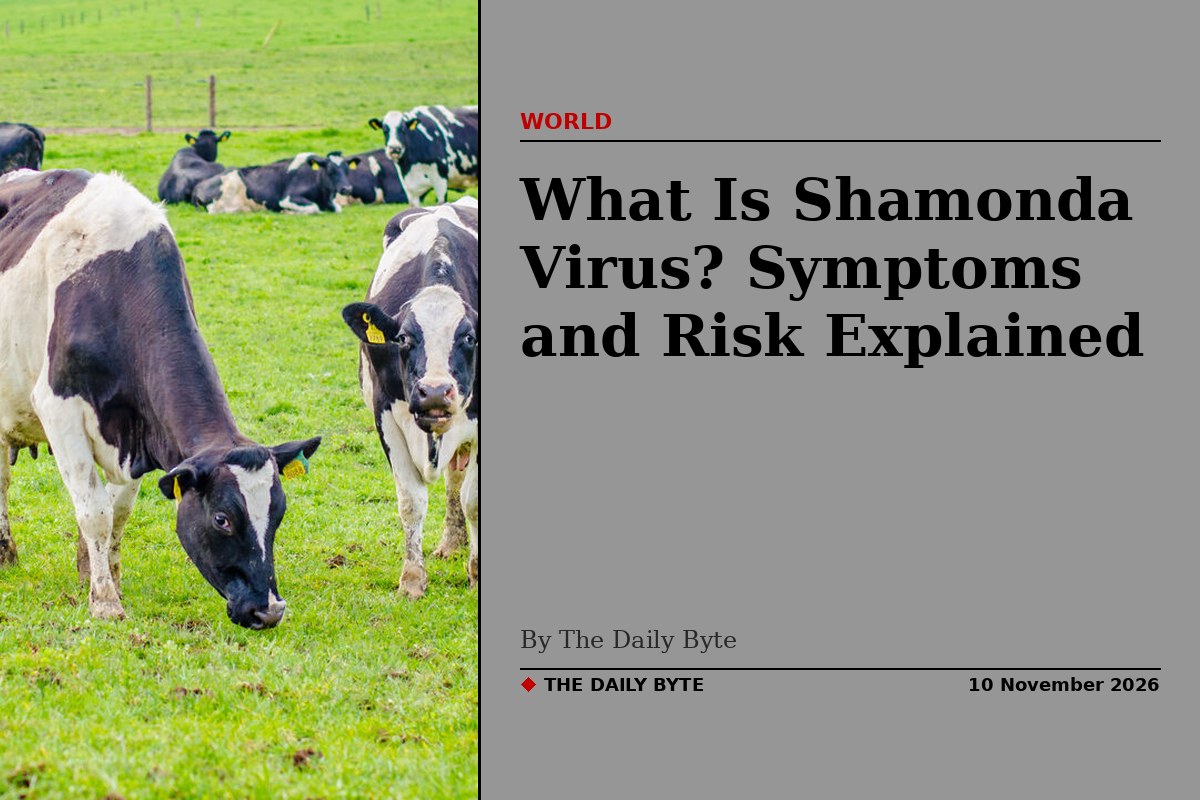
Shamonda virus is a midge-borne virus that mainly infects cattle and other livestock. Until autumn 2026 it had never been found in a person, but on 20 October 2026 France notified the World Health Organization (WHO) of the first documented human infection, in a severely immunocompromised man who died of brain inflammation. Health authorities say the risk to the general public cannot yet be assessed, because there is only one human case to learn from.
This explainer sets out what Shamonda virus is, what happened in France, how it spreads, what the symptoms are in animals and in people, where it has been found in Europe, and what is still unknown.
What is Shamonda virus?
Shamonda virus, often shortened to SHAV, belongs to the family Peribunyaviridae and the genus Orthobunyavirus, within the Simbu serogroup. It belongs to the same species as Schmallenberg virus, a related livestock virus already circulating in Europe. Like Schmallenberg virus, Shamonda virus is recognised primarily as an animal virus, and until the French case there were no documented human infections.
The virus was first isolated from cattle in Nigeria in the 1960s. It was subsequently identified in animals in parts of Africa and Japan, and it stayed a largely African and Asian livestock virus for decades. That changed in the summer of 2026, when it was detected in Europe for the first time, in cattle, horses and alpacas in Belgium, France, Germany, the Netherlands and Switzerland.
Two distinct variants of the virus have been identified in animals in Europe. SHAV-EU1 has been reported in Germany, Austria, France and Switzerland, while SHAV-EU2 has been identified in Belgium, the Netherlands, northern Germany and north-western France. The French human case involved the SHAV-EU1 genotype, and its genome sequence was 99 per cent identical to a virus circulating in neighbouring Switzerland.
What happened in the first human case in France?
The case was an immunocompromised older man from rural eastern France who had not travelled in the preceding year. He had been hospitalised on 18 August 2026 for his underlying illness, and he developed severe neurological illness on 23 September, including visual disturbances, confusion, loss of consciousness and seizures. Doctors diagnosed severe encephalitis, an inflammation of the brain, on 25 September. He died on 8 October 2026.
Shamonda virus was confirmed by metagenomic sequencing and by reverse transcription polymerase chain reaction, known as RT-PCR. Very high viral loads were found in tissue samples collected after death, including in the brain, liver and spleen, and a wide panel of tests for other causes of encephalitis returned negative results. Retrospective testing of stored blood samples collected from early July through October, as well as faecal, urine, saliva and respiratory samples, confirmed the presence of Shamonda virus RNA.
French health authorities were notified on 7 October, and France formally notified the WHO on 20 October. A case report was published in the journal Eurosurveillance on 22 October 2026. French health and agriculture ministries said at the time that no health risk to the general public had been identified.
- First human case: notified to the WHO on 20 October 2026, the first laboratory-confirmed human infection reported anywhere in the world.
- Patient: an immunocompromised older man from rural eastern France, with no travel in the preceding year.
- Illness: severe encephalitis, with symptoms from 23 September 2026; the patient died on 8 October 2026.
- Confirmation: metagenomic sequencing and RT-PCR, with very high viral loads in post-mortem brain, liver and spleen samples.
- Variant: SHAV-EU1, 99 per cent genomically identical to a virus circulating in Switzerland.
- Further cases: no additional human cases had been detected as of the WHO report.
How does Shamonda virus spread?
Shamonda virus is a vector-borne disease. It is thought to be transmitted primarily by biting midges of the genus Culicoides, although the main vector species remain unknown. It is not considered to spread directly between animals. In the French case, the source and route of infection remain unknown. Vector-borne transmission is considered the most likely route, and the patient had reported mosquito exposure, but food-borne transmission is also under investigation, and the authorities are assessing whether the virus can be excreted in the milk of infected cattle.
Midges are widespread, and the WHO notes that climate change may alter their geographical distribution and abundance, potentially affecting the transmission of midge-borne viruses in Europe. Wind-assisted dispersal of infected midges over long distances may also help introduce such viruses into previously unaffected areas, although its role in Shamonda virus transmission requires further investigation. In animals, the virus can also pass from mother to foetus during pregnancy.
Investigations are continuing into the circumstances of the French case, including the possible contribution of vector exposure, and testing of the blood donors linked to transfusions the patient received was negative for Shamonda virus, making transfusion-associated transmission unlikely, although it cannot be completely excluded at this stage. Serological investigations are also being carried out among the patient's close contacts.
What are the symptoms of Shamonda virus?
In animals, the reported signs in cattle include acute systemic illness such as fever, diarrhoea, reduced activity or appetite, and reduced milk production. Neurological disease has been observed in horses, with Shamonda virus found in brain tissue. Congenital malformations have occurred during gestational infection with related Simbu serogroup viruses in animals, although the full effects of the recently detected European strains on pregnancy, reproduction and foetal development in animals still require further investigation.
In people, the symptoms are not known, because only one case exists. The single patient developed severe encephalitis, but he was already very ill, with a profoundly weakened immune system after a stem cell transplant for an underlying blood cancer. The WHO is explicit that a single case is insufficient to assess the risk to the general population, including people with healthy immune systems, or to determine how often human infection occurs, what symptoms it typically causes, or how severe it can be.
Because the signs in cattle overlap with those of bluetongue virus, which is also circulating in Europe, the WHO says veterinary surveillance and laboratory-based differential diagnosis are important. Laboratory confirmation relies on molecular methods such as RT-PCR, with sequencing where indicated.
Where has Shamonda virus been found in Europe?
Shamonda virus was detected in Europe for the first time during the summer of 2026. Confirmed or suspected infections were reported in cattle, horses and alpacas in Belgium, France, Germany, the Netherlands and Switzerland. By 21 October 2026, additional European countries and territories had reported detections in animals: Austria, Ireland, Jersey, Liechtenstein, Portugal, Slovenia and Spain.
In metropolitan France, animal detections had been reported in 54 departments as of 20 October, predominantly in cattle. The WHO notes that there is currently widespread circulation of the virus in animals in Europe, including outbreaks across much of France.
The virus has also reached the United Kingdom. The Department for Environment, Food and Rural Affairs confirmed on 2 November 2026 that Shamonda virus had been detected in cattle at two dairy farms, following testing by the Animal and Plant Health Agency. Infected cattle typically show fever, diarrhoea, lethargy and reduced milk production.
What is the risk to people?
The honest answer is that nobody yet knows. The WHO says the public health risk cannot yet be reliably assessed or quantified, because the evidence is limited to a single confirmed human infection. The fact that the virus is circulating widely in animals in Europe justifies further investigation of possible human exposure, but it does not establish how likely human infection is, or whether sustained transmission between people could occur.
There is no evidence of spread from person to person, and no additional human cases have been detected anywhere in the world since the French case was reported. The WHO notes that seasonal declines in midge activity may reduce vector-borne transmission in the short term in northern climates, but that does not exclude other routes or future exposure.
French health authorities said when the case was announced that no health risk to the general public had been identified at that time. That remains the position while investigations continue: one serious case in a severely immunocompromised patient, no wider pattern, and a risk assessment that must be updated as further evidence becomes available.
Is there a vaccine or treatment for Shamonda virus?
There is no specific antiviral treatment or vaccine currently available for Shamonda virus. In animals, prevention measures focus on reducing exposure to biting midges, livestock management practices and routine farm biosecurity. In people, suspected infections should be investigated in line with national procedures, and the WHO says Shamonda virus should be considered and tested for in people with relevant symptoms when occupational or environmental exposure may be compatible, until the risk to humans is better understood.
As of October 2026, Shamonda virus was not included in the World Organisation for Animal Health list of reportable diseases, but where it meets the definition of an emerging disease, veterinary authorities are required to notify that organisation. The WHO recommends strengthened surveillance and information sharing, continued investigation of the circumstances of the French case, and a coordinated One Health approach bringing together human, animal and environmental health experts.
What happens next?
Clinical, biological and epidemiological investigations are continuing in France, in conjunction with experts in human, animal and environmental health. The WHO has recommended further investigation of the source of infection, assessment of the potential for infection across different population groups, strengthened entomological studies to identify the midge species involved, and serosurveys to look for evidence of past human infection.
The risk assessment should be updated if additional human infections are identified, if the route of transmission is clarified, or if new evidence emerges about the consequences of infection in immunocompromised or immunocompetent people. For now, the picture is a virus that is well established in European livestock, has caused one confirmed human infection in a very vulnerable patient, and is under close surveillance across the continent.
Frequently asked questions
Can humans catch Shamonda virus? One human infection has been confirmed, in France in 2026. Whether healthy people can be infected, and how often, is not yet known, because there is only a single case to study.
What are the symptoms of Shamonda virus in humans? They are not known. The only confirmed patient developed severe encephalitis, but he was severely immunocompromised. There is not enough evidence to say what symptoms the virus would typically cause in a healthy person.
Can Shamonda virus spread from person to person? No person-to-person spread has been documented, and no additional human cases have been detected anywhere in the world since the French case.
Is there a vaccine or treatment? No. There is no specific antiviral treatment or vaccine for Shamonda virus in humans or animals. Animal-health measures focus on reducing midge exposure and farm biosecurity.
Is milk from infected cattle safe? Investigations are ongoing into whether the virus is excreted in the milk of infected cattle and what that means for food safety. No food-safety warning has been issued on the basis of the evidence so far, and food-borne transmission is considered unlikely, but the assessment is not yet complete.
Should I worry about Shamonda virus? Health authorities say no health risk to the general public has been identified at this time. The virus is a serious concern for livestock farmers and for veterinary surveillance, and it is being watched closely, but the evidence so far points to a very limited human risk.


