What Is Starlink? How Elon Musk's Satellite Internet Works
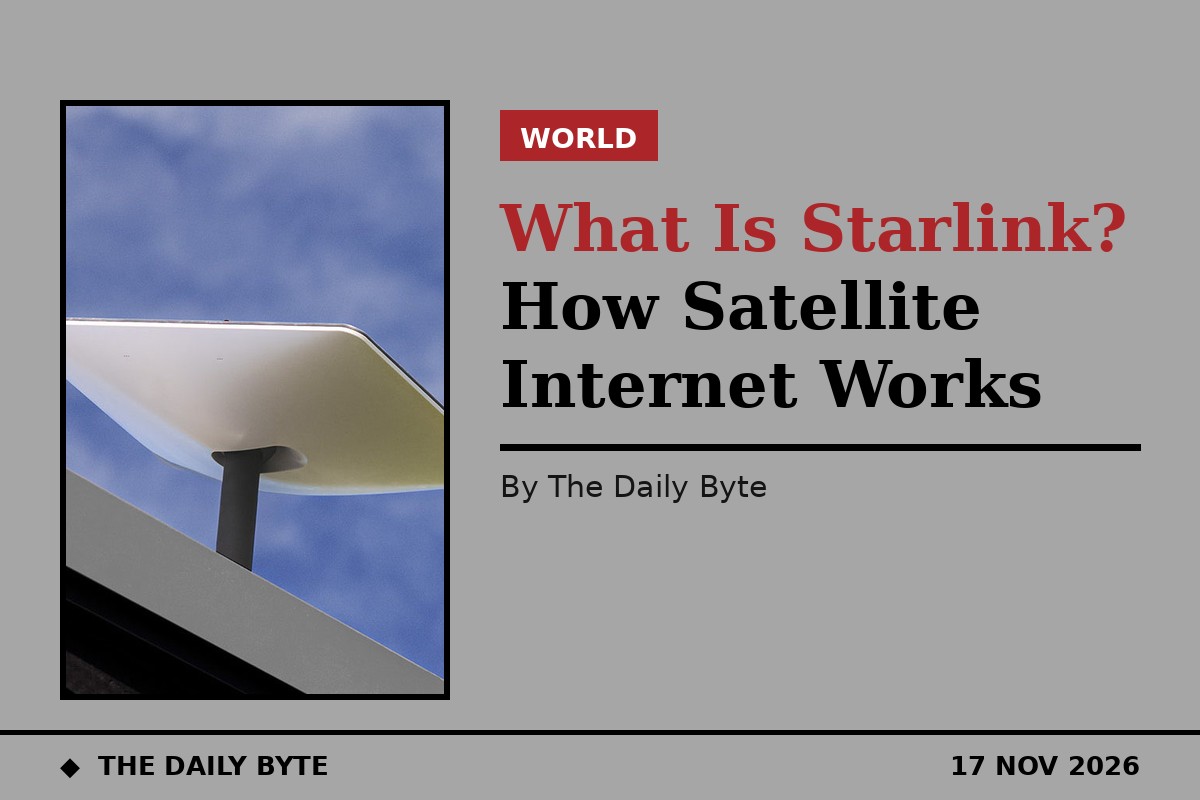
Starlink is a satellite internet service run by SpaceX, the rocket company founded by Elon Musk. Instead of sending your broadband through cables in the ground, it beams it down from thousands of small satellites orbiting much closer to Earth than traditional communications satellites. A flat dish at your home, office or vehicle talks to whichever satellite is passing overhead, and that satellite connects you to the rest of the internet. The result is fast broadband in places where fibre and mobile signals cannot reach, from rural farms to ships at sea.
The idea of satellite internet is not new. What Starlink changed is the orbit. Older satellite broadband comes from a handful of large satellites parked in geostationary orbit, about 35,786 kilometres above the equator, where they stay fixed over one spot. That distance makes the signal slow to make the round trip, which is why older satellite internet felt laggy and struggled with video calls. Starlink's satellites fly in low Earth orbit, at about 550 kilometres up, so the signal travels a far shorter distance and the delay drops sharply.
How Starlink works, step by step
Everything starts with the dish, which Starlink calls a terminal. It is a flat, rectangular panel that sits on a roof, a pole or the ground, pointed at the sky. Inside it is a phased-array antenna, which is a grid of hundreds of tiny antenna elements that steer a radio beam electronically, without any moving parts. As one satellite races across the sky, the dish locks onto it, then hands over to the next satellite a few minutes later. You never have to move the dish by hand, and the switching happens so quickly that you should not notice it.
The dish sends your request up to the satellite overhead. From there, your data takes one of two routes back to Earth. If a ground station, known as a gateway, is within the satellite's view, the data is beamed straight down to it and enters the ordinary internet through fibre, in the same way as any other broadband connection. This is sometimes called a bent-pipe route, because the satellite simply bends the signal back down.
If no gateway is in sight, which is common over oceans, deserts and polar regions, the satellites pass your data between themselves using laser links in space. Each Starlink satellite carries three optical space lasers, or optical inter-satellite links, which Starlink says can operate at up to 200 gigabits per second. Together they form a mesh in orbit, hopping your data from satellite to satellite until one of them can see a ground station. That laser mesh is what lets Starlink serve ships, aircraft and remote areas far from any gateway.
Why low Earth orbit matters
Distance is the whole story. Starlink says its satellites orbit at about 550 kilometres, compared with about 35,786 kilometres for a geostationary satellite. Because the signal has far less distance to travel, Starlink puts typical latency, the delay before data starts moving, at around 25 milliseconds, against more than 600 milliseconds for older geostationary services. That difference is the gap between a video call that feels natural and one where everyone talks over each other.
Low orbit has a cost, though. A satellite at 550 kilometres crosses the sky in minutes, so one satellite alone is useless. You need a constellation of thousands, constantly handing customers over from one satellite to the next, and you need to keep launching replacements as satellites age and burn up in the atmosphere. SpaceX can do that because it launches its own satellites on its own Falcon 9 rockets, and it says it is the only satellite operator able to launch its own satellites as needed. Starlink describes itself as the world's largest satellite constellation, with more than 6,750 satellites in orbit according to its own technology page, while independent satellite tracking put the total above 11,000 by late October 2026. The two figures differ because they were counted on different dates and by different methods, and the total rises with every launch.
What is inside a Starlink satellite?
Each satellite is small and flat, designed to be stacked by the dozen inside a rocket. Starlink says each one uses five advanced Ku-band phased-array antennas and three dual-band antennas, using Ka-band and E-band frequencies, to provide high-bandwidth connections to customers below. The laser links described above connect the satellites to each other, and the satellites are built and operated in Redmond, Washington, while the customer kits are manufactured in Bastrop, Texas.
One detail shows how different the design is from older spacecraft. Starlink says its satellites are the first argon-propelled spacecraft ever flown in space, using argon gas in their thrusters to adjust their orbits and, at the end of their lives, to steer themselves down to burn up safely. That matters because thousands of satellites in low orbit have to be managed carefully to avoid collisions and space debris, and operators are expected to remove them when they stop working.
What speeds can you expect from Starlink?
Speeds vary by place, plan and time of day, because you share the capacity of the satellites overhead with other users nearby. In its 2025 progress report, Starlink gave a global median of more than 200 megabits per second for downloads, more than 30 megabits per second for uploads, and latency of about 26 milliseconds. That is enough for streaming in high definition, video calls, online gaming and working from home, which older satellite services struggled with. But it is a median, not a promise. In a crowded area at peak time, or during heavy rain, speeds can fall, and Starlink is open about that in its own service descriptions.
Weather matters more than with fibre. The dish needs a mostly clear view of the sky, and heavy rain, snow or thick tree cover can weaken the signal. The dish has a heater to melt snow, and the Starlink app helps you check for obstructions before you install it. The kit also draws power continuously, typically in the range of 40 to 100 watts depending on the model and conditions, which is worth knowing if you plan to run it from batteries in a van or off-grid cabin.
What do you need to get Starlink?
You buy a Starlink kit, which contains the dish, a mount, cables and a Wi-Fi router, and you pay a monthly service charge. Prices and plans differ by country and change over time, so the only reliable place to check them is Starlink's own website for your country. Installation is designed to be done by the customer. You mount the dish where it can see the sky, plug it in, and use the app to aim it and set up the Wi-Fi network. There is no engineer visit in the standard home package, although professional installers exist for businesses and larger buildings.
Starlink sells different kits for different uses. The standard kit is for a fixed home. Starlink Mini is a smaller, portable dish that can be carried in a backpack and used while travelling. Roam plans are aimed at motorhomes, boats and people who move around. Business plans offer higher-priority data and larger hardware for offices, farms and remote sites. There is also a maritime and aviation service for ships and aircraft, where the laser mesh matters most because there are no ground stations in mid-ocean.
Direct to Cell: internet without a dish
Starlink is also building a service called Direct to Cell, which puts what amounts to a mobile phone tower in orbit. It talks directly to an ordinary, unmodified mobile phone on the ground, with no dish needed. SpaceX presents it as a way to send messages and provide basic connectivity in places with no mobile coverage, such as remote countryside or after a disaster. It is not broadband. The speeds and capacity are far lower than the dish service, and it is being rolled out in partnership with mobile networks country by country, so availability and features depend on where you are and which network you use.
Where is Starlink available?
Starlink is a licensed service, and it can only operate where the regulator in each country has allowed it. It is available in the UK and in many countries across Europe, the Americas, Asia and Oceania, and the list grows as new licences are agreed. Availability, plans and prices all differ by country, and the service can be switched off or restricted in places where it is not licensed. Before ordering, check the coverage map on starlink.com for your own address, and buy only from Starlink or its authorised resellers. Starlink has also been used in conflict zones and disaster areas, including Ukraine, where it has provided connectivity when ground networks were damaged, which has made it a political as well as a technical story.
Who is Starlink best for?
Starlink makes the most sense where there is no good alternative. If you have full-fibre broadband at a fair price, fibre will usually be faster, cheaper and more reliable in bad weather. But if you live in a rural area with slow copper broadband, run a business beyond the reach of fibre, travel in a motorhome, or need connectivity on a boat, Starlink can be the difference between being online and not. It is also used as a backup connection by businesses that cannot afford to lose internet access, and by emergency services when storms or earthquakes take ground networks down.
The trade-offs are real. The upfront cost of the kit is higher than a normal broadband router, the monthly charge is higher than most fibre deals, and performance depends on the sky above you and the number of users sharing your satellites. It is also a single-provider system. Your connection depends on SpaceX's satellites, its ground stations and its decisions, in a way that a wired connection does not. For many rural users that is a fair exchange. For a city flat with fibre on the street, it usually is not.
Frequently asked questions about Starlink
Is Starlink owned by Elon Musk? Starlink is a division of SpaceX, the space company founded and led by Elon Musk. SpaceX builds the satellites, launches them on its own rockets and operates the network.
Does Starlink work in bad weather? It works in most weather, but heavy rain and snow can reduce speeds, and the dish needs a clear view of the sky. Trees, buildings and hills blocking the view cause dropouts, so the app's obstruction check matters before you install it.
Can I use Starlink anywhere in the world? No. Starlink needs a licence in each country, and coverage, plans and prices differ by location. Check the map on starlink.com for your address before ordering.
Is Starlink faster than fibre? Usually not. Full-fibre broadband is generally faster and more stable, and often cheaper. Starlink's advantage is reach, not raw speed. It brings fast internet to places fibre does not go.
Do I need a phone line or cable for Starlink? No. The dish connects to the satellites by radio, and the satellites connect to ground stations. You only need power, a clear view of the sky and the Starlink kit.
Sources: Starlink, Technology; Starlink. Speed and latency figures are Starlink's own published medians from its 2025 progress report, and satellite counts change with every launch, so check the official pages for the latest figures.


