What Is Static Electricity?
Static electricity is an imbalance of electric charge that sits still on the surface of a material. Atoms are normally neutral, with equal numbers of positively charged protons and negatively charged electrons, but when electrons move from one material to another, one surface ends up with too many electrons and the other with too few. The charge stays put until it finds a path to flow, and then it discharges, often as a tiny spark and a sharp shock. It is called static because the charge is not moving, unlike the current electricity that flows through wires.
Most people meet static electricity several times a day without thinking about it: hair standing on end after a balloon is rubbed on it, clothes clinging together in a tumble dryer, or the small shock from a car door on a dry winter morning. All of those are the same phenomenon at different scales, and the largest example of all is lightning, a giant static discharge that can stretch for kilometres across the sky.
Charge, atoms and electrons
Everything is made of atoms, and every atom has a nucleus of positively charged protons and neutrons, surrounded by negatively charged electrons. In a normal, uncharged object, the numbers balance exactly, and the object is electrically neutral. Static electricity begins when that balance is disturbed, which is easier than it sounds, because electrons are light and loosely held, while protons are locked deep inside the nucleus.
When two different materials touch, or rub against each other, a small number of electrons can jump from one surface to the other. The material that loses electrons ends up positively charged, because it now has more protons than electrons, and the material that gains them ends up negatively charged. Which way the electrons go depends on the materials involved: some give up electrons easily, and some grab them. Rubber and plastic tend to gain electrons, while glass, hair and wool tend to lose them.
Whether the charge stays put depends on the kind of material. Insulators, such as rubber, plastic and dry air, hold charge in place, because their electrons cannot move freely. Conductors, such as metals and the human body, let electrons flow through them, so any extra charge spreads out or drains away quickly. That is why static builds up on a plastic comb but not on a metal one: the metal lets the charge escape as fast as it forms.
The triboelectric effect: how charge builds up
The transfer of electrons between materials is called the triboelectric effect, from the Greek word for rubbing, and it is the main cause of static electricity in everyday life. Rubbing is not strictly necessary, contact alone is enough, but rubbing increases the contact and the number of electrons transferred, which is why the classic demonstrations all involve rubbing: a balloon on hair, a plastic rod with fur, shoes scuffing across a carpet.
Walking across a carpet is the most familiar example. With each step, your shoes press against the carpet fibres, electrons move from the carpet to your shoes, and from your shoes into your body, and because your body is separated from the ground by the insulating soles, the charge has nowhere to go. It spreads across your skin, and like charges repel each other, so the extra electrons push apart to the extremities, which is why strands of hair can stand on end as you reach for a metal doorknob. When your finger gets close enough, the charge suddenly finds a path, jumping across the tiny air gap to the metal, and you feel the shock.
Scientists have measured how much charge a person can hold, and it is surprisingly small in absolute terms but enough to sting. The voltage can reach several thousand volts, far higher than a household socket, but the total amount of energy is tiny, because the current flows for only a fraction of a second. That is why a static shock hurts but does not injure: it is high in voltage and almost nothing in energy.
Why static is worse in winter
Static shocks are far more common in winter, and the reason is water. Humid air is slightly conductive, because water molecules in the air give the extra electrons a path to leak away, so charge rarely builds up far enough to spark. Dry air is a much better insulator, so the charge stays put and keeps growing until it discharges all at once.
Winter makes the air dry in two ways. Cold air holds less moisture to begin with, and heating it indoors drives the relative humidity down further. That is why a carpet that gives no trouble in a damp summer can deliver a shock with every step in January, and why static cling in the laundry is worst in the cold months. Opening a window or running a humidifier raises the moisture in the air and lets the charge drain away before it can build up.
Clothing matters too. Synthetic fabrics such as nylon and polyester build up charge more readily than cotton or wool, which is why clothes from a tumble dryer cling together: the tumbling rubs the fabrics against each other thousands of times, transferring electrons with every contact, and the dry, warm air gives the charge nowhere to go. Fabric softeners and dryer sheets work by coating the fibres with a thin layer that lets the charge leak away.
Lightning: static electricity on a grand scale
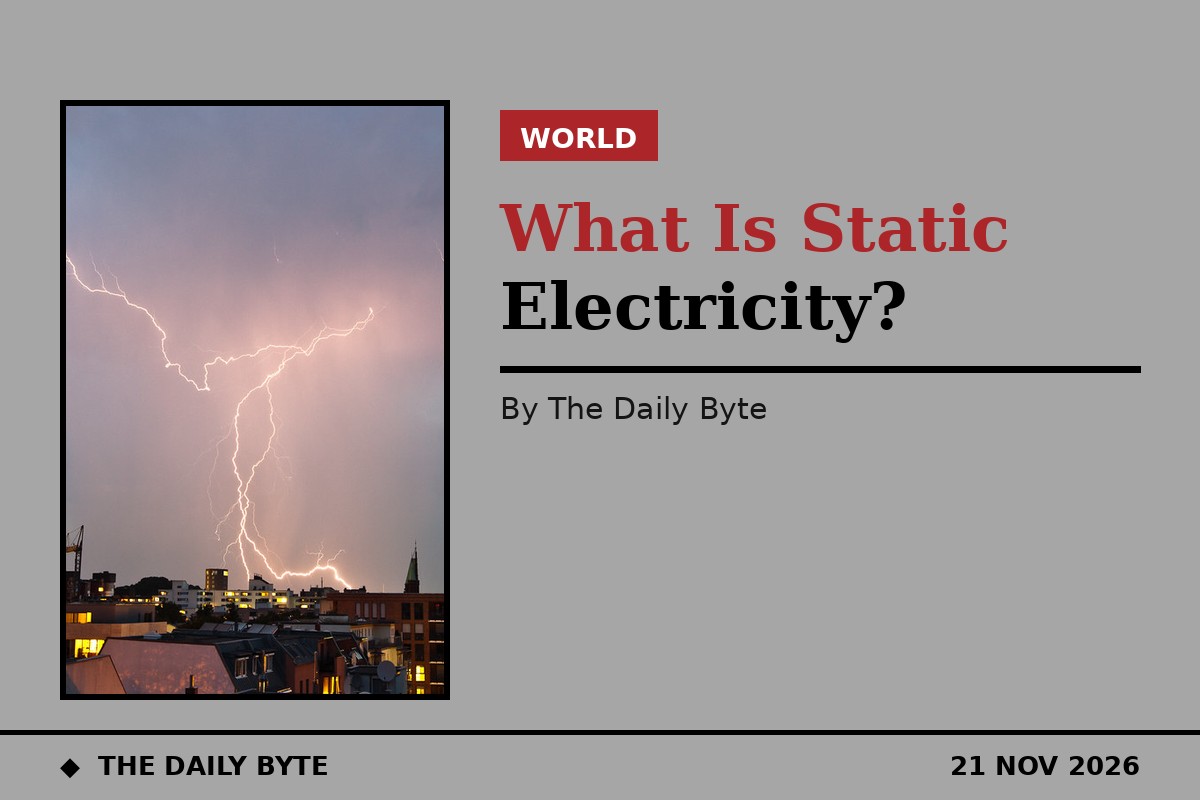
Lightning is static electricity, only vastly larger. Inside a thundercloud, small ice particles called graupel, which are soft hail pellets a few millimetres across, collide with smaller ice crystals as they are carried up and down by the wind. The collisions transfer charge, with the heavier graupel carrying negative charge to the bottom of the cloud and the lighter crystals carrying positive charge to the top. The cloud becomes a giant charged object, with the ground below it becoming positively charged in response.
Air is normally an insulator, and it holds the two charges apart, but as the charge keeps building, the insulating ability of the air is eventually overcome. A faint channel of ionised air, called a stepped leader, works its way down from the cloud in a series of short jumps, and when it gets close to the ground, sparks rise from tall objects to meet it. The moment they connect, a huge current surges down the channel in a return stroke, and that is the flash we see. The whole event is a discharge, the same process as the spark from a doorknob, scaled up millions of times.
The channel of a lightning bolt is astonishingly hot. It heats the air around it to about 30,000 degrees Celsius, roughly five times hotter than the visible surface of the Sun, for a few millionths of a second. The air expands so violently that it creates a shock wave, and that shock wave is thunder. Lightning can occur inside a cloud, between clouds, or between a cloud and the ground, and the flash briefly equalises the charged regions until the charge builds up again. Thunder can be heard up to 25 miles from the strike, although it fades and deepens with distance, which is why distant thunder rolls while a close strike cracks.
Scientists still debate the fine details of how a cloud builds up its charge, and the exact sequence that turns a charged cloud into a bolt is an active area of research. The broad picture, though, is settled: lightning is a static discharge, and it follows the same rules as the spark from your fingertip.
Where static electricity is useful
Static electricity is not only a nuisance. It is put to work in several everyday technologies. The best known is the photocopier, and the laser printer, which uses the same idea. A drum inside the machine is given an electric charge, light erases the charge everywhere except where the image should be, and toner powder, which carries the opposite charge, is attracted to the charged areas. The toner is then transferred to paper and fused in place with heat. Without static, there would be no dry photocopying.
Electrostatic spray painting works the same way. Paint droplets are given an electric charge as they leave the spray gun, and the object being painted is given the opposite charge, so the paint is pulled onto the surface evenly, including around corners and into recesses that a normal spray would miss. The method wastes less paint and gives a more even coat, which is why it is used for cars, bicycles and metal furniture.
Air filters use static too. In an electrostatic precipitator, the kind fitted to factory chimneys and power stations, dust and smoke particles are given a charge as they pass through, and are then pulled onto plates carrying the opposite charge, cleaning the exhaust before it reaches the air. Smaller versions are used in home air purifiers. Even the Van de Graaff generator, the machine with a metal dome that makes hair stand on end in science museums, was built as a serious research tool: it was developed in the early 1930s to produce the high voltages needed for early particle physics experiments.
Where static electricity is dangerous
The same spark that stings your finger can be dangerous in the wrong place. A static discharge carries enough energy to ignite flammable vapour, which is why it is a recognised hazard when refuelling aircraft and in factories that handle solvents, grain dust or fireworks. Petrol stations warn against getting back into a car while filling up, because sliding across a seat can build up a charge that discharges when you touch the nozzle. Bonding wires and grounding straps are used wherever fuel is handled, to give any charge a safe path to the ground.
Electronics are vulnerable for a different reason. A static discharge that you can barely feel can carry enough voltage to damage the tiny circuits inside a computer chip, which is why people who handle electronic components wear grounded wrist straps and work on anti-static mats. The damage is often invisible and delayed: a chip can be weakened by a discharge and fail weeks later.
The ancient Greeks noticed the effect more than two thousand years ago, when they found that amber, rubbed with cloth, could attract dust and feathers. The Greek word for amber is elektron, and it is where the word electricity comes from. The phenomenon has been familiar ever since, but it was only in the eighteenth and nineteenth centuries that scientists began to measure it properly and to distinguish the static charge that sits still from the current that flows.
How to reduce static shocks
There is no way to eliminate static electricity, but it is easy to reduce. Raising the humidity indoors is the most effective step, because moist air lets charge leak away before it builds up. Wearing natural fibres, such as cotton and leather-soled shoes, helps, because they build up less charge than synthetics and rubber soles. Moisturising dry skin in winter helps too, for the same reason: damp skin conducts charge away.
A practical trick for doorknobs and car doors is to touch the metal with something else first, such as a key or a coin held in your hand, which lets the discharge happen through the metal rather than through your fingertip, so you feel nothing. Anti-static sprays do the same job on carpets and upholstery, by leaving a thin conductive coating that drains charge away. None of these change the physics; they just give the charge a gentler path to ground.
Static electricity and current electricity: the difference
It helps to keep the two kinds of electricity separate in your mind. Static electricity is charge at rest: electrons have moved to a new place and are sitting there, building up voltage, until something gives them a path. Current electricity is charge in motion: electrons flowing steadily through a conductor, as they do in a wire, driven by a battery or a generator. A static shock is a single, brief rush of charge; a current is a continuous flow.
The difference is also why one is safe and the other is not. A static discharge can reach thousands of volts, but it lasts less than a millionth of a second and carries very little energy, so it stings and does nothing more. Mains electricity is far lower in voltage, but it can keep flowing for as long as you are in contact with it, which is what makes it dangerous. Voltage alone does not decide whether electricity hurts you; how long the current flows, and how much energy it carries, matters just as much.
Frequently asked questions
Why do I get more static shocks in winter? Because winter air is dry, and dry air is a good insulator, so charge builds up on your body instead of leaking away. Humid summer air lets the charge drain off gradually, so it never gets far enough to spark.
Can static electricity start a fire? Yes, in the right conditions. A static spark can ignite petrol vapour, grain dust or other flammable material, which is why fuel handling uses grounding wires and why you should not get back into a car while filling the tank.
Is a static shock dangerous? Almost never. The voltage can reach several thousand volts, but the discharge lasts less than a millionth of a second and carries very little energy, so it stings without injuring. The danger is to sensitive electronics, not to people.
Why does my hair stand up when I rub a balloon on it? Rubbing transfers electrons from your hair to the balloon, leaving your hair positively charged. Like charges repel, so the individual hairs push away from each other and stand up. The balloon, now negatively charged, will also stick to a wall, because it attracts the opposite charge in the wall's surface.
What is the difference between static and current electricity? Static electricity is charge sitting still on a surface, built up by contact or rubbing, which discharges in a single spark. Current electricity is charge flowing continuously through a conductor, as in a wire powered by a battery. One is a build-up waiting for a path; the other is a flow already under way.


